Barium enema
Peer reviewed by Dr Adrian Bonsall, MBBSLast updated by Dr Colin Tidy, MRCGPLast updated 21 Feb 2018
Meets Patient’s editorial guidelines
- DownloadDownload
- Share
- Language
- Discussion
- Audio Version
- Add to preferred sources on Google
This page has been archived.
It has not been reviewed recently and is not up to date. External links and references may no longer work.
A barium enema is a test used to help see the outline of the large bowel (colon).
Note: the information below is a general guide only. The arrangements, and the way tests are performed, may vary between different hospitals. Always follow the instructions given by your doctor or local hospital.
At a glance
A barium enema is an X-ray test to check for problems in your large bowel (colon).
Problems it can detect include polyps, inflammation, narrowing, tumours, and diverticula.
Before the test, you will need to clear your bowel with laxatives.
During the test, a barium liquid is passed into your colon, and X-rays are taken.
You might feel sick or have stomach cramps afterwards, and your poo may be white.
Drink plenty and eat fruit after the test to help prevent constipation.
Tell your doctor if you are diabetic or pregnant, as special considerations apply.
What is a barium enema?
A barium enema is used to look for problems in the large bowel (colon). These problems may include:
Small fleshy lumps (polyps).
Inflammation (colitis).
Narrowing of the colon.
Tumours.
Small pouches (diverticula) which stick out from the wall of the gut (intestines).
The gut does not show up very well on ordinary X-ray pictures. However, if a liquid that contains barium is placed in the gut, the outline of the gut shows up clearly on X-ray pictures. This is because X-rays do not pass through barium. A thick white liquid that contains barium is used as an enema to place in the colon.
Barium liquid can also be taken as a drink and is used to obtain clear X-ray pictures of the upper gut - the gullet (oesophagus), stomach and small intestine. See the separate leaflet called Barium Tests (Swallow/Meal/Follow Through) for more details.
What is the preparation before a barium enema?
Cross-section diagram showing a barium enema
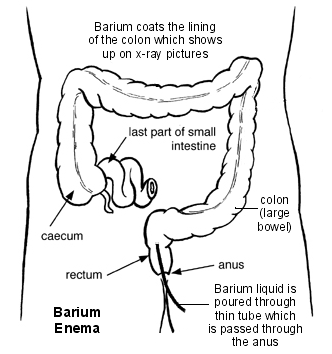
Any poo (faeces) needs to be cleared from your large bowel (colon) before the test. So, you should be given some strong laxatives, and instructions on how to use them, from your doctor or the hospital department which does the test.
You should also be advised on the kind of food to eat for a day or so before the test.
You will usually be advised to carry on with your normal medication, except for iron tablets.
How is a barium enema done?
You will be asked to wear a gown and to lie on a couch on your side or front. A small tube is then put into your back passage (anus) and gently pushed up a few centimetres. Barium liquid is then passed through the tube into your large bowel (colon).
The aim is to get the barium liquid to spread all along the colon as far as the point where the small intestine joins the colon (the caecum). To help with this, the person doing the test may:
Ask you to move into different positions on to your back, sides, etc, to help with the flow of the barium liquid.
Give you an injection of a drug that makes the muscles in the wall of the colon relax.
Pass some air down the enema tube into the colon. (This may feel a little uncomfortable - like 'trapped wind'.) The air expands the colon and also pushes the barium to coat the lining of the colon. This makes the X-ray pictures much clearer. It is the shape and contours of the lining of the colon which need to be seen most clearly on the pictures.
When the barium has spread throughout the colon, several X-ray pictures are taken, with you in different positions. The aim is to have pictures of all parts of the colon. (Low-dose X-rays are used so the total amount of radiation for the whole test is quite small and thought to be safe.)
The tube is then removed and you can go to the toilet. The test takes about 15-20 minutes.
Are there any side-effects or risks from a barium enema?
Some people feel a little sickly or have stomach cramps for a few hours afterwards.
The barium may make you constipated. So, to help prevent constipation:
Have lots to drink for a day or so to flush the barium out of your gut (intestines).
Eat plenty of fruit for a day or so.
See your doctor if you haven't passed any poo (faeces) after three or four days.
If you had an injection to relax the muscles in your large bowel (colon), it may cause some blurring of your vision for an hour or so. If this happens it is best not to drive until this passes.
The barium does not get absorbed into the body. So, it is rare for a barium test to cause any other complications or side-effects. Rare complications are:
A small hole (perforation) of the colon being made. This is generally only a risk if you have a badly inflamed colon.
A reaction to the injection of muscle relaxant mentioned above.
During the procedure several X-ray pictures will be taken. This will involve you being exposed to a small amount of radiation. This amount is about the same as you would get in everyday life over three years. It is thought to be safe.
After you have had a barium enema
You should be able to go home as soon as the test is finished. However, you may have some stomach cramps due to some 'trapped air'. So, you may want to stay near a toilet for an hour or so.
You can eat normally straight afterwards.
The barium will make your poo (faeces) white or pale until it has all passed out from your large bowel (colon). This may take a day or so.
Some other points about a barium enema
Tell your doctor if you have insulin-dependent diabetes, so that you can arrange for the best time for you to stop eating and for the test to be done.
Pregnant women, if possible, should not have an any X-ray test as there is a small risk that X-rays may cause an abnormality to the unborn child. This is why women are asked before having an X-ray whether they are, or might be, pregnant.
A barium enema is done less commonly these days, as the more common test to look inside the large bowel (colon) is with a flexible telescope (colonoscopy). However, there is still a place for a barium enema to help to diagnose and assess various conditions of the gut (intestines).
Patient picks for Imaging

Tests and investigations
Bone scan
A bone scan is a special type of nuclear medicine procedure that uses radionuclides to create a picture of the bones. Radionuclides are chemicals which emit radioactivity that can be detected by special scanners. A bone scan is different to a bone density scan (DEXA). See the DEXA Scan leaflet for more information on this bone density test. A DEXA scan is also known as a DXA scan. Note: the information below is a general guide only. The arrangements, and the way tests are performed, may vary between different hospitals. Always follow the instructions given by your doctor or local hospital.
by Dr Doug McKechnie, MRCGP
Tests and investigations
MRI scan
An MRI scan is a safe and painless test that can provide detailed pictures of organs and other structures inside your body. Note: the information below is a general guide only. The arrangements (and the way tests are performed) may vary between different hospitals. Always follow the instructions given by your doctor or local hospital. These are usually included with your appointment letter.
by Dr Toni Hazell, FRCGP
Frequently asked questions
What is the typical recovery after a barium enema?
You can usually go home immediately after the test. You might experience some stomach cramps due to trapped air for a short while, so it's advisable to stay near a toilet for an hour or so. You can resume your normal eating habits straight away. Your faeces will appear white or pale until all the barium has passed out of your large bowel, which may take about a day.
Are there any dietary restrictions after the procedure?
You can eat normally straight after the test. However, to help prevent constipation caused by the barium, it's recommended to drink plenty of fluids and eat a good amount of fruit for a day or so following the procedure.
How long does it take for the barium to leave my system?
The barium will cause your faeces to be white or pale until it has all exited your large bowel. This process typically takes about a day or so. It's important to drink plenty of fluids to help flush it out and prevent constipation.
Is a barium enema still a common procedure?
Barium enemas are performed less frequently now compared to the past. A colonoscopy, which uses a flexible telescope to examine the large bowel, is generally the more common test. However, a barium enema still plays a valuable role in diagnosing and assessing certain gut conditions when a colonoscopy may not be suitable or available.
What should I do if I don't have a bowel movement for several days after the test?
If you haven't passed any faeces after three or four days following a barium enema, you should contact your doctor.
Can I drive myself home after the procedure?
If you received an injection to relax the muscles in your large bowel, it might cause your vision to be blurry for about an hour. It is best not to drive until your vision returns to normal.
Further reading and references
- Mensah Y, Dakubo J, Asiamah S, et al; Outcome of barium enema in patients with colorectal symptoms. Ghana Med J. 2008 Sep;42(3):113-6.
- Li YZ, Wu PH; Conventional radiological strategy of common gastrointestinal neoplasms. World J Radiol. 2015 Jan 28;7(1):7-16. doi: 10.4329/wjr.v7.i1.7.
About the authorView full bio

Dr Colin Tidy, MRCGP
General Practitioner, Medical Author
MBBS, MRCGP, MRCP (Paediatrics), DCH
Dr Colin Tidy is an NHS Doctor, based in Oxfordshire.
About the reviewerView full bio

Dr Adrian Bonsall, MBBS
Medical Author
MA (Chemistry), MBBS (Hons), DCH
Since 2000 Adrian has been employed in emergency and critical care paediatrics based in Sydney, with particular interests in toxicology, trauma and resuscitation.
Article history
The information on this page is written and peer reviewed by qualified clinicians.
Article also available in English, German, Spanish, French, Italian, Portuguese, Hindi, Hebrew, Arabic, and Swedish.
21 Feb 2018 | Latest version
Join the conversation
Share your thoughts or experiences with others in our patient communities.

Ask, share, connect.
Browse discussions, ask questions, and share experiences across hundreds of health topics.

Feeling unwell?
Assess your symptoms online for free
Sign up to the Patient newsletter
Your weekly dose of clear, trustworthy health advice - written to help you feel informed, confident and in control.
By subscribing you accept our Privacy Policy. You can unsubscribe at any time. We never sell your data.
More in tests and investigations
- Amniocentesis
- Antibody and antigen tests
- Blood groups and types
- Blood tests to detect inflammation
- Bone marrow biopsy and aspiration
- Bone scan
- Chorionic villus sampling
- CT scan
- Cystoscopy
- DMSA scan
- Electrocardiogram
- Faecal immunochemical test
- Fine-needle aspiration
- Glucose tolerance test
- Hyponatraemia
- Hysterosalpingography
- Kidney biopsy
- Nasoendoscopy
- Osmolality, osmolarity and fluid homeostasis
- PET scan