End of life care: medical, emotional and spiritual support
Peer reviewed by Dr Krishna Vakharia, MRCGPAuthored by Amberley DavisOriginally published 14 Apr 2023
Meets Patient’s editorial guidelines
- DownloadDownload
- Share
- Language
- Discussion
- Audio Version
- Add to preferred sources on Google
End of life care can be varied, holistic, and filled with love. We look at two end of life services - hospices and end of life doulas - that show how medical, emotional, and spiritual needs can be looked after in different settings.
What is end of life care and what is palliative care?
There's a lot of confusion around palliative and end of life care. For starters, although related these two terms do not describe the same thing - they are distinct.
Receiving palliative care doesn't neccesarily mean you're dying - rather that this kind of care is for people with incurable diseases, many of whom could or will live for many more years or decades. It's about making life as manageable and as good as it can be.
End of life care is a form of palliative care you are given when you're approaching end of life - it offers support and is wide-ranging and holistic.
When does end of life care start?
From a healthcare perspective, end of life care may be recommended if you are likely to die within the next 12 months, although this can sometimes be hard for doctors to accurately predict. End of life care may last a few hours, days, weeks, months, or sometimes more than a year - the only rule is that it begins when you need it.
Who provides end of life care?
End of life care doesn't just take place in a hospital or hospice with doctors and nurses. Depending on your needs and care plan, you could receive various forms of this care at home, over the phone, or at specialist day centres. A whole host of specialists and non-specialists can deliver end of life care.
Specialists include palliative care physicians and nurses - such as Marie Curie and Macmillan nurses - but also counsellors, social workers, bereavement therapists, speech therapists, religious or spiritual carers, and many others.
Non-specialists are made up of people in your community who have different roles to play in your care. These include district and practice nurses, GPs, and pharmacists.
This should give an idea of how varied and personalised end of life care services can be.
What services are available for end of life care?
Here we take a look at two important forms of care that showcase the range of services available.
Hospices - hospices are specialised healthcare spaces for palliative and end of life support. Yet, hospice care extends beyond hospice beds and medical treatment.
End of life doulas - outside of your medical needs, doulas offer emotional and spiritual care, and they can do this inside or outside of the hospice setting.
Spotlight on: hospice care
In hospices, specialist palliative and end of life care is delivered by a multi-disciplinary team, made up of people who have different roles in a person's care. This includes doctors, nurses, physiotherapists, occupational therapists, complementary therapists, counsellors and chaplains.
Jodie Morris is deputy director of nursing and care at Myton Hospice. She explains how hospices offer so much more than medical treatment:
"Hospices are happy places full of love and laughter where families can create special memories and spend quality time with their loved ones. This isn't just about medicine - it's about whatever is important to the patient and their family and friends. We take a holistic approach and see the person - not their illness.
“At Myton, we provide support right from the moment a person is told that their illness cannot be cured until the very end of life. We provide this free service in our three hospices, in the community via our Myton at home service, and as an outpatient service:
Our outpatient services - help people to live well for longer with their terminal illness. This may include advance care planning, counselling, lymphoedema therapy, complementary therapy such as massage for relaxation, physiotherapy, and occupational therapy.
Our hospice inpatient services - provide symptom control and end of life care.
Our hospice at home services - provide care and support for people in their own homes in the last weeks and days of life.
Our bereavement support - looks after the wellbeing of family and friends after their loved one has passed.
Going the extra mile
Jodie goes on to describe how the staff and volunteers at Myton go the extra mile to look after the wellbeing of their patients, welcoming beloved pets and arranging birthday celebrations, weddings and christenings at their hospices, often at very short notice.
Kerry and David's Myton Wedding
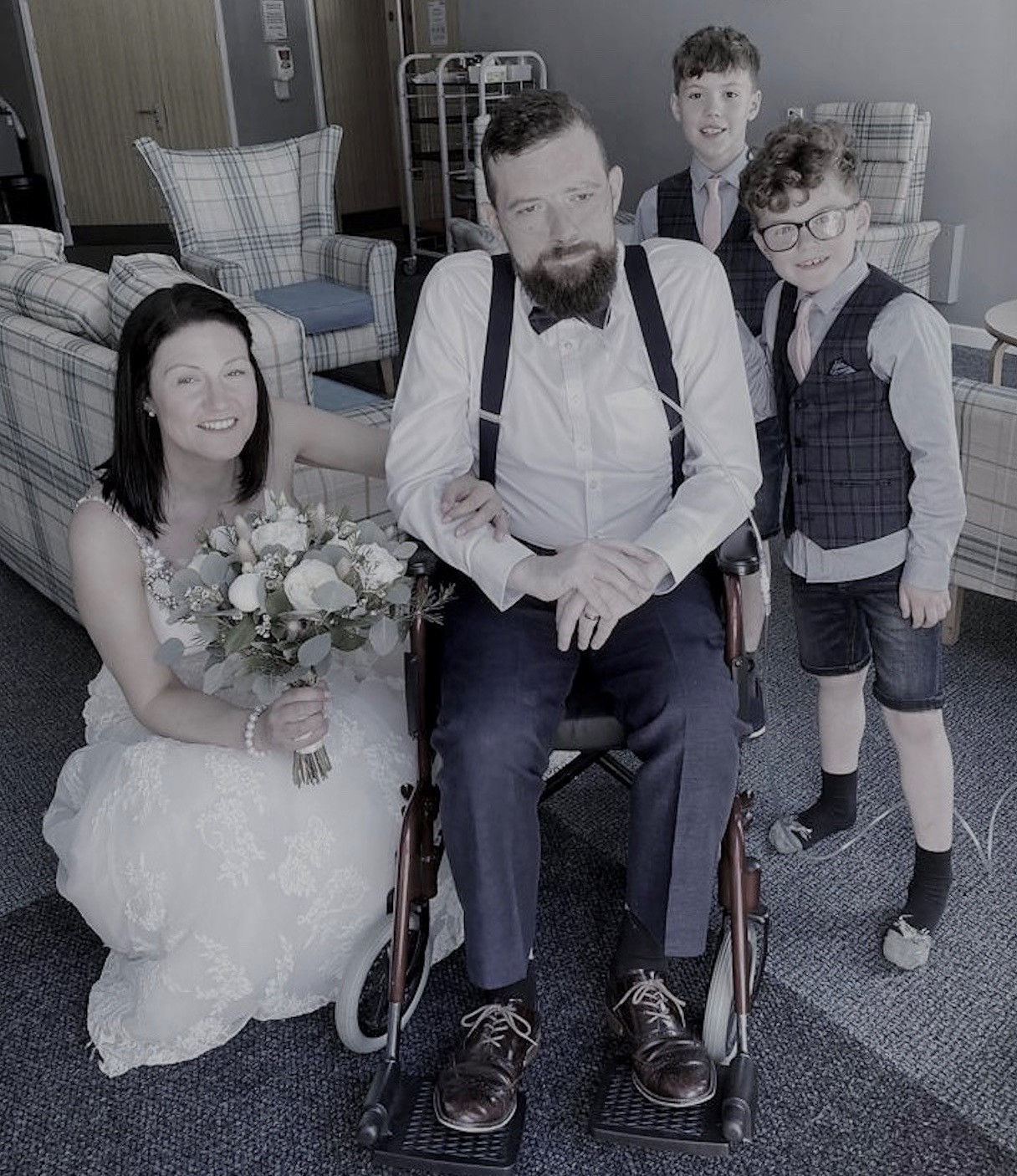
David Black was admitted to Coventry Myton Hospice on Friday 13th May 2022 and less than 24 hours later he and his wife Kerry had their wedding at the hospice. On hearing the couple's plans to marry, Myton staff and volunteers pulled out all the stops to arrange decorations, food, and refreshments to ensure they had the best possible day making precious memories. They were surrounded by close family members and their two sons, Fergus now aged 10 and Alfie, 7. David sadly died aged just 41, one week after being admitted to Myton.
Kerry said: "Alfie and Fergus were so excited to see us get married and I'm so pleased that they have such happy memories of the hospice. Their faces say it all and for that I will be forever thankful to Myton."
Kerry and David's wedding
Spotlight on: an end of life doula
An end of life doula, sometimes called a death doula or death midwife, is a non-medical specialist trained to provide emotional and spiritual support to terminally ill people. According to the International End of Life Doula Association, a doula "holds the space for the kind of dying experience that honours who the person is and has been in their life."1
Alessandra Olanow is a trained end of life doula and author of Hello Grief: I'll be Right with You. She explains how a doula can be a comforting and positive presence:
"Doulas are there to allow the dying person to be who they are, and to allow them to be more than old or sick. A doula listens deeply to the concerns, fears, hopes, and life stories of the dying person and their loved ones to bring them peace at the end of life."
There are many things a doula can do, including:
Being a companion and source of comfort.
Offering emotional support to the care recipient and their loved ones.
Have conversations that help death seem less scary and lonely.
Providing practical support - for example, walking the dog, providing care, preparing meals, and running errands.
Being a point of contact for the other care teams.
Enabling family carers to take a break.
Advocating for the care recipient's wishes - for example, making sure the desired religious or cultural rituals are followed during end of life or after death.
Doulas can visit people at home, or in a facility such as a hospice or nursing home. Alessandra volunteers on the palliative care floor of a New York hospital. She adds that training as an end of life doula has helped her appreciate living: "I used to avoid thinking about death and dying; it was just this fearful thing. Now, I choose to live my life with an understanding that every single day is a gift."
Alessandra's advice for coping with loss
If your loved one is approaching death, an end of life doula needn't disappear the moment they have passed on. They can also support you through your grief, offering guidance and comfort.
Alessandra shares this advice from her experience helping with grief: "Allow yourself the time and space you need without expectation. There is a misconception that grief has a timeline and that there is a certain way to grieve. But there isn't. Everyone grieves at their own pace and that is ok.
"It can be helpful to have a creative outlet to express overwhelming feelings of loss. When I first lost my mother, I began to draw my feelings - these drawings became my book, Hello Grief. I hope it helps others to process their own grief."
Further reading
Patient picks for End of life care

Senior health
LGBTQI+: what are the barriers and challenges in end of life care?
Everyone deserves access to good quality end of life care. Unfortunately, a significant number of LGBTQI+ people still have poorer experiences than non-LGBTQI+ patients. Common barriers and challenges include intentional and accidental discrimination, inappropriate care, and lack of knowledge among healthcare providers. What practical steps can be taken to create a welcoming environment, provide more comfort, and eliminate prejudice at the end of LGBTQI+ people's lives?
by Amberley Davis

Senior health
What are the options for end of life care?
Death and dying can be difficult subjects to speak about. But if you've received a terminal diagnosis, or are caring for someone who is nearing the end of their life, it's important to understand the options available for care.
by Gillian Harvey
About the authorView full bio
Authored by

Amberley Davis
Senior writer
BA (Hons), CPD
Amberley is a senior writer with Patient and has written extensively on a range of health and wellbeing topics.
About the reviewerView full bio

Dr Krishna Vakharia, MRCGP
Chief Medical Officer for Health, Optum UK
MBChB, MRCGP(2013), BMedSci (hons), DFSRH, DRCOG, PGDipDerm (Distn)
Dr Krishna Vakharia is an NHS GP. She is also a regular examiner for the postgraduate Diploma in Practical Dermatology at Cardiff University as well as being the Chief Medical Officer for health at Optum UK.
Article history
Article also available in English, German, Spanish, French, Italian, Portuguese, Hindi, Hebrew, Arabic, and Swedish.
14 Apr 2023 | Originally published
Authored by:
Amberley DavisPeer reviewed by
Dr Krishna Vakharia, MRCGP
Join the conversation
Share your thoughts or experiences with others in our patient communities.

Ask, share, connect.
Browse discussions, ask questions, and share experiences across hundreds of health topics.

Feeling unwell?
Assess your symptoms online for free
Sign up to the Patient newsletter
Your weekly dose of clear, trustworthy health advice - written to help you feel informed, confident and in control.
By subscribing you accept our Privacy Policy. You can unsubscribe at any time. We never sell your data.