التهاب الجراب أمام الرضفة
مراجعة من قبل الدكتورة سارة جارفيسآخر تحديث بواسطة الدكتور كولين تايدي، MRCGPآخر تحديث 29 أبريل 2022
يتوافق مع الإرشادات التحريرية
- تنزيلتنزيل
- مشاركة
- Language
- نقاش
- نسخة صوتية
- أضف إلى المصادر المفضلة على جوجل
المهنيين الطبيين
تم تصميم مقالات المراجع المهنية لاستخدامها من قبل المتخصصين في الرعاية الصحية. يتم كتابتها بواسطة أطباء من المملكة المتحدة وتستند إلى أدلة بحثية وإرشادات المملكة المتحدة وأوروبا. قد تجد ركبة الخادمة مقالة أكثر فائدة، أو واحدة من مقالاتنا الأخرى مقالاتنا الصحية.
What is prepatellar bursitis?
A bursa is a small sac of fibrous tissue with a thin synovial lining that is filled with fluid. Numerous bursae are found in the body, around joints and in places where ligaments and tendons pass over bones. They can also form in other places as a response to unusual pressure or friction. Generally, bursae help to reduce friction and allow maximal range of motion around joints. Bursitis is inflammation within a bursa. The inflammation leads to an increase in synovial fluid production and causes the bursa to swell.
There are four bursae located around the knee joint. They are all susceptible to bursitis but the prepatellar bursa is most commonly affected. Less frequently, the infrapatellar and deep patellar bursae can become inflamed.1
ركبة الخادمة
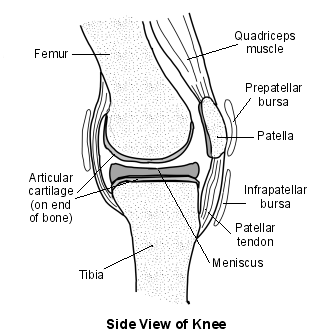
The prepatellar bursa is located superficially on the anterior aspect of the knee between the skin and the patella. The bursa does not communicate with the knee joint and the knee joint itself is normal in prepatellar bursitis.
Prepatellar bursitis causes (aetiology)2
Prepatellar bursitis may occur due to:
Acute trauma: fall/direct blow on to the knee.
Recurrent minor injury: occurs after long periods of time spent kneeling forwards and putting pressure on the patella. Historically, this was typical of housemaids who spent long periods of time on their knees scrubbing floors; hence, the term 'housemaid's knee'. It is now more commonly seen in tradesmen - eg, carpet fitters, concrete finishers, roofers.
عدوى: pyogenic prepatellar bursitis is common in children. It may be mistaken for septic arthritis of the knee. Staphylococcus aureus is the usual causal agent. There is usually a history of a break in the skin prior to its onset.3
A co-existing inflammatory disease: for example, synovitis related to rheumatoid arthritis.
A crystal-depositing condition: prepatellar bursitis is more common in people with gout or pseudogout.
How common is prepatellar bursitis? (Epidemiology)2
Prepatellar bursitis is believed to have an annual incidence of 1 per 10,000 people.
Prepatellar bursitis is more common in:
Men aged 40-60 years.
People whose occupation involves prolonged kneeling or leaning against the knees, eg cleaners, carpet layers, gardeners, and roofers.
People who play sports which involve repetitive movement of the knees or direct impact to the knees, eg basketball and wrestling.
About 30% of cases of prepatellar bursitis are septic. Septic bursitis is more common in children and in people who are immunocompromised - eg, diabetes or systemic corticosteroid treatment.
.
Prepatellar bursitis symptoms2
انظر أيضًا إلى القسم المنفصل Knee Pain مقالة.
الأعراض
Knee pain, swelling and redness.
Difficulty kneeling and walking.
حمى.
علامات
Tenderness and swelling superficial to the patella.
Erythema and localised warmth of the skin over the patella.
Reduced knee movement.
Fever, tachycardia or signs of systemic upset may indicate septic bursitis.
Key points to elicit in the history
Occupation - establish if this involves excessive kneeling.
Ask whether there is a history of a fall or acute knee injury.
Ask whether there is history of any repetitive motion involving the knee.
Establish whether there has been recent steroid treatment.
Determine whether the patient is immunocompromised.
Ask whether there Is a history of crystal arthropathy or inflammatory disease.
Differential diagnosis of prepatellar bursitis
التهاب المفاصل الإنتاني of the knee: clinical judgement should be used to distinguish between prepatellar bursitis and septic arthritis. The swelling in bursitis is usually distinguishable as being prepatellar but, if very large, the whole knee can appear swollen. If uncertain, refer for a specialist opinion.
Knee joint effusion secondary to trauma.
Infrapatellar bursitis: bursitis may also affect the infrapatellar bursa. This has the synonyms 'parson's knee', or 'vicar's knee'. Management follows the same principles as prepatellar bursitis.
التحقيقات
Aspiration of the prepatellar bursa
it is important to differentiate septic and non-septic bursitis. If infection is suspected, fluid should be aspirated under aseptic conditions by an experienced physician and sent for culture. See also the separate article Joint Injection and Aspiration.
Aspirate should be examined for:
White cell count - this may be 5000/μL or greater.
Protein - may be raised.
Lactate - may be raised.
Glucose - may be decreased.
Culture - the presence of Gram-negative bacteria may indicate septic bursitis.
Monosodium urate crystals - indicate gout.
Calcium pyrophosphate crystals - indicate pseudogout.
Cholesterol crystals - may be present in rheumatoid arthritis.
التصوير
This is not usually required for uncomplicated cases. However, plain X-ray may be required if fracture or dislocation is a clinical possibility. MRI or CT may be required in cases where there is a failure to respond to treatment for septic prepatellar bursitis. Ultrasound may also be useful for diagnosis.4
Prepatellar bursitis treatment and management5
The management of prepatellar bursitis depends on its aetiology. When considering management, separate into septic and non-septic bursitis. According to one study, patients with septic bursitis usually presented earlier and had more pain, erythema, warmth and tenderness, and some had mild fever (37.5°C maximum recorded). Clinical features alone could not identify all the septic cases. Have a low threshold for performing, or referring for, aspiration.
Non-operative treatment is the mainstay of treatment, and bursectomy is indicated for intractable bursitis resistant to conservative treatment. Open bursectomy has significant risk of surgical site morbidity. Endoscopic resection of prepatellar bursa is minimally invasive and has the advantage of better cosmetic results and fewer wound complications.
Non-septic bursitis
Conservative treatment
Rest.
Ice.
Patient education about the condition and its aetiology.
A thick foam cushion, or knee pads, to kneel on can help prevent recurrence. Occupational therapy referral may be helpful.
Physiotherapy referral may be helpful if there is reduced range of movement in the knee joint. A stick or cane may be needed to aid walking.
العلاج الطبي
Aspiration of the prepatellar bursa and injection of a corticosteroid: infection must be excluded prior to this.6 Complications should be discussed with the patient, including infection, subcutaneous atrophy, bleeding and patellar tendon rupture. Hydrocortisone may be used.
Non-steroidal anti-inflammatory drugs (NSAIDs) - eg, ibuprofen: these can be used for mild-to-moderate pain and to reduce inflammation
العلاج الجراحي
This may be needed if prepatellar bursitis is chronic or recurrent:7
Arthroscopic bursectomy: this can be performed under local anaesthetic on an outpatient basis. The cosmetic effect is better than open bursectomy.
Open bursectomy: the traditional open surgical approach of excising the bursa.
Septic bursitis
Prepatellar septic bursitis is usually successfully managed non-operatively with rest, compression, immobilisation, aspiration and antibiotics. Surgical bursectomy may rarely be required for recalcitrant cases.8
Aspiration: this should be performed to confirm septic bursitis as detailed in 'Investigations', above. Guidance on diagnosis and treatment can be obtained rapidly from the aspirated fluid white cell count whilst waiting for culture results. Take care here because if the knee joint is opened, septic arthritis will ensue.
Antibiotic therapy: if septic bursitis is suspected and whilst waiting for confirmatory culture results, start antibiotics. Intravenous antibiotics should be used if the patient is systemically unwell. Flucloxacillin is the preferred antibiotic. Clarithromycin may be used if the person is allergic to penicillin. Erythromycin is the preferred macrolide in pregnancy and breastfeeding.2
شق وتصريف: if symptoms of septic bursitis have not improved significantly within 36-48 hours of antibiotic treatment, incision and drainage are usually performed.
التكهن
Prepatellar bursitis can lead to pain and reduced function of the knee joint. This may be worse if septic bursitis is not recognised promptly. Generally the prognosis is very good with appropriate treatment.
الوقاية
Education to avoid prolonged and repetitive kneeling.
Use of knee pads in certain occupations.
تحديثات حصرية لمتخصصي الرعاية الصحية
ابقَ على اطلاع بأحدث التحديثات السريرية، والرؤى المهنية، والإرشادات المستندة إلى الأدلة. تقوم نشرة Patient Pro الإخبارية بتجميع محتوى أساسي لمتخصصي الرعاية الصحية - يتم تسليمه مباشرة إلى بريدك الوارد.
من خلال الاشتراك، فإنك تقبل سياسة الخصوصية. يمكنك إلغاء الاشتراك في أي وقت. نحن لا نبيع بياناتك أبدًا.
قراءة إضافية ومراجع
- Rishor-Olney CR, Pozun A; التهاب الجراب أمام الرضفة. ستاتبيرلز، يناير 2024.
- Khodaee M; Common Superficial Bursitis. Am Fam Physician. 2017 Feb 15;95(4):224-231.
- الأجربة والتهاب الأجربة في الركبة; كتاب ويليس لطب العظام
- التهاب الجراب قبل الرضفي; NICE CKS، مايو 2024 (الوصول متاح فقط في المملكة المتحدة)
- Sato M, Watari T; ركبة الخادمة (التهاب الجراب الإنتاني قبل الرضفة). كيوريوس. 11 سبتمبر 2020;12(9):e10398. doi: 10.7759/cureus.10398.
- Iagnocco A, Vavala C, Scirocco C, et al; Unilateral painful, swollen and erythematosus knee. Case report. Med Ultrason. 2012 Sep;14(3):251-3.
- Luk WCB, Lui TH; Endoscopic Resection of Prepatellar Bursa. Arthrosc Tech. 2020 Jul 1;9(7):e1057-e1060. doi: 10.1016/j.eats.2020.04.003. eCollection 2020 Jul.
- Aaron DL, Patel A, Kayiaros S, et al; Four common types of bursitis: diagnosis and management. J Am Acad Orthop Surg. 2011 Jun;19(6):359-67.
- Huang YC, Yeh WL; Endoscopic treatment of prepatellar bursitis. Int Orthop. 2011 Mar;35(3):355-8. doi: 10.1007/s00264-010-1033-5. Epub 2010 Jun 4.
- Gendernalik JD, Sechriest VF 2nd; Prepatellar septic bursitis: a case report of skin necrosis associated with open bursectomy. Mil Med. 2009 Jun;174(6):666-9.
عن المؤلفعرض السيرة الذاتية الكاملة

الدكتور كولين تايدي، MRCGP
طبيب عام، مؤلف طبي
MBBS, MRCGP, MRCP (Paediatrics), DCH
الدكتور كولين تايدي هو طبيب في هيئة الخدمات الصحية الوطنية، ويعمل في أوكسفوردشاير.
حول المراجععرض السيرة الذاتية الكاملة

الدكتورة سارة جارفيس
استشاري سريري
MA (Cantab), BM, BCh (Oxon), DRCOG, FRCGP, MBE
بعد التدريب في الطب في كامبريدج وأكسفورد، أصبحت الدكتورة سارة جارفيس حاصلة على وسام الإمبراطورية البريطانية طبيبة عامة.
تاريخ المقال
تمت كتابة المعلومات على هذه الصفحة ومراجعتها من قبل أطباء مؤهلين.
المقال متاح أيضًا باللغة الإنجليزية, الألمانية, إسبانية, الفرنسية, إيطالي, البرتغالية, الهندية, العبرية, العربية ,، و السويدية.
Next review due: 28 Mar 2027
29 أبريل 2022 | أحدث إصدار

اسأل، شارك، تواصل.
تصفح المناقشات، اطرح الأسئلة، وشارك التجارب عبر مئات المواضيع الصحية.

هل تشعر بتوعك؟
قم بتقييم أعراضك عبر الإنترنت مجانًا
المزيد في جراحة العظام والطب الرياضي
- ضمور العضلات بيكر
- تقييم الضفيرة العضدية والإصابات الشائعة
- كسور الرسغ والخلوع
- فرط التعظم الهيكلي مجهول السبب المنتشر
- ضمور العضلات الدوشيني
- فحص العمود الفقري
- كسر في عظم العضد
- مرض فريبرغ
- صلابة إبهام القدم
- إصابات اليد وتقييمها
- خلع الورك
- ألم الركبة
- مرض كولر العظمي
- داء كثرة المنسجات لخلايا لانغر هانز
- ألم أسفل الظهر وعرق النسا
- كسور وخلوع الفك السفلي
- التهاب العظم والغضروف
- آلام الساق
- قصر القامة
- اضطرابات المفصل الصدغي الفكي