Pseudoxanthoma elasticum
مراجعة من قبل الدكتور جون كوكس، MRCGPآخر تحديث بواسطة Dr Nick Imm, MRCGPآخر تحديث 11 Apr 2015
يتوافق مع الإرشادات التحريرية
- تنزيلتنزيل
- مشاركة
- Language
- نقاش
- Ask Patient
- نسخة صوتية
- أضف إلى المصادر المفضلة على جوجل
تنويه بشأن المحتوى
لم تتم مراجعة هذه الصفحة مؤخرًا، لذا ربما تكون بعض المعلومات أو الروابط الخارجية قد تغيّرت.
المهنيين الطبيين
تم تصميم مقالات المراجع المهنية لاستخدامها من قبل المتخصصين في الرعاية الصحية. يتم كتابتها بواسطة أطباء من المملكة المتحدة وتستند إلى الأدلة البحثية والإرشادات البريطانية والأوروبية. قد تجد أحد مقالاتنا مقالاتنا الصحية أكثر فائدة.
Synonyms: include - PXE and Grönblad-Strandberg syndrome
This is a rare, genetic connective tissue disorder with progressive calcification and fragmentation of elastic fibres in the skin, the retina and the cardiovascular system. It is important to recognise the disease early to minimise the problem of retinal or gastrointestinal (GI) haemorrhage and cardiovascular complications.
علم الأوبئة
Pseudoxanthoma elasticum (PXE) is a recessive disorder with a prevalence of between 1 in 25,000 and 1 in 100,000.1It is caused by mutations in the ABCC6 gene on chromosome 16p13.1. Presentation can be highly variable and phenotypic penetration may be incomplete.2 It affects all races and females twice as often as males.
عرض
نقاط عامة
The first lesions to be noted are on the skin in the lateral part of the neck. Skin lesions (see below) begin in childhood but they are not usually noted until adolescence. The complaint is purely cosmetic. In some people skin lesions do not appear until the seventh decade of life or later.
Mucosal involvement follows, leading to GI haemorrhage with melaena, frank bleeding, occult blood in the stool, or haematemesis.
Patients may complain of fatigue from chronic blood loss or claudication from blood vessel involvement.
Slowly, as the disease progresses, patients note more severe skin lesions and there may be cardiovascular disease like angina and hypertension.
Haematuria has also been reported.
Retinal haemorrhages with loss of central vision occur after the fourth decade of life.
Skin signs
Small, yellow papules are seen in a linear or reticular pattern and may coalesce to form plaques. The skin is variously described as like a plucked chicken, Moroccan leather or as having a cobblestone appearance. Usually, these changes are first noted on the lateral part of the neck and later involve the antecubital fossae, the axillae, the popliteal fossae, the inguinal and periumbilical areas and also the oral, vaginal, and rectal mucosa.
The lesions are symmetrical and may involve the whole body, but this is unusual.
As the disease progresses, the skin of the neck, the axillae, and the groin may become soft, lax and wrinkled, hanging in folds. This can be corrected by plastic surgery.
Acneiform lesions and chronic granulomatous nodules have been reported in the literature. The cutaneous lesions of PXE usually remain unchanged throughout life.
Elastosis perforans serpiginosa may coexist with PXE. This is a rare disorder of elastic tissue of the skin, which affects males more than females. It may be idiopathic, related to other disorders such as Down's syndrome, Ehlers-Danlos syndrome and Marfan's syndrome, and it can be a reaction to penicillamine in about 1% of those who receive the drug.
Eye signs
The characteristic features are angioid streaks of the retina, which are grey to reddish brown curvilinear bands radiating from the optic disc.
Angioid streaks result from calcification of the elastic fibres in Bruch's membrane of the retina, with cracking and fissuring. This ocular disease is bilaterally symmetrical and appears several years after the onset of cutaneous lesions, in patients aged 20-40 years. Angioid streaks are present in 85% of patients with PXE. Although these lesions are highly characteristic of PXE, they are not pathognomonic. Angioid streaks are found in a variety of other conditions, such as sickle cell disease and thalassaemia.3They can also be seen in Paget's disease of the bone and in Ehlers-Danlos syndrome.
Fibrovascular ingrowth in the retina may lead to retinal haemorrhages - a serious complication of the disease.
Loss of central vision progresses with each haemorrhage; however, peripheral vision is always spared.
Before bleeding occurs, a subretinal net often forms that can be detected by an Amsler grid and intravenous fluorescein angiography. Before angioid streaks are visible there is often leopard spotting of the posterior pole of the retina, concurrent with the onset of skin lesions. Yellowish speckled mottling is suggestive of early retinopathy.
Cardiovascular system signs
Intermittent claudication is often the first sign of accelerated atherosclerosis and is the most common cardiovascular symptom (30% of patients).4
Calcification of the elastic media and intima of the blood vessels leads to various physical findings. Peripheral pulses are often much reduced. Renal artery disease causes hypertension and coronary artery disease causes angina and myocardial infarction. Mitral valve prolapse often occurs. This prolapse may not be significant unless there is also mitral regurgitation.
GI haemorrhage is usually from the stomach and is the most significant vascular complication. The calcified submucosal vessels are very fragile. Bleeding may occur early in the disease and without warning. 10% of patients have a GI haemorrhage at some time in their lives. Less commonly, bleeding may occur in the urinary tract or cerebrovascular system.
Illustrations
PSEUDOXANTHOMA ELASTICUM
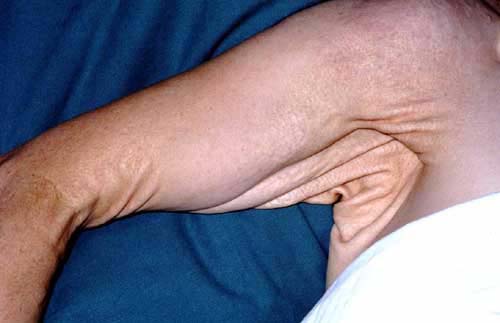
An example of saggy skin in the axilla
PSEUDOXANTHOMA ELASTICUM
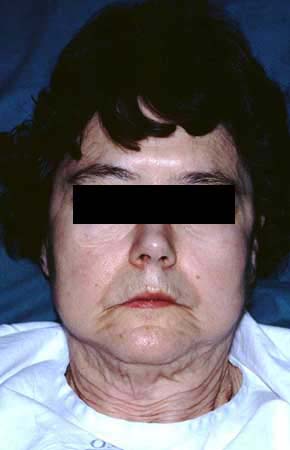
Loss of elastic tissue in the neck
التشخيص التفريقي
Dermatofibrosis lenticularis (Buschke-Ollendorff syndrome).
Localised acquired cutaneous PXE.
Severe actinic damage to the neck.
Long-term penicillamine therapy.
التحقيقات
اختبارات الدم
FBC and ferritin for Fe-deficient anaemia from bleeding.
Serum lipids.
Occult blood for GI haemorrhage.
Urinalysis for blood.
Serum calcium and serum phosphate are sometimes elevated but usually normal.
التصوير
Plain X-rays may show calcified arteries.
Echocardiogram for mitral valve involvement.
Coronary angiography if indicated
إجراءات أخرى
Regular ophthalmic examination is essential to detect early signs of retinopathy, angioid streaks and retinal haemorrhages. Laser treatment may spare vision.
Endoscopy is indicated for any form of frank GI bleeding.
Ankle/brachial blood pressure using Doppler methods is useful in patients with intermittent claudication or significantly diminished peripheral pulses.
Biopsy can give histological confirmation of the diagnosis.
الإدارة
إجراءات عامة
Smoking aggravates the condition.
Because of the risk of cardiovascular disease, advice about diet and exercise should be given as for anyone at high risk. A low-calcium diet may also help, especially in earlier life.5
Avoid contact sports to reduce the risk of damage to the eyes.
All patients with PXE should be monitored on a regular basis by an ophthalmologist. One author suggests bi-yearly fundus examination for younger patients and an examination twice per year for those aged over 40 years.6
Patients should be advised to self-monitor their visual acuity using the Amsler grid.
Most women with PXE have a normal pregnancy but may (rarely) experience GI or uterine bleeding. They are reported to be at a higher risk for perineal tears and abdominal striae.4
دوائي
Avoid non-steroidal anti-inflammatory drugs because of the risk of GI haemorrhage.
With the exception of aspirin, there should be standard management of high-risk coronary heart disease.
If there is mitral regurgitation, antibiotic prophylaxis may be indicated for dentistry, etc.
Oestrogens (eg, the oral contraceptive pill) should be avoided.4
Pentoxifylline may reduce blood viscosity but it can also increase risk of haemorrhage.
جراحي
Plastic surgery can correct the sagging skin.
المضاعفات
The problem is mostly cosmetic and there is a normal life expectancy but there can be problems of haemorrhage, especially from the GI tract, as well as problems with arteries and prolapsed mitral valve.7
Ocular involvement with retinal haemorrhages leads to the progressive loss of central vision. Peripheral vision is always spared.
Involvement of the elastic media and intima of the arteries causes claudication, hypertension, angina, myocardial infarction and GI or cerebral haemorrhage.
Cerebral and GI haemorrhage or coronary occlusion, although uncommon, may be fatal.
التكهن
Life expectancy is usually normal, although sudden, unexpected death can occur involving accelerated atherosclerosis with acute myocardial ischaemia, hypertension, mitral valve prolapse, restrictive cardiomyopathy, GI haemorrhage and cerebral ischaemia or haemorrhage.8
الوقاية
There is no means of prevention and there is no antenatal test for the condition. First-degree relatives should be screened for the disease so that action can be taken at an early stage.4When an unexpected case is found at post-mortem, family counselling and screening should be considered.8Significant progress has been made in understanding the molecular genetics of PXE and potential treatments for use at the pre-clinical stage are being researched.9
تحديثات حصرية لمتخصصي الرعاية الصحية
ابقَ على اطلاع بأحدث التحديثات السريرية، والرؤى المهنية، والإرشادات المستندة إلى الأدلة. تقوم نشرة Patient Pro الإخبارية بتجميع محتوى أساسي لمتخصصي الرعاية الصحية - يتم تسليمه مباشرة إلى بريدك الوارد.
من خلال الاشتراك، فإنك تقبل سياسة الخصوصية. يمكنك إلغاء الاشتراك في أي وقت. نحن لا نبيع بياناتك أبدًا.
قراءة إضافية ومراجع
- Pseudoxamthoma Elasticum (Autosomal Dominant); الوراثة المندلية البشرية عبر الإنترنت (OMIM)
- Pseudoxanthoma Elasticum (Autosomal Recessive); الوراثة المندلية البشرية عبر الإنترنت (OMIM)
- Varadi A, Szabo Z, Pomozi V, et al; ABCC6 as a target in pseudoxanthoma elasticum. Curr Drug Targets. 2011 May;12(5):671-82.
- Sherer DW, Bercovitch L, Lebwohl M; Pseudoxanthoma elasticum: significance of limited phenotypic expression in parents of affected offspring. J Am Acad Dermatol. 2001 Mar;44(3):534-7.
- Aessopos A, Farmakis D, Loukopoulos D; Elastic tissue abnormalities resembling pseudoxanthoma elasticum in beta thalassemia and the sickling syndromes. Blood. 2002 Jan 1;99(1):30-5.
- Laube S, Moss C; Pseudoxanthoma elasticum. Arch Dis Child. 2005 Jul;90(7):754-6.
- Renie WA, Pyeritz RE, Combs J, et al; Pseudoxanthoma elasticum: high calcium intake in early life correlates with severity. Am J Med Genet. 1984 Oct;19(2):235-44.
- Orssaud C, Roche O, Dufier JL, et al; Visual Impairment in Pseudoxanthoma Elasticum: A Survey of 40 Patients. Ophthalmic Genet. 2014 Apr 21.
- Przybojewski JZ, Maritz F, Tiedt FA, et al; Pseudoxanthoma elasticum with cardiac involvement. A case report and review of the literature. S Afr Med J. 1981 Feb 21;59(8):268-75.
- Combrinck M, Gilbert JD, Byard RW; Pseudoxanthoma elasticum and sudden death. J Forensic Sci. 2011 Mar;56(2):418-22. doi: 10.1111/j.1556-4029.2010.01647.x. Epub 2011 Jan 6.
- Uitto J, Bercovitch L, Terry SF, et al; Pseudoxanthoma elasticum: progress in diagnostics and research towards treatment : Summary of the 2010 PXE International Research Meeting. Am J Med Genet A. 2011 Jul;155A(7):1517-26. doi: 10.1002/ajmg.a.34067. Epub 2011 Jun 10.
عن المؤلفعرض السيرة الذاتية الكاملة
تم التحديث بواسطة

Dr Nick Imm, MRCGP
Surgeon Commander, Medical Author
BM, MRCGP, DRCOG, DFFP, DTMH
Nick Imm qualified in 1993 and joined EMIS as a clinical author for Patient.info in 2013.
حول المراجععرض السيرة الذاتية الكاملة

الدكتور جون كوكس، MRCGP
MA, MB, B Chir, DCH, DRCOG, MRCP (UK), MRCGP
عمل الدكتور جون كوكس كمسجل طبي في المملكة المتحدة ونيوزيلندا وكطبيب مؤقت في نيوزيلندا.
تاريخ المقال
المقال متاح أيضًا باللغة الإنجليزية, الألمانية, إسبانية, الفرنسية, إيطالي, البرتغالية, الهندية, العبرية, العربية ,، و السويدية.
11 Apr 2015 | أحدث إصدار
وصول بسيط إلى العلاجات والخدمات الصحية الموثوقة عبر الإنترنت.
Common conditions
Get help with common conditions through the NHS, without a GP appointment.
 التهاب الجيوب الأنفية الحاد
 التهاب اللوزتين البكتيري
 القوباء
 لدغات الحشرات
 الحزام الناريعدوى المسالك البولية
المزيد في الاضطرابات الخلقية والوراثية
- البيلة الكابتونية
- نقص ألفا-1 أنتي تربسين
- متلازمة ألبورت
- الأعضاء التناسلية الغامضة
- متلازمة شيدياك هيغاشي
- كولوبوما
- الفتق الحجابي الخلقي
- مشاكل الأذن الخلقية
- العدوى الخلقية والوليدية وحديثي الولادة
- متلازمة دوبين جونسون
- ضمور العضلات الدوشيني
- اضطرابات تخزين الجليكوجين
- داء ترسب الأصبغة الدموية الوراثي
- متلازمة أوسلر-ويبر-ريندو
- القناة الشريانية السالكة
- متلازمة برادر-ويلي
- نقص إنزيم البيروفات كيناز
- مرض فقر الدم المنجلي وفقر الدم المنجلي
- مرض تاي ساكس
- متلازمة التكاثر اللمفاوي المرتبطة بالكروموسوم X