فحص الكتف
مراجعة من قبل الدكتورة توني هازيل، زميلة الكلية الملكية للأطباء العامينآخر تحديث بواسطة الدكتورة هايلي ويلاسي، زميلة الكلية الملكية للأطباء العامين آخر تحديث 30 يناير 2023
يتوافق مع الإرشادات التحريرية
- تنزيلتنزيل
- مشاركة
- Language
- نقاش
- Ask Patient
- نسخة صوتية
- أضف إلى المصادر المفضلة على جوجل
المهنيين الطبيين
تم تصميم مقالات المراجع المهنية لاستخدامها من قبل المتخصصين في الرعاية الصحية. يتم كتابتها بواسطة أطباء من المملكة المتحدة وتستند إلى الأدلة البحثية والإرشادات البريطانية والأوروبية. قد تجد أحد مقالاتنا مقالاتنا الصحية أكثر فائدة.
What is a shoulder examination?
Shoulder examination is a practical skill which requires background knowledge of anatomy, of normal shoulder function and of abnormalities affecting the shoulder. The likely diagnosis will have been derived from the history. The necessary skills can be developed by examining colleagues or patients. The background knowledge can be learned with the help of pictures and video clips.
Rotator cuff
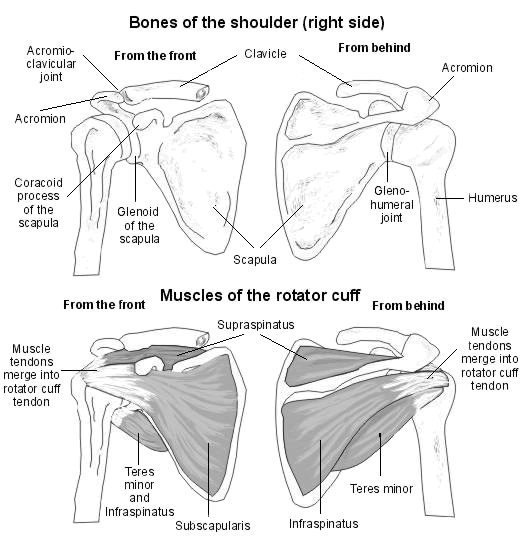
Inspection
View from the rear, with the patient standing straight. Look for lateral symmetry, swelling, position of scapula and signs of muscle wasting.
Palpation
Palpate all over the shoulder girdle, acromioclavicular joint, deltoid and supraspinatus muscles and scapular borders feeling for pain and tenderness, crepitus, effusions, deformities and abnormal muscle development.1
Range of movement
Perform the following with the patient seated:2
External rotation - with the patient's elbow at right angles and held into side, turn the arm outwards as far as possible (expected 70°).
Internal rotation - with the patient's elbow held into side, raise the arm as far as possible up the patient's back (expected level T5).
Forward flexion - start with the patient's arm at their side and lift the arm forwards and upwards as far as possible (expected 150-170°).
Extension - with the arm by the patient's side, lift the arm backwards as far as possible (expected 40°).
Abduction - with the arm at the patient's side, lift the arm away from the body as far as possible, continuing past the horizontal by allowing the shoulder to rotate externally, bringing the hand behind the head (expected 160-180°).
Adduction - draw the patient's arm across the anterior chest wall as far as possible (expected 30-40°).
Signs in individual joint problems3
Acromioclavicular joint
Ask the patient to place their hand on their opposite shoulder. If gentle pressure on the joint elicits pain, this is indicative of acromioclavicular joint inflammation (cross-arm horizontal adduction test).
Glenohumeral joint
With the patient lying on their back and their arm at right angles over the edge of the couch, gently push their wrist downwards. The patient will complain if the joint is unstable (apprehension test). With the patient lying on their back and the scapula stable, support their elbow and gently move the humeral head up and down in the glenoid fossa, by pressing anteriorly and posteriorly on the upper humerus, to assess laxity.
Impingement tests4
Turn the patient's arm so that the thumb points downwards and lift their arm outwards and upwards. With the patient standing and their arm abducted at right angles, support the elbow and rotate the forearm internally. In both tests, pain on movement indicates impingement of the rotator cuff.
Rotator cuff tests5
With the patient seated and elbows tucked into their sides, ask the patient to push both outwards and inwards, against resistance, in order to assess strength.
Supraspinatus
Ask the patient to hold both arms stretched out straight and level with the shoulders and thumbs pointed downwards. Assess strength by asking the patient to push the forearms both upwards and downwards against resistance.
تحديثات حصرية لمتخصصي الرعاية الصحية
ابقَ على اطلاع بأحدث التحديثات السريرية، والرؤى المهنية، والإرشادات المستندة إلى الأدلة. تقوم نشرة Patient Pro الإخبارية بتجميع محتوى أساسي لمتخصصي الرعاية الصحية - يتم تسليمه مباشرة إلى بريدك الوارد.
من خلال الاشتراك، فإنك تقبل سياسة الخصوصية. يمكنك إلغاء الاشتراك في أي وقت. نحن لا نبيع بياناتك أبدًا.
قراءة إضافية ومراجع
- Shoulder Examination - OSCE Guide; Geeky Medics
- Yang S, Kim TU, Kim DH, et al; Understanding the physical examination of the shoulder: a narrative review. Ann Palliat Med. 2021 Feb;10(2):2293-2303. doi: 10.21037/apm-20-1808. Epub 2021 Feb 2.
- Gismervik SO, Drogset JO, Granviken F, et al; Physical examination tests of the shoulder: a systematic review and meta-analysis of diagnostic test performance. BMC Musculoskelet Disord. 2017 Jan 25;18(1):41. doi: 10.1186/s12891-017-1400-0.
- Shoulder Examination; A Practical Guide to Clinical Medicine 2005, University of California
- Range of Movement; Sports Coach
- Cotter EJ, Hannon CP, Christian D, et al; Comprehensive Examination of the Athlete's Shoulder. Sports Health. 2018 Jul-Aug;10(4):366-375. doi: 10.1177/1941738118757197. Epub 2018 Feb 14.
- Garving C, Jakob S, Bauer I, et al; Impingement Syndrome of the Shoulder. Dtsch Arztebl Int. 2017 Nov 10;114(45):765-776. doi: 10.3238/arztebl.2017.0765.
- Ujsasi D, Filipovic K, Zvekic-Svorcan J, et al; The Applicability of Provocative Functional Tests in the Diagnosis of Rotator Cuff Muscle Injuries of the Best University Athletes. Biomed Res Int. 2022 Oct 13;2022:7728277. doi: 10.1155/2022/7728277. eCollection 2022.
عن المؤلفعرض السيرة الذاتية الكاملة
تم التحديث بواسطة

الدكتورة هايلي ويلاسي، زميلة الكلية الملكية للأطباء العامين
طبيب عام، مؤلف طبي
MBChB (1992), DRCOG, DFFP, MRCOG (Part 1) MRCGP (2007), DFSRH (2013), MSc - medical education (2020)
كانت الدكتورة هايلي ويلاسي طبيبة عامة في هيئة الخدمات الصحية الوطنية تعمل في شمال غرب إنجلترا، وتقاعدت من الممارسة السريرية في عام 2022 بعد 30 عامًا.
حول المراجععرض السيرة الذاتية الكاملة

Dr Toni Hazell, FRCGP
بكالوريوس الطب والجراحة، بكالوريوس العلوم، زميل الكلية الملكية للأطباء العامين، دبلوم في الصحة الجنسية والإنجابية، دبلوم في طب الجهاز البولي التناسلي، دبلوم الكلية الملكية لأطباء النساء والتوليد، دبلوم في صحة الطفل (لندن، المملكة المتحدة، 2000)
تخرجت الدكتورة توني هازيل من كلية الطب بمستشفى سانت ماري وأكملت تدريبها في مستشفى نورثويك بارك.
تاريخ المقال
المقال متاح أيضًا باللغة الإنجليزية, الألمانية, إسبانية, الفرنسية, إيطالي, البرتغالية, الهندية, العبرية, العربية ,، و السويدية.
المراجعة التالية مستحقة: 29 يناير 2028
30 يناير 2023 | أحدث إصدار
آخر تحديث بواسطة
الدكتورة هايلي ويلاسي، زميلة الكلية الملكية للأطباء العامينمراجعة من قبل
Dr Toni Hazell, FRCGP
وصول بسيط إلى العلاجات والخدمات الصحية الموثوقة عبر الإنترنت.
Common conditions
Get help with common conditions through the NHS, without a GP appointment.
 التهاب الجيوب الأنفية الحاد
 التهاب اللوزتين البكتيري
 القوباء
 لدغات الحشرات
 الحزام الناريعدوى المسالك البولية
المزيد في التاريخ والفحص
- انتفاخ البطن والغازات
- الفتوق البطنية
- الأدوية المضادة للروماتيزم المعدلة للمرض
- عسر البلع
- ضيق التنفس في الرعاية التلطيفية
- اختبار تحمل التمارين
- رائحة الفم الكريهة
- القيلة المائية
- متلازمة الضائقة التنفسية عند الرضع
- ألم الركبة
- ركبتان تتورمان
- ألم أسفل الظهر وعرق النسا
- اليرقان الوليدي
- الرعب الليلي واضطرابات النوم
- متلازمة بانكوست
- فحص النبض
- تضخم الطحال وفرط الطحال
- التهاب الكبد الدهني والتنكس الدهني
- تعجر الأصابع وأصابع القدم