Bedwetting reward systems
Peer reviewed by Dr Hannah Gronow, MBACPLast updated by Dr Mary Harding, MRCGPLast updated 28 Feb 2017
Meets Patient’s editorial guidelines
- DownloadDownload
- Share
- Language
- Discussion
- Audio Version
- Add to preferred sources on Google
This page has been archived.
It has not been reviewed recently and is not up to date. External links and references may no longer work.
The prospect of rewards may encourage your child to get to the toilet if they are about to wet the bed, and may help to cure bedwetting.
At a glance
A reward chart is a calendar used to track a child's progress.
They can be used to help children who wet the bed by rewarding good nights.
Children generally need to be aged 4 or 5 years or older to use a reward chart.
Rewards can include stars, special treats, or extra activities.
If no progress is made after a few weeks, consider stopping and consulting your GP.
A reward system such as a reward chart (star chart) aims to reward a child for progress.
What are reward charts?
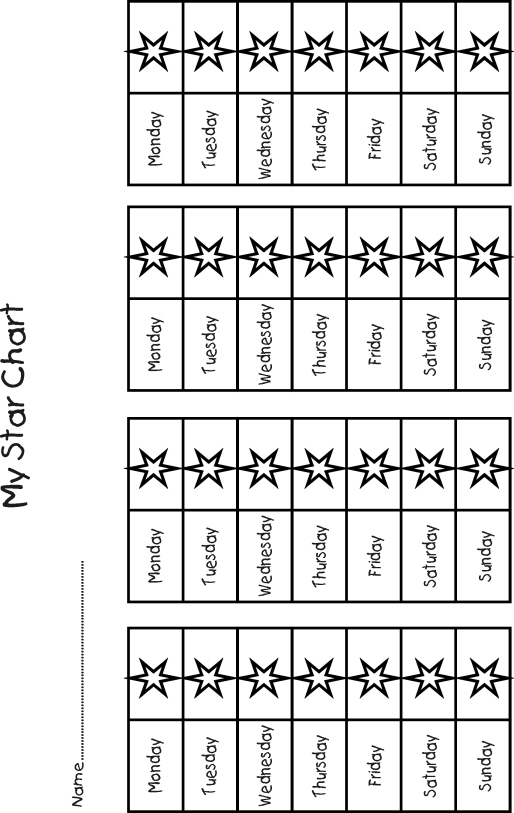
A reward system may be useful for a child who wets the bed. Basically, they are calendars with a space for each day. Commonly, a sticky star is placed on a chart (a star chart) each day following a good night. For a poor night, the day is left blank. There are many variations and styles of star chart.
Your doctor may give you one. If not - why not make one with your child? Instead of the sticky stars you could colour in different days. For example, red for dry nights, blue for wet ones, yellow for signs of progress. It is a visual reminder to the child of their progress.
A suggested plan
Your child must be old enough to co-operate and to understand what is expected (about the age of 4 or 5 years or above). They should be adapted to the age of your child. It can almost be made into a game. At bedtime, produce the chart to remind your child of progress so far. The following morning, if there has been a good night, make a fuss and have a little ceremony of sticking on the star or colouring in the space. If it was a poor night, do not punish. Say something like "we can try again tomorrow".
The chart should be kept in a prominent place. If progress is good, perhaps comment to others in front of your child about the good chart. However, be sensitive about this so as not to embarrass the child in front of others. Some children may not want others to know about the bedwetting. (If progress is bad, do not make any public comments which will discourage.) Progress need not be just dry nights.
Charts and rewards should not just be about dry nights. Your child may gain a star or point for other signs of progress which you have agreed with your child. These might be for: going to the toilet before going to bed, getting up and telling you they are wet, helping to remake the bed, drinking recommended levels of fluid during the day, etc.
Rewards
A star chart can enable you to make a deal with your child. The deal has to be realistic. If the child wets every night then any sign of progress is worth rewarding. If bedwetting is less often, a full week of dry nights might be the goal. You can give a reward if the child gains an agreed number of points or coloured stars.
Every family has their own idea of what should be a reward for progress. To some children, just the pleasure of being able to stick shiny stars on dry days is reward enough. Other families may prefer to give a special treat - for example, sweets or other goodies. Some parents say that so many points can be cashed in for extra activities. This may be such things as extra swimming trips or a trip to a favourite restaurant.
There are no fixed rules but it is important to keep your word. Whatever your deal, you must keep to it. Your child will become confused and discouraged if things are not consistent. Therefore, do not forget the reward. Also, do not be soft and give rewards when they have not been won. You should never remove reward points from the chart, even after a very bad night. It is important to reward positive changes, but not punish the child for something over which they may have no control.
Research studies have shown that reward systems do help to cure bedwetting in some cases. However, if they don't work, the child may become frustrated at never getting rewards. If no progress is made after a few weeks or so, it may be best to stop and try again in a few months. Or visit your GP to discuss other treatment options.
Reward star chart
For this simple chart, place a sticky star on each day following a dry night.
Example of a simple star chart
Patient picks for Bedwetting
Children's health
Bedwetting alarms
Using an alarm reduces bedwetting in about two thirds of children during treatment, and about half the children remain dry after stopping using the alarm.
by Dr Mary Harding, MRCGP
Children's health
Bedwetting
Bedwetting is common. In time, most children become dry at night without any treatment. However, an option is to use treatment which promotes dry nights sooner rather than later. Treatment is considered for children aged 5 years and over.
by Dr Hayley Willacy, FRCGP
Frequently asked questions
What is the primary purpose of a reward chart for bedwetting?
The main goal of a reward chart, also known as a star chart, is to acknowledge and reward a child's progress in managing bedwetting. It serves as a visual tool to help them track their improvement and stay motivated.
At what age is a reward chart most effective for a child?
A reward chart is generally effective for children who are old enough to understand expectations and cooperate with the system, typically around 4 or 5 years old. The chart should be adapted to suit your child's specific age and understanding.
What are some suggestions for non-monetary rewards or activities that can be used?
Beyond simply sticking stars, rewards can include special treats like sweets or other goodies, or extra activities such as additional swimming trips or a visit to a favourite restaurant. Some children even find the act of placing shiny stars on the chart rewarding in itself.
What should I do if my child has a poor night and wets the bed?
If your child has a poor night, it's important not to punish them. Instead, leave that day's space on the chart blank and offer encouragement by saying something like "we can try again tomorrow." The focus should always be on rewarding positive progress, not penalising setbacks.
How long should we try using a reward chart before considering other options?
If no noticeable progress is made after a few weeks of consistently using the reward chart, it might be beneficial to pause and try again after a few months. Alternatively, you could consult your GP to discuss other potential treatment options for bedwetting.
Further reading and references
- Bedwetting in under 19s; NICE Clinical Guideline (October 2010 - surveillance in 2018 reported no need for update)
- Glazener CM, Evans JH, Peto RE; Alarm interventions for nocturnal enuresis in children. Cochrane Database Syst Rev. 2005 Apr 18;(2):CD002911.
- Caldwell PH, Deshpande AV, Von Gontard A; Management of nocturnal enuresis. BMJ. 2013 Oct 29;347:f6259. doi: 10.1136/bmj.f6259.
- Bedwetting (enuresis); NICE CKS, October 2014 (UK access only)
- Vande Walle J, Rittig S, Bauer S, et al; Practical consensus guidelines for the management of enuresis. Eur J Pediatr. 2012 Jun;171(6):971-83. doi: 10.1007/s00431-012-1687-7. Epub 2012 Feb 24.
- Caldwell PH, Sureshkumar P, Wong WC; Tricyclic and related drugs for nocturnal enuresis in children. Cochrane Database Syst Rev. 2016 Jan 20;(1):CD002117. doi: 10.1002/14651858.CD002117.pub2.
- Huang T, Shu X, Huang YS, et al; Complementary and miscellaneous interventions for nocturnal enuresis in children. Cochrane Database Syst Rev. 2011 Dec 7;(12):CD005230. doi: 10.1002/14651858.CD005230.pub2.
About the authorView full bio

Dr Mary Harding, MRCGP
General Practitioner, Medical Author
BA, MA, MB, BChir, MRCGP, DFFP
Dr Mary Harding qualified from Cambridge University medical school in 1989.
About the reviewerView full bio

Dr Hannah Gronow, MBACP
General Practitioner
MB, ChB, MBACP
Hannah qualified as a GP in 1997. She joined EMIS (Patient) as a peer reviewer in August 2006.
Article history
The information on this page is written and peer reviewed by qualified clinicians.
Article also available in English, German, Spanish, French, Italian, Portuguese, Hindi, Hebrew, Arabic, and Swedish.
28 Feb 2017 | Latest version
Join the conversation
Share your thoughts or experiences with others in our patient communities.

Ask, share, connect.
Browse discussions, ask questions, and share experiences across hundreds of health topics.

Feeling unwell?
Assess your symptoms online for free
Sign up to the Patient newsletter
Your weekly dose of clear, trustworthy health advice - written to help you feel informed, confident and in control.
By subscribing you accept our Privacy Policy. You can unsubscribe at any time. We never sell your data.