أنواع سرطان الجلد
مراجعة من قبل الدكتور كولين تايدي، MRCGPآخر تحديث بواسطة الدكتورة توني هازيل، زميلة الكلية الملكية للأطباء العامينآخر تحديث ٢٤ فبراير ٢٠٢٣
يتوافق مع الإرشادات التحريرية
- تنزيلتنزيل
- مشاركة
- Language
- نقاش
- Ask Patient
- نسخة صوتية
- أضف إلى المصادر المفضلة على جوجل
This leaflet gives a general overview about skin cancer and the different skin cancer types - الميلانوما و non-melanoma.
نظرة سريعة
Skin cancer occurs when skin cells grow abnormally and multiply out of control.
The main types are melanoma, basal cell carcinoma (BCC), and squamous cell carcinoma (SCC).
BCC and SCC are more common, often appearing as lumps, red scaly patches, or ulcers.
Melanoma is less common but more serious and can spread to other body areas.
Most skin cancers are caused by damage from ultraviolet (UV) radiation from the sun.
Early detection leads to a better chance of successful treatment for all types.
Protect your skin from the sun, especially children, to reduce your risk.
What is cancer?
السرطان is a disease of the cells in the body. There are many different types of cell in the body, and there are many different types of cancer which arise from different types of cell. What all types of cancer have in common is that the cancer cells are abnormal and multiply out of control. انظر النشرة المنفصلة المسماة السرطان لمزيد من التفاصيل.
What are the different skin cancer types?
There are different types of skin cell in the body and different types of cancer develop from them. Skin cancers are divided into:
Melanoma (malignant melanoma). This type of skin cancer develops from melanocytes. There are around 13,000 new cases in the UK each year.
Non-melanoma. These are more common than melanomas. The different types of non-melanomatous skin cancer are:
سرطان الخلايا القاعدية (BCC) - skin cancer which develops from basal cells. There are around 75,000 new cases in the UK each year.
Squamous cell carcinoma (SCC) - skin cancer which develops from keratinocytes. There are around 25,000 new cases in the UK each year.
أخرى - other types of skin cancer, which are rare.
A malignant tumour is a growth of tissue made up from cancer cells which continue to multiply. Malignant tumours can invade into nearby tissues and cause damage. Most types of malignant tumour also tend to spread (metastasise) to other parts of the body. Melanoma and SCC can spread (metastasise) to distant parts of the body, but a BCC can only spread locally. However, this local spread can be very damaging, particularly if the BCC is close to an important structure such as the eye.
سرطان الخلايا القاعدية (BCC)
Basal cell carcinoma - nodular type
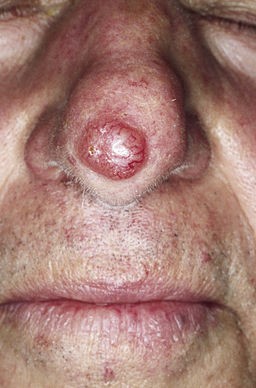
Basal cell skin cancer is the most common type of skin cancer in white and fair-skinned people. BCC is rare in dark-skinned people. BCC is more common in older people. Those aged over 75 years are about five times more likely to have a BCC than those people aged between 50-55 years.
A BCC typically develops on a sun-exposed area of the skin such as the head and neck. However, one can develop on any area of skin. The first sign is often a small red, pink or pearly lump which appears on previously normal skin. The lump is often dome-shaped. However, BCCs can vary in shape and colour. They usually grow very slowly and it can take many months for one to grow to a centimetre or more.
In time, the lump on the skin may crust over, ulcerate or bleed from time to time. A skin ulcer caused by a BCC is sometimes called a rodent ulcer which often looks like a small inflamed crater with a raised edge. BCCs very rarely spread (metastasise) to other parts of the body. However, untreated they will continue to grow locally and can cause damage to nearby structures. For example, a BCC on the face may erode and damage the nose or an ear.
Squamous cell carcinoma (SCC)
Squamous cell carcinoma - forearm
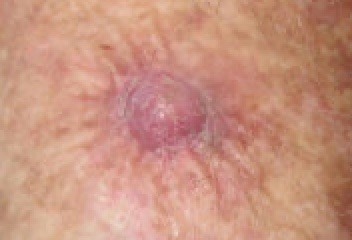
Squamous cell skin cancer is the second most common skin cancer in white and fair-skinned people. SCC is rare in dark-skinned people. Like BCCs, SCCs are more common in older people. Those aged over 75 years are about thirty-five times more likely to have an SCC than those aged between 50-55 years.
An SCC typically develops on the face - most commonly on or around the ears or lips. However any area of skin can be affected. It typically starts as a red scaly patch. It may grow into a lump which may look like a wart. An SCC may ulcerate or bleed from time to time. However, an early SCC can vary in shape, appearance and colour.
As an SCC grows larger and deeper, it damages nearby structures. For example, if left untreated, an SCC next to a nose or ear can grow into, erode and then completely destroy the nose or ear. An SCC may also spread to other areas of the body. However, this is uncommon in the early stages and most are treated before any spread occurs.
Melanoma (malignant melanoma)
Melanoma is the least common form of skin cancer, but it is the most serious. There are about 9,000 new cases of melanoma each year in the UK. Melanoma is the second most common cancer in people aged 15-34 years. It is more than twice as common in young women as it is in young men.
A typical melanoma starts as a small dark patch on the skin (similar to a mole). It can develop from a normal part of skin, or from an existing mole. A melanoma is often different to a mole in one or more of the following ways (summed up as ABCDE) - that is:
تsymmetry - the shape of a melanoma is often uneven and asymmetrical, unlike a mole which is usually round and even.
لorder - the border or edges of a melanoma are often ragged, notched or blurred. A mole has a smooth well-defined edge.
حolour - the colour (pigmentation) of a melanoma is often not uniform. So there may be 2-3 shades of brown or black. A mole usually has one uniform colour.
Diameter - the size of a melanoma is usually larger than a normal mole and it continues to grow.
بvolving - any change in size, shape, colour, or elevation or any new symptom such as bleeding, itching or crusting may be due to a melanoma.
اقرأ المزيد عن melanoma skin cancer. The section includes diagrams of melanomas and compares then to normal moles.
مرض بوين
Bowen's disease is a very early type of skin cancer, which usually presents with a red scaly patch on the skin, usually on the lower legs. It is also known as an SCC in situ. If left alone it may develop into an SCC - this only happens to about 3-5% of those with Bowen's disease.
What causes skin cancer?
The cause of most skin cancers is sun damage to the skin. About 9 in 10 non-melanoma skin cancers and about 6 in 10 melanomas are thought to be caused by excessive exposure to the sun. In particular, past episodes of sunburn significantly increase the risk.
It is the ultraviolet (UV) radiation in the sunshine which does the damage. Skin cells which are damaged are at greater risk of becoming abnormal and cancerous.
See the leaflets called Melanoma Skin Cancer, Non-melanoma Skin Cancer و Preventing Skin Cancer, for other possible risk factors and causes.
Although skin cancer is rare in children, the amount of sun exposure during childhood is thought to increase the risk of developing skin cancers in adult life. Therefore, it is vital to protect children from too much sunshine (see below).
فهم الجلد
The skin has two layers - the epidermis and the dermis. Beneath the dermis is a layer of fat and then the deeper structures such as muscles and tendons. There are different cells in each layer of the skin.
عرض مقطع عرضي لرسم الجلد
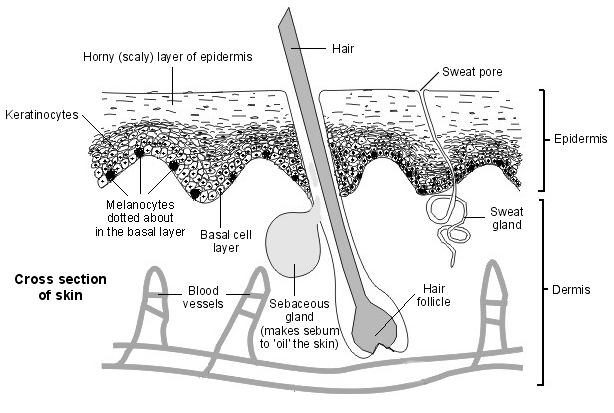
تحتوي البشرة على ثلاثة أنواع رئيسية من الخلايا:
الخلايا القاعدية. هذه هي الطبقة السفلية من الخلايا في البشرة.
الخلايا الكيراتينية. These cells are in layers above the basal layer. They make a substance called keratin which is a hard wax-like material. Keratinocytes are constantly dividing and a certain number are dying at any given time. The top horny layer of the epidermis is made of dead keratinocytes which contain keratin. The top of the skin is constantly being shed and replaced by new dead cells which contain keratin.
الخلايا الميلانينية. تتوزع هذه الخلايا في الجزء السفلي من البشرة. تقوم بإنتاج صبغة تسمى الميلانين عند تعرض الجلد للشمس. يتم نقل الميلانين إلى الخلايا الجلدية المجاورة لحمايتها من أشعة الشمس. يسبب الميلانين اسمرار الجلد لدى الأشخاص ذوي البشرة الفاتحة. الأشخاص ذوي البشرة الداكنة لديهم خلايا ميلانينية أكثر نشاطًا.
What is the treatment and prognosis for skin cancer?
All three main skin cancer types - basal cell carcinoma (BCC), squamous cell carcinoma (SCC) and melanoma - are curable if they are detected at an early stage. A small operation or other method to remove the affected area of skin is all that is required in early cases.
For non-melanoma skin cancers
The overall cure rate is over 95%, even for ones which have been present for a while. However, the larger they grow, the more difficult they are to treat. More extensive surgery or other localised treatments may be needed if they grow large or deep before they are treated.
For melanomas
The risk of spread to other parts of the body is high. This is why urgent early treatment is needed. An operation is required to remove the melanoma. If it has already spread to other areas of the body then there is less chance of a cure. Treatments such as chemotherapy, radiotherapy or immunotherapy may be used for melanomas which have spread.
How can I check for the early signs of skin cancer?
Try to get to know the site and look of the normal moles or marks on your body so that you will know if there has been any change. If you notice any new growth or new change on your skin and you do not know what it is then see a doctor. In particular, if you notice any change in the size, shape or colour of an existing mole, or if a new dark area of skin develops.
See our skin cancer checklist for more information on how to spot the signs.
How can I prevent skin cancer from developing?
Most skin cancers are caused by excessive exposure to the sun. We should all limit our sun exposure in the summer months (or all year when in hot countries nearer the equator) by:
Staying indoors or seeking the shade as much as possible between 11 am and 3 pm.
Covering up with clothes and a wide-brimmed hat when you are out in the sunshine.
Applying sunscreen of at least sun protection factor (SPF) 15 (SPF 30 for children or people with pale skin) which also has high ultraviolet A (UVA) protection.
In particular, children should be protected from the sun. Sunburn or excessive exposure to the sun in childhood is thought to be the biggest risk factor for the developing of skin cancer as an adult.
اختيارات المرضى لـ سرطان الجلد
السرطان
سرطان الجلد الميلانيني
Melanoma (also called malignant melanoma) is the most serious type of skin cancer. It affects young adults as well as older people. It can be caused by too much sun exposure, but sometimes even people who haven't had much sun get melanoma too. The treatment for melanoma is mainly surgical but other treatments, including chemotherapy and radiotherapy, are increasingly used, especially if it is not possible to remove all the melanoma or if the melanoma is diagnosed at a relatively late stage.
بقلم الدكتور دوغ مكيتشني، MRCGP
السرطان
الوقاية من سرطان الجلد
يمكن الوقاية جزئيًا من بعض أنواع سرطان الجلد عن طريق حماية نفسك من الشمس، وعدم التدخين، والاعتناء بصحتك بشكل عام. ومع ذلك، لا يمكن الوقاية من بعض أنواع سرطان الجلد لأنها ناتجة عن خلل في جيناتك: وهذا خارج عن سيطرتك.
بقلم الدكتور أوليفر ستار، MRCGP
الأسئلة الشائعة
Can skin cancer affect dark-skinned individuals?
While the article mentions that Basal Cell Carcinoma (BCC) and Squamous Cell Carcinoma (SCC) are rare in dark-skinned people, it does not state that they are impossible. The article focuses on fair-skinned individuals as the primary demographic for these types, but it does not exclude others. Melanoma can also affect all skin types.
What specifically is a 'malignant tumour'?
A malignant tumour is a growth of tissue made up of cancer cells that continue to multiply. These tumours can invade and damage nearby tissues and, in most cases, have the ability to spread (metastasise) to other parts of the body. Different types of skin cancer have varying tendencies to spread; for example, melanoma and SCC can spread distantly, while BCC typically spreads only locally.
What is Bowen's disease and how does it relate to skin cancer?
Bowen's disease is considered a very early type of skin cancer, also referred to as SCC in situ. It typically appears as a red, scaly patch on the skin, often on the lower legs. If left untreated, there is a small chance (about 3-5%) that it could develop into a more serious Squamous Cell Carcinoma (SCC).
Are there other risk factors for skin cancer besides sun exposure?
The article states that sun damage is the cause of most skin cancers, specifically mentioning that about 9 in 10 non-melanoma skin cancers and 6 in 10 melanomas are linked to excessive sun exposure, particularly past episodes of sunburn. It also mentions that more information on other possible risk factors and causes can be found in separate leaflets, implying additional factors exist even if not detailed here.
How quickly do different types of skin cancer grow?
Basal Cell Carcinoma (BCC) usually grows very slowly; it can take many months for a BCC to grow to a centimetre or more. The article does not specify growth rates for Squamous Cell Carcinoma (SCC) or Melanoma, but notes that SCC can grow larger and deeper, and melanoma involves 'evolving' changes indicating growth.
قراءة إضافية ومراجع
- ديرم نت نيوزيلندا
- توقعات الأشعة فوق البنفسجية؛ مكتب الأرصاد الجوية
- DermIS - نظام معلومات الأمراض الجلدية
- الميلانوما: التقييم والإدارة; إرشادات NICE (يوليو 2015 - آخر تحديث يوليو 2022)
- Cutaneous Melanoma: Clinical Practice Guidelines; European Society for Medical Oncology (2019)
- سرطان الخلايا القاعدية; British Association of Dermatologists, 2022
- Squamous Cell Carcinoma; British Association of Dermatologists, 2022
عن المؤلفعرض السيرة الذاتية الكاملة
تم التحديث بواسطة

Dr Toni Hazell, FRCGP
بكالوريوس الطب والجراحة، بكالوريوس العلوم، زميل الكلية الملكية للأطباء العامين، دبلوم في الصحة الجنسية والإنجابية، دبلوم في طب الجهاز البولي التناسلي، دبلوم الكلية الملكية لأطباء النساء والتوليد، دبلوم في صحة الطفل (لندن، المملكة المتحدة، 2000)
تخرجت الدكتورة توني هازيل من كلية الطب بمستشفى سانت ماري وأكملت تدريبها في مستشفى نورثويك بارك.
حول المراجععرض السيرة الذاتية الكاملة

الدكتور كولين تايدي، MRCGP
طبيب عام، مؤلف طبي
MBBS, MRCGP, MRCP (Paediatrics), DCH
الدكتور كولين تايدي هو طبيب في هيئة الخدمات الصحية الوطنية، ويعمل في أوكسفوردشاير.
تاريخ المقال
المقال متاح أيضًا باللغة الإنجليزية, الألمانية, إسبانية, الفرنسية, إيطالي, البرتغالية, الهندية, العبرية, العربية ,، و السويدية.
موعد المراجعة التالية: 7 فبراير 2028
٢٤ فبراير ٢٠٢٣ | أحدث إصدار
شارك أفكارك أو تجاربك مع الآخرين في مجتمعات المرضى.
وصول بسيط إلى العلاجات والخدمات الصحية الموثوقة عبر الإنترنت.
Common conditions
Get help with common conditions through the NHS, without a GP appointment.
 التهاب الجيوب الأنفية الحاد
 التهاب اللوزتين البكتيري
 القوباء
 لدغات الحشرات
 الحزام الناريعدوى المسالك البولية
اشترك في النشرة الإخبارية للمرضى
جرعتك الأسبوعية من النصائح الصحية الواضحة والموثوقة - مكتوبة لمساعدتك على الشعور بالاطلاع والثقة والتحكم.
من خلال الاشتراك، فإنك تقبل سياسة الخصوصية. يمكنك إلغاء الاشتراك في أي وقت. نحن لا نبيع بياناتك أبدًا.