Cauda equina syndrome
Peer reviewed by Dr Doug McKechnie, MRCGPLast updated by Dr Colin Tidy, MRCGPLast updated 20 Jun 2024
Meets Patient’s editorial guidelines
- DownloadDownload
- Share
- Language
- Discussion
- Audio Version
- Add to preferred sources on Google
In this series:Back and spine painLower back painSlipped discSpinal stenosisThoracic back painBack pain in children
Cauda equina syndrome is a particularly serious type of nerve root problem. This is a rare disorder where there is pressure on the nerves at the very bottom of the spinal cord.
The collection of nerves at the bottom of the spinal cord is called the cauda equina because it is said to look like a horse's tail. Cauda equina means horse's tail in Latin.
The condition may cause low back pain and problems with bowel and bladder function (usually not being able to pass urine), numbness in the saddle area, which is around the back passage (anus), and weakness in one or both legs. It needs urgent investigation and treatment to prevent the nerves to the bladder and bowel from becoming permanently damaged.
See a healthcare professional immediately if you suspect CES.
At a glance
Cauda equina syndrome (CES) is caused by pressure on nerves at the bottom of the spinal cord.
The most common cause of CES is a prolapsed disc.
Symptoms include severe back pain, numbness or weakness in both legs, and altered bladder or bowel control.
If not treated quickly, it may cause permanent nerve damage.
If you have any symptoms, you should seek medical help immediately.
What is the cauda equina?
The lower end of the spinal cord is at the level of the first or second lumbar bone (vertebra). The nerves from the spinal cord then form a structure called the conus medullaris. The spinal nerves continue to branch out below the conus medullaris to form the cauda equina.
The corda equina carries nerves which control the bladder and bowel. The cauda equina also carries nerves which control movement of the legs, and nerves which sense light touch and pain in the legs or around the back passage (perineum).
What is cauda equina syndrome?
Cauda equina syndrome (CES) is a particularly serious type of nerve root problem. There is pressure on the nerves at the very bottom of the spinal cord. The pressure on the nerves stops the nerves from working properly. If the pressure is not treated quickly then CES may cause permanent nerve damage.
What causes cauda equina syndrome?
The most common cause of CES is a prolapsed disc (often called a 'slipped disc'). Other much rarer causes include infection and bone cancer.
How common is cauda equina syndrome?
CES is rare. It occurs mainly in adults but can occur at any age. Around 3 people per every 100,000 people develop it every year.
Symptoms of cauda equina syndrome
The symptoms of CES usually start suddenly and progress quickly. Occasionally the symptoms start slowly. CES may cause low back pain but not all people with CES have back pain.
The symptoms of cauda equina syndrome include pain radiating down one or both legs and/or severe low back pain with:
Numbness or weakness in both legs.
Loss of feeling pins and needles between your inner thighs or genitals.
Numbness in or around your back passage or buttocks.
Altered feeling when using toilet paper to wipe yourself.
Increasing difficulty when you try to pass urine.
Increasing difficulty when you try to stop or control your flow of urine.
Loss of sensation when you pass urine.
Leaking urine or a need to use pads.
Not knowing when your bladder is either full or empty.
Inability to stop a bowel movement or leaking.
Loss of sensation when you pass a bowel motion.
Change in ability to achieve an erection or ejaculate.
Loss of sensation in genitals during sexual intercourse.
If you experience any of these symptoms then you should seek medical help immediately.
How is cauda equina syndrome diagnosed?
CES is mainly suspected on the symptoms and, sometimes, also by a doctor's examination. The diagnosis of CES then requires an emergency scan in hospital. Therefore, anyone with possible CES should be seen urgently in hospital.
Investigations usually include an MRI scan to confirm the diagnosis. Other investigations may include a CT scan and tests of bladder control.
Cauda equina treatment
Urgent surgery is often but not always needed to relieve the pressure on the nerves and prevent permanent nerve damage.
The treatment otherwise depends on the cause of CES - for example, for infection, antibiotic medicines. Radiotherapy may be used if CES has been caused by bone cancer.
Can you recover from cauda equina syndrome?
The outlook (prognosis) depends on the cause of CES and how quickly treatment can be provided.
Recovery of cauda equina syndrome after spinal decompression surgery is a gradual process that can take weeks or months for the nerves to heal.
A delay in diagnosis and effective treatment increases the risk of long-term bladder, bowel and sexual problems. Late diagnosis and a delay in treatment can also increase the risk of a permanent nerve damage affecting the bladder, bowel and legs.
Understanding the lower back
The lower back is also called the lumbosacral area of the back. It is the part of the back between the bottom of the ribs and the top of the legs.
Most of the lower back is made up from muscles that attach to, and surround, the spine. The spine is made up of many bones called vertebrae. The vertebrae are roughly circular and between each vertebra is a disc.
The discs between the vertebrae are a combination of a strong fibrous outer layer and a softer, gel-like centre. The discs act as shock absorbers and allow the spine to be flexible.
Close-up view
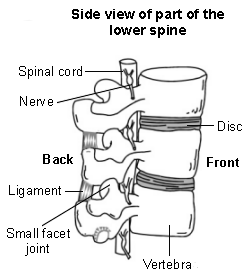
Strong ligaments also attach to nearby (adjacent) vertebrae to give extra support and strength to the spine. The various muscles that are attached to the spine enable the spine to bend and move in various ways.
The spinal cord, which contains the nerve pathways to and from the brain, is protected by the spine. Nerves from the spinal cord come out from between the vertebrae to take and receive messages to various parts of the body.
Patient picks for Limb weakness and numbness
Brain and nerves
Multiple sclerosis
Multiple sclerosis is a disorder of the brain and spinal cord. It can cause various symptoms. In most cases, episodes of symptoms come and go for several years. In time, some symptoms can become permanent and can cause disability. Although there is no cure for multiple sclerosis, various medicines and therapies may reduce the number of flare-ups and can help to ease symptoms and disability.
by Dr Hayley Willacy, FRCGP

Brain and nerves
Pins and needles
Numbness is a condition where you can't feel anything in part of your body, some describe it as a 'limb falling asleep'. Pins and needles are a tingling or numbness feeling or prickling sensation that is often felt in hands or feet. Usually this is due to pressure on nerves/nerve cells or the blood vessels that supply nerves. This often happens after you've been in an awkward position, like sitting cross-legged, or it may be the sign of a trapped nerve. Occasionally, it may be the sign of a more serious underlying problem such as diabetes. The most common causes are mentioned below.
by Dr Hayley Willacy, FRCGP
Frequently asked questions
Can I have cauda equina syndrome if I don't have back pain?
Yes, it is possible to have cauda equina syndrome without experiencing back pain. While low back pain can be a symptom, not all individuals with CES will have it.
How quickly do the symptoms of cauda equina syndrome usually appear?
The symptoms of cauda equina syndrome typically start suddenly and progress rapidly. However, in some cases, the symptoms can develop slowly.
What is the typical recovery process like after treatment for cauda equina syndrome?
Recovery after spinal decompression surgery for cauda equina syndrome is a gradual process. It can take several weeks or even months for the nerves to heal following treatment.
Can cauda equina syndrome cause sexual problems?
Yes, cauda equina syndrome can lead to changes in the ability to achieve an erection or ejaculate, as well as a loss of sensation in the genitals during sexual intercourse.
How is cauda equina syndrome usually confirmed after initial suspicion?
Once cauda equina syndrome is suspected, an emergency scan, typically an MRI scan, is required in a hospital to confirm the diagnosis. Other investigations like a CT scan or bladder control tests may also be used.
Further reading and references
- National Suspected Cauda Equina Syndrome (CES) Pathway; NHS Getting it Right First Time (GIRFT), October 2023.
- Tamburrelli FC, Genitiempo M, Bochicchio M, et al; Cauda equina syndrome: evaluation of the clinical outcome. Eur Rev Med Pharmacol Sci. 2014;18(7):1098-105.
- Ma B, Wu H, Jia LS, et al; Cauda equina syndrome: a review of clinical progress. Chin Med J (Engl). 2009 May 20;122(10):1214-22.
- Gitelman A, Hishmeh S, Morelli BN, et al; Cauda equina syndrome: a comprehensive review. Am J Orthop (Belle Mead NJ). 2008 Nov;37(11):556-62.
- Gardner A, Gardner E, Morley T; Cauda equina syndrome: a review of the current clinical and medico-legal position. Eur Spine J. 2011 May;20(5):690-7. doi: 10.1007/s00586-010-1668-3. Epub 2010 Dec 31.
- Woodfield J, Lammy S, Jamjoom AAB, et al; Demographics of Cauda Equina Syndrome: A Population-Based Incidence Study. Neuroepidemiology. 2022;56(6):460-468. doi: 10.1159/000527727. Epub 2022 Oct 31.
- Sciatica (lumbar radiculopathy); NICE CKS, September 2023 (UK access only)
About the authorView full bio

Dr Colin Tidy, MRCGP
General Practitioner, Medical Author
MBBS, MRCGP, MRCP (Paediatrics), DCH
Dr Colin Tidy is an NHS Doctor, based in Oxfordshire.
About the reviewerView full bio

Dr Doug McKechnie, MRCGP
Medical Writer
MA, MBBS, MSc, DRCOG, MRCP(UK), MRCGP(2021), FHEA
Dr Doug McKechnie is an NHS GP working in London. He works full-time clinically and is also the Deputy Lead for the Clinical and Professional Practice module at University College London Medical School.
Article history
The information on this page is written and peer reviewed by qualified clinicians.
Article also available in English, German, Spanish, French, Italian, Portuguese, Hindi, Hebrew, Arabic, and Swedish.
Next review due: 19 Jun 2027
20 Jun 2024 | Latest version
Join the conversation
Share your thoughts or experiences with others in our patient communities.

Ask, share, connect.
Browse discussions, ask questions, and share experiences across hundreds of health topics.

Feeling unwell?
Assess your symptoms online for free
Sign up to the Patient newsletter
Your weekly dose of clear, trustworthy health advice - written to help you feel informed, confident and in control.
By subscribing you accept our Privacy Policy. You can unsubscribe at any time. We never sell your data.
More in brain and nerves
- Absence seizures
- Bell's palsy
- Causes of memory loss and dementia
- Cerebral palsy
- Chronic tension headache
- Dyslexia
- Epilepsy
- Epilepsy and planning pregnancy
- Epilepsy medication and side-effects
- Foot drop
- Functional neurological disorder
- Idiopathic intracranial hypertension
- Migraine treatment
- Parkinson's disease
- Post-concussion syndrome
- Post-dural puncture headache
- Sudden unexpected death in epilepsy
- Tension headache
- Transient ischaemic attack
- Tremors