ألم الفخذ المذلي
مراجعة من قبل الدكتور كولين تايدي، MRCGPآخر تحديث بواسطة الدكتورة توني هازيل، زميلة الكلية الملكية للأطباء العامينآخر تحديث ١٥ سبتمبر ٢٠٢٣
يتوافق مع الإرشادات التحريرية
- تنزيلتنزيل
- مشاركة
- Language
- نقاش
- نسخة صوتية
- أضف إلى المصادر المفضلة على جوجل
Meralgia paraesthetica is a nerve (neurological) condition that causes pain in the outer thigh. It is caused by compression of a nerve called the lateral cutaneous nerve of the thigh. This nerve supplies feeling (sensation) to the outer thigh. In many cases, the cause is not known. Usually the condition improves with conservative (non-surgical) treatment - such as anti-inflammatories, painkillers or steroid injections.
نظرة سريعة
Meralgia paraesthetica is a nerve condition causing pain, numbness, or tingling in the outer thigh.
It is caused by compression or trapping of the lateral cutaneous nerve of the thigh.
Symptoms are often worse with standing or walking and better when lying down.
Risk factors include obesity, pregnancy, and ascites.
Treatment often involves non-surgical options like rest, weight loss, or painkillers.
What is meralgia paraesthetica?
Meralgia paraesthetica is a nerve (neurological) condition that causes an area of skin over the upper outer thigh to become painful, numb or tingly.
Meralgia paraesthetica is known as a nerve entrapment syndrome. This means it is a collection of symptoms caused by a trapped or compressed nerve. The trapped nerve in question is called the lateral cutaneous nerve of the thigh (also known as the lateral femoral nerve).
Meralgia paraesthetica symptoms
The most common symptoms are burning pain or numbness in the upper thigh, on the outer side. Children and younger people may just have pain that limits normal activities.
Other symptoms include altered sensation of that part of the thigh, or tingling/وخز وتنميل. Symptoms tend to be made worse by walking and standing but relieved by lying down with the hip flexed. (Hip flexion is movement of the leg towards your tummy (abdomen); this can be with your knee bent or straight - but on your back it is easiest to draw your bent knee up to your chest.)
Other reported symptoms include aching in the groin, pain in the buttocks and an area of skin that seems super-sensitive to heat and light touch (as opposed to firm pressure).
Meralgia paraesthetica causes
Most cases have no identifiable cause.
Meralgia paraesthetica can, however, be caused by direct injury to the lateral cutaneous nerve of the thigh accidentally. For example:
A seat belt injury from a car accident.
Inadvertently, during medical or surgical procedures - for example, keyhole (laparoscopic) hernia repairs.
Various sports and physical activities can be associated with meralgia paraesthetica. These include gymnastics, baseball, soccer, bodybuilding and strenuous exercise.
Rarer causes include a neuroma. Neuromas are non-cancerous (benign) growths (tumours) on a nerve. Pelvic or intra-abdominal tumours (including cancerous ones) could also compress the nerve and cause this problem. This is rare.
Other possible causes include lying down for long periods of time in a curled-up position. السكري can affect nerves in general and, although it would be unusual simply to have this one nerve affected, the lateral cutaneous nerve of the thigh could potentially be damaged by diabetes.
What is the lateral cutaneous nerve of the thigh?
Meralgia Paraesthetica
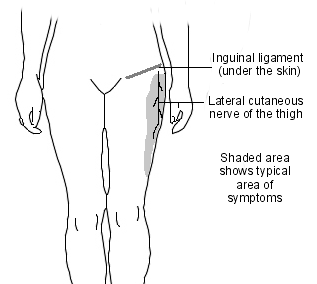
The lateral cutaneous nerve of the thigh is found in the upper leg. It provides sensation to an area of skin on the upper outer thigh. If this nerve is trapped or compressed, burning pain, numbness or tingling might be felt in the area of skin supplied by the nerve. These symptoms constitute meralgia paraesthetica.
The lateral cutaneous nerve of the thigh is a sensory nerve that supplies the skin. It starts off in the lower part of the spinal cord, in the lumbar region. It has to pass over the front of the hip bones and under the inguinal ligament before reaching the thigh. The inguinal ligament is a tough fibrous band in the groin. This is the site at which the nerve is most commonly compressed or trapped.
Who develops meralgia paraesthetica?
Anyone can develop meralgia paraesthetica. It is more common in men than in women. Generally it occurs between the ages of 30-40 years. It is much rarer in children.
Risk factors include obesity, pregnancy and ascites. Ascites is the term used for a tense swelling of the tummy (abdomen) due to fluid.
How common is meralgia paraesthetica?
Meralgia paraesthetica is a very uncommon condition. It most often affects people between the ages of 30-40 years. The condition is thought to be much rarer in children. It occurs more often in men than in women.
How is meralgia paraesthetica diagnosed?
A doctor can make the diagnosis based on your symptoms and examination of your body. The diagnosis is likely to be suspected if you have typical pain or sensory symptoms affecting the upper outer thigh. The condition can, occasionally, affect both sides at the same time (about 1 in 5 cases).
Examination might show altered sensation in the area of skin supplied by the lateral cutaneous nerve of the thigh. The pain can usually be provoked by getting you to extend your hip. Hip extension is the movement of the leg backwards. The main buttock muscle (gluteus maximus) tightens when you make this movement.
Because the lateral cutaneous nerve of the thigh is a sensory nerve, it affects feeling and sensation. It does not affect movement of the leg or hip. Your doctor will check to see that there is no weakness of the muscles - if there is, the diagnosis is not meralgia paraesthetica.
Do I need any investigations?
Often no investigations (such as blood tests, X-rays and scans) are needed for the diagnosis of meralgia paraesthetica. However, an الموجات فوق الصوتية may be used if there is concern that a mass in the pelvis is causing the symptoms.
Further tests may be done if an underlying problem or alternative diagnosis is suspected. If you have meralgia paraesthetica arising from an accident or injury (such as a pelvic fracture) then other tests will be needed.
In some cases, nerve conduction tests are performed if surgery for meralgia paraesthetica is planned. Nerve conduction tests look at the electrical activity running through a nerve. This is adversely affected if a nerve is compressed or trapped.
Meralgia paraesthetica treatment
Treatments can be grouped into conservative treatments (which are non-surgical) and surgical treatment (operations). In most cases, only conservative treatments are needed.
Examples of conservative treatments include:
Rest - meralgia paraesthetica is aggravated by standing and walking. Reduction in physical activity may be advised in severe cases. It may even be necessary to rest in bed.
فقدان الوزن - if obesity is thought to be the cause.
Physical therapies - manipulation, massage and stretching exercises sometimes help.
Painkillers (analgesics) - such as الباراسيتامول أو كودين.
الأدوية المضادة للالتهابات غير الستيرويدية (NSAIDs) - such as الإيبوبروفين, naproxen و ديكلوفيناك.
Corticosteroid injections - commonly referred to as steroid injections. A steroid and, usually some local anaesthetic, can be injected around the lateral cutaneous nerve to numb it and reduce inflammation.
Other medicines - sometimes medications are used that act as nerve painkillers. Some types of antidepressant medications (مضادات الاكتئاب ثلاثية الحلقات) such as أميتريبتيلين أو anticonvulsant drugs can be useful for nerve-related pain (also called neuralgia or ألم عصبي المنشأ). Examples of these drugs include gabapentin (brand name Neurontin®), pregabalin (brand name Lyrica®) و carbamazepine (brand name Tegretol®).
If you have meralgia paraesthetica it is also advisable to avoid tight clothing, such as belts or corsets, that presses on the upper thigh/hip area.
Surgical treatment involves taking the pressure off the nerve (surgical decompression) and releasing any entrapment.
What is the outlook (prognosis) for meralgia paraesthetica?
Generally, the prognosis is good. Often, the symptoms of pain and pins and needles resolve with time but sometimes the numbness and altered sensation can remain long-term. However, if there is a serious underlying cause of the entrapment (this is rare) then the prognosis will depend on the underlying cause.
اختيارات المرضى لـ ضعف الأطراف وخدرها

الدماغ والأعصاب
الضلع العنقي
About 1 in 100 people are born with an extra rib called a cervical rib. About 1 in 10 people who have a cervical rib develop thoracic outlet syndrome. This happens if the cervical rib squashes the nerves and blood vessels going into the arm. Treatment can include painkillers, physiotherapy and sometimes surgery to relieve the compression caused by, for example, a cervical rib.
بقلم الدكتور دوغ مكيتشني، MRCGP
الدماغ والأعصاب
مرض العصبون الحركي
Motor neurone disease (MND) is a neurological condition causes a progressive weakness and wasting of many of the muscles in the body. There are various types of motor neurone disease. This leaflet is mainly about amyotrophic lateral sclerosis (ALS), which is the most common type of motor neurone disease. Although there is no cure for motor neurone disease, treatments can help to ease symptoms and disability.
بقلم الدكتورة راشيل هدسون، MRCGP
الأسئلة الشائعة
Can meralgia paraesthetica affect both of my thighs at the same time?
Yes, meralgia paraesthetica can occasionally affect both sides of the body simultaneously. This occurs in about 1 in 5 cases.
If I have meralgia paraesthetica, does it mean I have muscle weakness in my leg?
No, if you have meralgia paraesthetica, it will not cause muscle weakness in your leg or hip. The lateral cutaneous nerve of the thigh is a sensory nerve, meaning it only affects feeling and sensation, not muscle movement. If there is muscle weakness, it suggests a different diagnosis.
Are there any specific exercises or physical activities that can help with meralgia paraesthetica?
Physical therapies such as manipulation, massage, and specific stretching exercises are sometimes helpful in managing meralgia paraesthetica symptoms.
What kind of non-surgical medications are used for meralgia paraesthetica if standard painkillers aren't enough?
If standard painkillers are not sufficient, other medications that act as nerve painkillers might be used. These can include certain types of antidepressant medications, such as tricyclic antidepressants like amitriptyline, or anticonvulsant drugs like gabapentin, pregabalin, and carbamazepine, which are useful for nerve-related pain.
قراءة إضافية ومراجع
- Treatment for meralgia paraesthetica; Cochrane Library, 2012
- Cheatham SW, Kolber MJ, Salamh PA; Meralgia paresthetica: a review of the literature. Int J Sports Phys Ther. 2013 Dec;8(6):883-93.
- Klauser AS, Abd Ellah MM, Halpern EJ, et al; Meralgia paraesthetica: Ultrasound-guided injection at multiple levels with 12-month follow-up. Eur Radiol. 2016 Mar;26(3):764-70. doi: 10.1007/s00330-015-3874-1. Epub 2015 Jun 21.
- Chopra PJ, Shankaran RK, Murugeshan DC; Meralgia paraesthetica: Laparoscopic surgery as a cause then and a cure now. J Minim Access Surg. 2014 Jul;10(3):159-60. doi: 10.4103/0972-9941.134883.
- Solomons JNT, Sagir A, Yazdi C; Meralgia Paresthetica. Curr Pain Headache Rep. 2022 Jul;26(7):525-531. doi: 10.1007/s11916-022-01053-7. Epub 2022 May 27.
عن المؤلفعرض السيرة الذاتية الكاملة

Dr Toni Hazell, FRCGP
بكالوريوس الطب والجراحة، بكالوريوس العلوم، زميل الكلية الملكية للأطباء العامين، دبلوم في الصحة الجنسية والإنجابية، دبلوم في طب الجهاز البولي التناسلي، دبلوم الكلية الملكية لأطباء النساء والتوليد، دبلوم في صحة الطفل (لندن، المملكة المتحدة، 2000)
تخرجت الدكتورة توني هازيل من كلية الطب بمستشفى سانت ماري وأكملت تدريبها في مستشفى نورثويك بارك.
حول المراجععرض السيرة الذاتية الكاملة

الدكتور كولين تايدي، MRCGP
طبيب عام، مؤلف طبي
MBBS, MRCGP, MRCP (Paediatrics), DCH
الدكتور كولين تايدي هو طبيب في هيئة الخدمات الصحية الوطنية، ويعمل في أوكسفوردشاير.
تاريخ المقال
تمت كتابة المعلومات على هذه الصفحة ومراجعتها من قبل أطباء مؤهلين.
المقال متاح أيضًا باللغة الإنجليزية, الألمانية, إسبانية, الفرنسية, إيطالي, البرتغالية, الهندية, العبرية, العربية ,، و السويدية.
المراجعة التالية مستحقة: 13 سبتمبر 2028
١٥ سبتمبر ٢٠٢٣ | أحدث إصدار

اسأل، شارك، تواصل.
تصفح المناقشات، اطرح الأسئلة، وشارك التجارب عبر مئات المواضيع الصحية.

هل تشعر بتوعك؟
قم بتقييم أعراضك عبر الإنترنت مجانًا
اشترك في النشرة الإخبارية للمرضى
جرعتك الأسبوعية من النصائح الصحية الواضحة والموثوقة - مكتوبة لمساعدتك على الشعور بالاطلاع والثقة والتحكم.
من خلال الاشتراك، فإنك تقبل سياسة الخصوصية. يمكنك إلغاء الاشتراك في أي وقت. نحن لا نبيع بياناتك أبدًا.
المزيد في الدماغ والأعصاب
- الرجفان الأذيني والوقاية من السكتة الدماغية
- متلازمة ذيل الفرس
- الضمور العضلي السكري
- الاعتلال العصبي السكري
- تخطيط كهربية الدماغ
- الصرع وتخطيط الحمل
- الرعاش الأساسي
- صداع
- تشنج نصف الوجه
- ارتفاع ضغط الدم داخل الجمجمة مجهول السبب
- الصداع النصفي
- ضعف العضلات
- دراسات توصيل الأعصاب
- تلف الأعصاب بعد حقن فوق الجافية
- ورم الأرومة العصبية
- الاعتلال العصبي المحيطي
- تلعثم
- النوبات التوترية الرمعية
- متلازمة توريت
- النوبة الإقفارية العابرة