مرض بوين
مراجعة من قبل الدكتورة هايلي ويلاسي، زميلة الكلية الملكية للأطباء العامين آخر تحديث بواسطة الدكتور كولين تايدي، MRCGPآخر تحديث 17 يناير 2023
يتوافق مع الإرشادات التحريرية
- تنزيلتنزيل
- مشاركة
- Language
- نقاش
- نسخة صوتية
- أضف إلى المصادر المفضلة على جوجل
المهنيين الطبيين
تم تصميم مقالات المراجع المهنية لاستخدامها من قبل المتخصصين في الرعاية الصحية. يتم كتابتها بواسطة أطباء من المملكة المتحدة وتستند إلى أدلة بحثية وإرشادات المملكة المتحدة وأوروبا. قد تجد مرض بوين مقالة أكثر فائدة، أو واحدة من مقالاتنا الأخرى مقالاتنا الصحية.
Synonym: squamous cell carcinoma in situ
ما هو مرض بوين؟
Bowen's disease is a form of intraepidermal (in situ) squamous cell carcinoma (SCC) of the skin. It was first described by John Bowen in 1912. Bowen's disease arises in the outer layers of the epidermis and the risk of progression to invasive SCC is relatively low at about 3% for typical cases.
How common is Bowen's disease? (Epidemiology)1
The incidence in the UK is estimated at around 15 per 100,000 per year but this is based on data from the USA. Incidence is highest in white people living in areas of high sunlight exposure.
It is more common in women (70-85% of cases) than in men.2
It most commonly appears between the ages of 60 and 70 years.
عوامل الخطر
Sun damage: exposure to sunlight (especially with fair skin) is a strong risk factor.
Other irradiation damage: radiotherapy, photochemotherapy, sunbeds.
Carcinogens: particularly arsenic. Exposure to inorganic arsenic is less common than in the past. Arsenic used to be found in Fowler's solution (used to treat psoriasis) and in Gay's solution (used to treat asthma). It has been banned from pesticides in developed countries but it is still found in contaminated well water and in foods grown on contaminated soil in developing countries.3
Viral infection: there is a strong association with human papillomavirus (HPV), particularly in genital and perianal lesions and in lesions on the hands and feet. (Often HPV-16 but several other HPV types have been implicated.)4
تثبيط المناعة: therapeutic following organ transplants, or due to الإيدز. Malignant and premalignant skin tumours are more common in patients who have received organ transplants. The risk may depend on the immunosuppressive regime used.5 The literature also contains a number of reports of Bowen's disease, quite often extensive, in patients with AIDS.6 7
Chronic skin injury or dermatoses: rarely, it arises in pre-existing skin lesions such as seborrhoeic warts.
Bowen's disease symptoms
It presents as a slowly growing erythematous, hyperkeratotic patch or plaque with an irregular border. It is sharply demarcated, scaling with a pink or red surface. There may be a small erosion or it may be crusted. It may reach a few centimetres in size.
The size of a lesion is directly related to its duration.
Lesions are usually asymptomatic but can bleed.
Lesions are usually solitary but in 10-20% of cases there are multiple lesions.8
They are most commonly found in sun-exposed areas: on the lower limbs in the UK (60-85%) or head and neck in Australia (44%), Denmark (40-59%) and the USA (66%). It is not known why there is a variation in the body site affected across different countries.8
Other locations are subungual, periungual, palmar, genital or perianal. When it arises on the mucosal surfaces of the glans penis, it is referred to as erythroplasia of Queyrat (EQ). Some vulval lesions also have features of Bowen's disease.9
Bowen's Disease
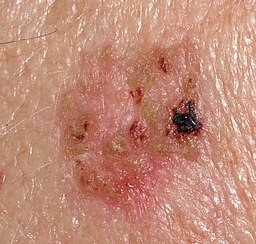
© Klaus D. Peter, Gummersbach, Germany, CC BY 3.0 DE, via Wikimedia Commons
التشخيص التفريقي
A characteristic feature is that it is well demarcated.
الأكزيما القرصية, other forms of eczema.
Superficial سرطان الخلايا القاعدية.
التحقيقات1
Bowen's disease is often diagnosed clinically, possibly with the additional use of a dermatoscope. If there is any doubt, a punch biopsy is required for histological diagnosis.
Bowen's disease treatment1 8
There is no definitive treatment for Bowen's disease; all therapeutic options have failure and recurrence rates in the order of 5-10%.10 The age of the patient and the number, size and location of the lesion(s) will all influence the choice of treatment. The advantages and disadvantages of the various options available should be discussed with the patient. In some situations (for example, when there is a small lesion on the shin of an elderly person where healing is poor), observation may be the best treatment.
Surgery is the most common treatment and topical treatments are the most widely available.
العلاجات الموضعية
Topical 5-fluorouracil (5-FU) cream is a cytotoxic agent and is one of the first-line therapies available. It may be as effective as photodynamic therapy and is a practical choice for large lesions, especially in areas of poor healing. It may be more effective when preceded by laser therapy or cryotherapy. It can also be used under occlusion or with iontophoresis, where an electrical current improves follicular penetration.
Imiquimod 5% cream is an immune response modifying agent. It appears to be an effective treatment for Bowen's disease, although it is not currently licensed in the UK for this purpose and there are no studies comparing it with other treatments. It causes significant scaling and inflammation.
العلاج بالتبريد
Liquid nitrogen is used to freeze the lesion. Different techniques and regimes are used and the efficacy is operator-dependent; however, it is a simple, quick and effective treatment and often first-line therapy.
الجراحة
Curettage with cautery: abnormal skin is scraped off under local anaesthetic and any additional tissue destroyed with electrocautery. It is simple, safe and cost-effective. It is preferable to cryotherapy in terms of pain, healing and recurrence rates
Surgical excision is simple, quick and effective although may not be suitable for some parts of the body. A 5 mm resection margin is recommended.10
Mohs' microsurgery is used in areas such as fingers, nails or the penis where tissue-sparing techniques are required: frozen sections from successive layers are examined until complete clearance of the surgical margin is achieved.
Photodynamic therapy (PDT)11
PDT is the most studied treatment for Bowen's disease. It is valuable particularly when treating large lesions. It is better tolerated and produces better cosmesis than cryotherapy and there is no difference in recurrence rates when compared with 5-FU.8
The lesion is prepared by removing scaly, crusty areas and then a photosensitising cream is applied. This is covered and left for a few hours, then uncovered and exposed to a light source which burns away the sensitised area. It may be painful.
العلاج الإشعاعي
Various radiotherapy techniques are used in areas unsuitable for other treatment options.
التكهن
This is excellent, especially with treatment. Untreated, 3% progress to invasive SCC; however, metastases are rare. The risk of progression of Bowen's disease of the penis is higher - possibly 10%. There is no association between Bowen's disease and internal malignancies.8
Bowens' disease should be seen as a risk marker for other non-melanoma skin cancer (NMSC); a third of patients will have another NMSC at the time of diagnosis and patients with Bowen's disease are 4.3 times more likely to develop NMSC in the future, most likely due to the common aetiology of ultraviolet (UV) light. Patients should therefore be followed up; however, there is no definitive guidance on the follow-up regime and it should be guided by the risk factors in the individual.
Prevention of Bowen's disease
The risk of Bowen's disease is reduced by sun-protective behaviour, ie limiting UV exposure, wearing sun-protective clothing outdoors, avoiding the mid-day sun, routine use and reapplication of broad-spectrum sunscreen and avoidance of sunbeds.
Organ transplant recipients in particular should avoid sun exposure and use sunscreen.12
تحديثات حصرية لمتخصصي الرعاية الصحية
ابقَ على اطلاع بأحدث التحديثات السريرية، والرؤى المهنية، والإرشادات المستندة إلى الأدلة. تقوم نشرة Patient Pro الإخبارية بتجميع محتوى أساسي لمتخصصي الرعاية الصحية - يتم تسليمه مباشرة إلى بريدك الوارد.
من خلال الاشتراك، فإنك تقبل سياسة الخصوصية. يمكنك إلغاء الاشتراك في أي وقت. نحن لا نبيع بياناتك أبدًا.
قراءة إضافية ومراجع
- مرض بوين - غير تناسلي; ديرم نت نيوزيلندا
- Bowen's Disease of Penis; ديرم نت نيوزيلندا
- Bowen's Disease of Vulva; ديرم نت نيوزيلندا
- Morton CA, Birnie AJ, Eedy DJ; British Association of Dermatologists' guidelines for the management of squamous cell carcinoma in situ (Bowen's disease) 2014. Br J Dermatol. 2014 Feb;170(2):245-60. doi: 10.1111/bjd.12766.
- مرض بوين; جمعية الأمراض الجلدية للرعاية الأولية (PCDS)
- Chung JY, Yu SD, Hong YS; Environmental source of arsenic exposure. J Prev Med Public Health. 2014 Sep;47(5):253-7. doi: 10.3961/jpmph.14.036. Epub 2014 Sep 11.
- Gormley RH, Kovarik CL; Dermatologic manifestations of HPV in HIV-infected individuals. Curr HIV/AIDS Rep. 2009 Aug;6(3):130-8.
- Tessari G, Girolomoni G; Nonmelanoma skin cancer in solid organ transplant recipients: update on epidemiology, risk factors, and management. Dermatol Surg. 2012 Oct;38(10):1622-30. doi: 10.1111/j.1524-4725.2012.02520.x. Epub 2012 Jul 17.
- Sharma R, Iyer M; Bowen's disease of the nipple in a young man with AIDS: a case report. Clin Breast Cancer. 2009 Feb;9(1):53-5.
- Kaushal S, Merideth M, Kopparthy P, et al; Treatment of multifocal Bowen's disease in immunocompromised women with surgery and topical imiquimod. Obstet Gynecol. 2012 Feb;119(2 Pt 2):442-4. doi: 10.1097/AOG.0b013e318236f1a0.
- Bath-Hextall FJ, Matin RN, Wilkinson D, et al; التدخلات لعلاج مرض بوين الجلدي. قاعدة بيانات كوكرين للمراجعات المنهجية. 24 يونيو 2013؛ (6): CD007281. doi: 10.1002/14651858.CD007281.pub2.
- Neubert T, Lehmann P; Bowen's disease - a review of newer treatment options. Ther Clin Risk Manag. 2008 Oct;4(5):1085-95.
- Westers-Attema A, van den Heijkant F, Lohman BG, et al; Bowen's disease: A six-year retrospective study of treatment with emphasis on resection margins. Acta Derm Venereol. 2014 Jul;94(4):431-5. doi: 10.2340/00015555-1771.
- العلاج الضوئي الديناميكي لأورام الجلد غير الميلانينية (بما في ذلك الآفات الجلدية ما قبل الخبيثة والأولية غير المنتشرة); إرشادات الإجراءات التدخلية من NICE، فبراير 2006
- Mihalis EL, Wysong A, Boscardin WJ, et al; Factors affecting sunscreen use and sun avoidance in a U.S. national sample of organ transplant recipients. Br J Dermatol. 2013 Feb;168(2):346-53. doi: 10.1111/j.1365-2133.2012.11213.x.
عن المؤلفعرض السيرة الذاتية الكاملة

الدكتور كولين تايدي، MRCGP
طبيب عام، مؤلف طبي
MBBS, MRCGP, MRCP (Paediatrics), DCH
الدكتور كولين تايدي هو طبيب في هيئة الخدمات الصحية الوطنية، ويعمل في أوكسفوردشاير.
حول المراجععرض السيرة الذاتية الكاملة

الدكتورة هايلي ويلاسي، زميلة الكلية الملكية للأطباء العامين
طبيب عام، مؤلف طبي
MBChB (1992), DRCOG, DFFP, MRCOG (Part 1) MRCGP (2007), DFSRH (2013), MSc - medical education (2020)
كانت الدكتورة هايلي ويلاسي طبيبة عامة في هيئة الخدمات الصحية الوطنية تعمل في شمال غرب إنجلترا، وتقاعدت من الممارسة السريرية في عام 2022 بعد 30 عامًا.
تاريخ المقال
تمت كتابة المعلومات على هذه الصفحة ومراجعتها من قبل أطباء مؤهلين.
المقال متاح أيضًا باللغة الإنجليزية, الألمانية, إسبانية, الفرنسية, إيطالي, البرتغالية, الهندية, العبرية, العربية ,، و السويدية.
المراجعة التالية مستحقة: 16 يناير 2028
17 يناير 2023 | أحدث إصدار
آخر تحديث بواسطة
الدكتور كولين تايدي، MRCGPمراجعة من قبل
الدكتورة هايلي ويلاسي، زميلة الكلية الملكية للأطباء العامين

اسأل، شارك، تواصل.
تصفح المناقشات، اطرح الأسئلة، وشارك التجارب عبر مئات المواضيع الصحية.

هل تشعر بتوعك؟
قم بتقييم أعراضك عبر الإنترنت مجانًا
المزيد في الأمراض الجلدية
- الظواهر التحسسية
- الوذمة الوعائية
- الأمراض الجلدية الفقاعية
- التهاب الغضروف الجلدي العقيدي
- التهاب الجريبات
- عدوى الأظافر الفطرية
- مرض دودة غينيا
- الصدفية النقطية
- Halo naevus
- فرط التعرق
- داء الفيلاريات اللمفي
- البورفيريا
- الصدفية في اليدين والقدمين
- التهاب المفاصل الصدفي
- مرض صدفية الأظافر
- الحمى القرمزية
- التهاب الجلد الدهني
- ثؤلول دهني
- التجليات الجلدية للأمراض الجهازية
- حروق الشمس