سعفة الجلد
Tinea infections
مراجعة من قبل الدكتورة فيليبا فينسنت، MRCGPآخر تحديث بواسطة الدكتور دوغ مكيتشني، MRCGPآخر تحديث ٢٧ فبراير ٢٠٢٥
يتوافق مع الإرشادات التحريرية
- تنزيلتنزيل
- مشاركة
- Language
- نقاش
- Ask Patient
- نسخة صوتية
- أضف إلى المصادر المفضلة على جوجل
المهنيين الطبيين
تم تصميم مقالات المراجع المهنية لاستخدامها من قبل المتخصصين في الرعاية الصحية. يتم كتابتها بواسطة أطباء من المملكة المتحدة وتستند إلى أدلة بحثية وإرشادات المملكة المتحدة وأوروبا. قد تجد العدوى الفطرية مقالة أكثر فائدة، أو واحدة من مقالاتنا الأخرى مقالاتنا الصحية.
What is dermatophytosis?1
Dermatophytosis (tinea) infections are fungal infections caused by dermatophytes - a group of fungi that invade and grow in dead keratin. Several species commonly invade human keratin and these belong to the Epidermophyton, Microsporum و Trichophyton genera. They tend to grow outwards on skin, producing a ring-like pattern - hence the term 'ringworm'. They are very common and affect different parts of the body. They can usually be successfully treated but success depends on the site of infection and on compliance with treatment.
انظر إلى القسم المنفصل سعفة الرأس, عدوى الأظافر الفطرية, النخالية المبرقشة و داء المبيضات مقالات.
علم الأمراض23
Infection is limited to the dead layers of skin but encouraged by a damp and warm local environment.
The infection can be transmitted to humans by anthropophilic (between people), geophilic (from soil) and zoophilic (from animals) spread.
The most common organisms are:
Trichophytons rubrum, Trichophytons tonsurans, Trichophytons interdigitale و Trichophytons mentagrophytes.
Microsporum canis.
Epidermophyton floccosum.
Clinical classification is according to site:
Scalp - tinea capitis.
Feet - tinea pedis.
Hands - tinea manuum.
Nail - tinea unguium (or onychomycosis).
Beard area - tinea barbae.
Groin - tinea cruris.
Body including trunk and arms - tinea corporis.
How common is dermatophytosis? (Epidemiology)
Infection is very common all over the world. Some types are more common than others, with tinea pedis being most common in adults and tinea capitis the most common in children. Onychomycosis is also extremely common.
Dermatophytosis symptoms (presentation)2
التاريخ
Itching, rash and nail discolouration are the most common symptoms of tinea infection.
Hair loss occurs with tinea capitis (mainly a disease of children).
Complications such as secondary infection (cellulitis and impetigo) can lead to symptoms.
It is common in people who play contact sports.
It occurs in immunocompromised patients.
الفحص
Tinea pedis:4
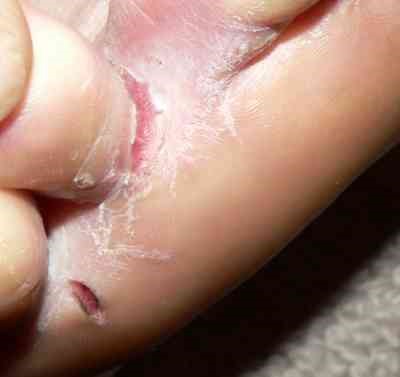
It particularly affects the web of the toe where skin may be macerated and erythematous.
It commonly affects the plantar surface of the foot. Erythema, vesicles and pustules can occur.
سعفة القدم - بين الأصابع
It can cause hair loss with broken hairs at the surface (as distinct from alopecia areata).
Clinical appearance is variable, including scaly, crusting, pustules and/or black dot alopecia.
Tinea unguium (onychomycosis):6
Onycholysis or separation of the nail from the nail bed commonly occurs.
Nail dystrophy with thickening and discolouration of the nail develops.
Tinea corporis:7
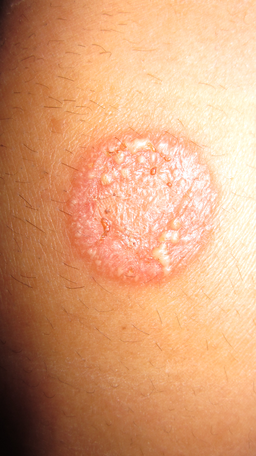
The skin lesions have annular scaly plaques with raised edges.
There may be vesicles and pustules.
Typically lesions are on exposed skin of the trunk, arms and legs (see 'Differential diagnosis', below).
More unusually the lesions can appear as overlapping concentric circles (tinea imbricate) or even herpetiform subcorneal vesicles or pustules (bullous tinea corporis).
تينيا الجسم
Tinea manuum:
Usually with tinea pedis.
Typically just affects one hand.
Scaling and redness are prominent.
Incorrect diagnosis and use of steroid may eventually exacerbate the infection.
Tinea cruris:8
Usually occurs in men.
Often tolerated for some time before presentation.
Typically erythematous with central clearing and raised edge.
Tinea barbae:9
Affects the beard area.
Redness, scaling and pustules are common.
التشخيص التفريقي7
Other annular rashes are often confused with tinea infections. الأكزيما و الصدفية are commonly confused with tinea. Pityriasis versicolor occurs all over the trunk while candida occurs as a flexural rash at extremes of age or in the immunocompromised, those with diabetes or patients on antibiotics.
Treatment with topical steroids often causes confusion, making tinea less scaly and more erythematous. Steroid use also makes the 'active' edge and the inactive centre less distinct (tinea incognito). Clinically the diagnosis can be difficult but, if it is a possibility, take scrapings for mycology. Other fungal infections look nothing like tinea. Other conditions to consider include:
Intertrigo.
Erythrasma.
Diagnosing dermatophytosis (investigations)10
Microscopy of skin and nail specimens may reveal hyphae and spores.
Fungal culture can identify the species but is not always reliable and it can take six weeks to obtain results.
Ultraviolet light (Wood's light) is useful for tinea capitis especially. Fluorescence is produced by the fungus. Fluorescence is not seen with tinea corporis or tinea cruris.
Rarely, a biopsy may be needed if the case is atypical or not responding to treatment.
الأمراض المرتبطة
Diabetes, immunocompromised states, atopy and متلازمة كوشينغ have all been associated with fungal infections.
Management of dermatophytosis45610
Offer advice on hygiene measures:
Keep affected skin cool and dry.
Wear cotton, absorbent clothing.
Avoid scratching affected skin.
After washing, dry thoroughly.
Do not share towels, and wash frequently, to reduce the risk of transmission.
Cover feet in communal bathing pools, changing areas and gymnasiums if feet are affected.
Continue school and sporting activities.
انظر إلى القسم المنفصل الأدوية المضادة للفطريات مقالة.
Topical agents containing a corticosteroid are not usually necessary. They may be used if there is a lot of skin inflammation. They should be used for a week only.
Referral may be needed if diagnosis is in doubt.
Complications of dermatophytosis
Secondary bacterial infection may occur. Hair loss is a complication of tinea capitis. Pain and difficulty with shoes can result from onychomycosis.
A dermatophytid (id) reaction may occur, especially after initiation of systemic antifungal treatment. This is thought to be a type IV hypersensitivity response, and causes a widespread pruritic rash, with papules, maculopapules, papulovesicles, or pustules at sites distinct from that of the original dermatophyte infection.11
Scarring is uncommon but more likely in people with pigmented skin. Scarring usually fades with time. Skin protection such as using a moisturiser cream and sunscreen can be helpful. Extensive or severe scarring may need further treatment, such as using laser therapy.
Dermatophytosis prognosis
Excellent with good compliance and subsequent precautions to avoid repeat infection.
Prevention of dermatophytosis
Good skin hygiene.
Good nail hygiene.
Avoiding prolonged wetting or dampness of the skin and feet.
Avoiding trainers, which can retain sweat and promote a warm, moist environment.
Treatment of tinea pedis - helps prevent onychomycosis.6
Wearing clean, loose-fitting underwear.
تحديثات حصرية لمتخصصي الرعاية الصحية
ابقَ على اطلاع بأحدث التحديثات السريرية، والرؤى المهنية، والإرشادات المستندة إلى الأدلة. تقوم نشرة Patient Pro الإخبارية بتجميع محتوى أساسي لمتخصصي الرعاية الصحية - يتم تسليمه مباشرة إلى بريدك الوارد.
من خلال الاشتراك، فإنك تقبل سياسة الخصوصية. يمكنك إلغاء الاشتراك في أي وقت. نحن لا نبيع بياناتك أبدًا.
قراءة إضافية ومراجع
- Dermatophytide reactions; ديرم نت نيوزيلندا
- Sahoo AK, Mahajan R; Management of tinea corporis, tinea cruris, and tinea pedis: A comprehensive review. Indian Dermatol Online J. 2016 Mar-Apr;7(2):77-86. doi: 10.4103/2229-5178.178099.
- Ely JW, Rosenfeld S, Seabury Stone M; Diagnosis and management of tinea infections. Am Fam Physician. 2014 Nov 15;90(10):702-10.
- Martinez DA, Oliver BG, Graser Y, et al; Comparative genome analysis of Trichophyton rubrum and related dermatophytes reveals candidate genes involved in infection. MBio. 2012 Sep 4;3(5):e00259-12. doi: 10.1128/mBio.00259-12. Print 2012.
- The Cutaneous Mycoses; Mycology Online
- Hainer BL; Dermatophyte infections. Am Fam Physician. 2003 Jan 1;67(1):101-8.
- عدوى فطرية في الجلد - القدم; NICE CKS، يونيو 2023 (الوصول متاح فقط في المملكة المتحدة)
- عدوى فطرية في الجلد - فروة الرأس; NICE CKS، يونيو 2023 (الوصول متاح فقط في المملكة المتحدة)
- عدوى فطرية في الأظافر; NICE CKS، أغسطس 2023 (الوصول متاح فقط في المملكة المتحدة)
- عدوى فطرية في الجلد - الجسم والفخذ; NICE CKS، يوليو 2023 (الوصول متاح فقط في المملكة المتحدة)
- Tinea Cruris; ديرم نت نيوزيلندا
- Tinea barbae; ديرم نت نيوزيلندا
- Fungal Skin and Nail Infections: Diagnosis and Laboratory Investigation - Quick Reference Guide for Primary Care; GOV.UK, 2017
- Leung AK, Lam JM, Leong KF, et al; Tinea corporis: an updated review. Drugs Context. 2020 Jul 20;9:2020-5-6. doi: 10.7573/dic.2020-5-6. eCollection 2020.
عن المؤلفعرض السيرة الذاتية الكاملة
تم التحديث بواسطة

الدكتور دوغ مكيتشني، MRCGP
كاتب طبي
MA, MBBS, MSc, DRCOG, MRCP(UK), MRCGP(2021), FHEA
الدكتور دوغ مكيتشني هو طبيب عام في هيئة الخدمات الصحية الوطنية يعمل في لندن. يعمل بدوام كامل في المجال السريري وهو أيضًا نائب رئيس وحدة الممارسة السريرية والمهنية في كلية الطب بجامعة كوليدج لندن.
حول المراجععرض السيرة الذاتية الكاملة

الدكتورة فيليبا فينسنت، MRCGP
طبيب عام، مؤلف طبي
MB BS, Bsc, MRCGP (2000), DCH, DFSRH, DRCOG
الدكتورة فيليبا فينسنت هو طبيب عام في هيئة الخدمات الصحية الوطنية يعمل في شمال لندن.
تاريخ المقال
المقال متاح أيضًا باللغة الإنجليزية, الألمانية, إسبانية, الفرنسية, إيطالي, البرتغالية, الهندية, العبرية, العربية ,، و السويدية.
المراجعة التالية مستحقة: 26 فبراير 2028
٢٧ فبراير ٢٠٢٥ | أحدث إصدار
وصول بسيط إلى العلاجات والخدمات الصحية الموثوقة عبر الإنترنت.
Common conditions
Get help with common conditions through the NHS, without a GP appointment.
 التهاب الجيوب الأنفية الحاد
 التهاب اللوزتين البكتيري
 القوباء
 لدغات الحشرات
 الحزام الناريعدوى المسالك البولية
المزيد في الأمراض الجلدية
- الوذمة الوعائية
- التهاب الحشفة
- وحمة بيكر
- بق الفراش
- وحمة زرقاء
- إصابة البرد
- الوذمة الوعائية الوراثية
- التهاب الغدد العرقية القيحي
- فرط التعرق
- حكة
- الحزاز المسطح
- مرض النسيج الضام المختلط
- المليساء المعدية
- تقنيات خزعة الجلد في الممارسة العامة
- متلازمة الجلد المسموط العنقودية
- حروق الشمس
- تصلب الجلد الجهازي
- الفرفرية القليلة الصفيحات التخثرية
- انحلال البشرة السمي
- متلازمة الظفر الأصفر