الفتوق الإربية
مراجعة من قبل الدكتورة توني هازيل، زميلة الكلية الملكية للأطباء العامينآخر تحديث بواسطة الدكتورة فيليبا فينسنت، MRCGPآخر تحديث 1 Oct 2026
يتوافق مع الإرشادات التحريرية
- تنزيلتنزيل
- مشاركة
- Language
- نقاش
- Ask Patient
- نسخة صوتية
- أضف إلى المصادر المفضلة على جوجل
المهنيين الطبيين
تم تصميم مقالات المراجع المهنية لاستخدامها من قبل المتخصصين في الرعاية الصحية. يتم كتابتها بواسطة أطباء من المملكة المتحدة وتستند إلى أدلة بحثية وإرشادات المملكة المتحدة وأوروبا. قد تجد فتق مقالة أكثر فائدة، أو واحدة من مقالاتنا الأخرى مقالاتنا الصحية.
What is an inguinal hernia?
An abdominal hernia comprises a protrusion of abdominal contents through the fascia of the abdominal wall; an inguinal hernia is where this protrudes through the internal inguinal ring. Hernias contain a portion of peritoneal sac and may contain viscera, usually small bowel and omentum.
فتق أربي
Inguinal hernia epidemiology
Inguinal hernias are common, making up 75% of all abdominal hernias.
Inguinal hernias are more common in men (the lifetime risk of an inguinal hernia is 27-43% in men and 3-6% in women).1 Although they are much more common in men, women with a groin hernia are still more likely to have an inguinal than a femoral hernia.2
As well as male sex, risk factors include increasing age (although there is also a significant spike in cases below the age of 5 years) and a genetic predisposition.2
Other risk factors are thought to include: smoking, chronic obstructive pulmonary disease, lower body mass index, high intrabdominal pressure, thoracic or abdominal aortic aneurysm, patent processes vaginalis, history of open appendectomy, peritoneal dialysis, and collagen vascular disease.2
Inguinal hernia presentation
An inguinal hernia will usually present as a swelling in the groin that may appear with lifting and be accompanied by sudden pain.
There may be a cough impulse. The hernia may not be visible when lying flat but may appear on standing.
The hernia may be reducible.
Indirect hernias can cause pain in the scrotum and cause a 'dragging sensation'.
Congenital inguinal hernias are usually detected at birth and all need urgent outpatient referral for surgical repair.
Inguinal hernias in older children and adults usually develop gradually but can occur suddenly with an episode of heavy lifting:
At first appearance, a hernia is usually easily reducible when the patient reclines. However, it may require manual replacement if large.
With time, the hernia enlarges and becomes harder to replace, due to fibrous adhesions forming.
When it can no longer be reduced, it is irreducible or incarcerated. This can occur at any time, as can strangulation. This occurs when visceral contents of the hernia become twisted or entrapped by the narrow opening. This compromises the blood supply, causing swelling and eventually infarction. Strangulation usually leads to bowel obstruction.
There are two types of inguinal hernia:
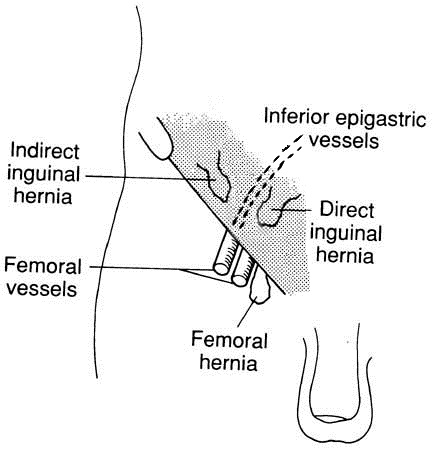
Indirect: a protrusion through the internal inguinal ring passes along the inguinal canal through the abdominal wall, running laterally to the inferior epigastric vessels. This is the more common form accounting for 80% of inguinal hernias, especially in children. It is associated with failure of the inguinal canal to close properly after passage of the testis in utero or during the neonatal period.
Direct: the hernia protrudes directly through a weakness in the posterior wall of the inguinal canal, running medially to the inferior epigastric vessels. It is more common in the elderly and rare in children.
تقييم3
Examine the patient both standing and lying and ask them to cough or strain.
Insert a finger through the top of the scrotum into the external inguinal ring and palpate for a lump when coughing - cough impulse.
Sliding hernias are probable with large scrotal hernias.
التشخيص التفريقي
انظر أيضًا إلى القسم المنفصل كتل في الفخذ وكيس الصفن مقالة.
القيلة المائية (when differentiating from an inguinoscrotal hernia, note that it is possible to get above a hydrocele on examination).
Spermatic cord hydrocele.
Lymph node swelling.
Abscess.
Saphena varix.
نزيف.
التحقيقات
Whilst most specialists agree that imaging is not necessary to make the diagnosis, in the UK there are often local constraints on referrals for hernia repair which mean that the diagnosis needs to be confirmed by imaging. Ultrasound scan is the imaging option of choice.34
Inguinal hernia treatment and management
البالغين5 2
If the inguinal hernia is small, the patient may only need reassurance. There is good recent evidence that "watchful waiting" is a safe option for many adults with inguinal hernias. Long-term follow-up of these patients suggests that around 68% proceed to surgical management eventually, usually due to worsening pain or lifestyle limitations from progression.2
Patients with pain, reduced mobility or other symptoms should be offered surgical management. Many patients with chronically incarcerated hernias may be asymptomatic but patients with obstruction or strangulation are a surgical emergency.
However, there is always the chance of it becoming a surgical emergency through obstruction and incarceration. Episodes of pain and tenderness suggest the need for urgent treatment but when these become prolonged and severe then emergency surgery is indicated for possible strangulation. The fundamentals of indirect inguinal hernia treatment are the same regardless of the patient's age. Reduction or excision of the sac and closure of the defect with minimal tension are the essential steps in any hernia repair.
Surgical guidelines recommend tailoring the choice of surgery to individual patient factors. Surgical options include either an open (tissue- or mesh-based) procedure or a minimally invasive (laparoscopic or robotic) procedure.
An open repair with mesh is associated with a 50%-75% lower risk of hernia recurrence, lower risk of chronic pain post-operatively, and an earlier return to work compared with a sutured repair. A tissue (sutured) repair is usually used where mesh is contraindicated, for example where there may be potential for infection from a contaminated field. Laparoscopic repair is recommended for bilateral inguinal hernias as the same port sites can be used.
Studies have shown no significant difference between mesh, laparoscopic and robotic procedures in terms of post-operative haematoma, surgical site infection, urinary retention, or hospital length of stay. However post-operative chronic pain appears to be lower in patients who have undergone laparoscopic procedures, though studies have been of questionable quality.
Inguinal hernias in children
The incidence of incarcerated or strangulated hernias in paediatric patients is higher than in adults, at around 7-11%.6 It is higher in infants than in older children. The risk increases with waiting time from diagnosis to procedure.67
Surgical repair is usually recommended as early as possible in paediatric patients because of these risks.
Laparoscopic repair has been shown to have better outcomes than open repair though both have low risks of complications.8910
المضاعفات
تشمل هذه الأشياء:
Post-operative chronic pain is reported to occur in between 8 and 16% of patients, though laparoscopic repair appears to reduce the risk.2
Recurrence: 1.0% - most happening within five years of operation. Recurrence rate increases:
In children aged younger than 1 year.
In elderly patients.
After incarcerations.
In those with ongoing increased intra-abdominal pressure.
Where there is growth failure.
With prematurity.
Where there are chronic respiratory problems.
In girls with sliding hernias.
Infarcted testis or ovary with atrophy.
عدوى الجرح.
Bladder injury.
Intestinal injury.
A hydrocele from fluid accumulation in the distal sac usually resolves spontaneously but sometimes requires aspiration.
التكهن
This is generally very good, depending on comorbidity.
تحديثات حصرية لمتخصصي الرعاية الصحية
ابقَ على اطلاع بأحدث التحديثات السريرية، والرؤى المهنية، والإرشادات المستندة إلى الأدلة. تقوم نشرة Patient Pro الإخبارية بتجميع محتوى أساسي لمتخصصي الرعاية الصحية - يتم تسليمه مباشرة إلى بريدك الوارد.
من خلال الاشتراك، فإنك تقبل سياسة الخصوصية. يمكنك إلغاء الاشتراك في أي وقت. نحن لا نبيع بياناتك أبدًا.
قراءة إضافية ومراجع
- Jorgenson E, Makki N, Shen L, et al; A genome-wide association study identifies four novel susceptibility loci underlying inguinal hernia. Nat Commun. 2015 Dec 21;6:10130. doi: 10.1038/ncomms10130.
- Gudigopuram SVR, Raguthu CC, Gajjela H, et al; Inguinal Hernia Mesh Repair: The Factors to Consider When Deciding Between Open Versus Laparoscopic Repair. Cureus. 2021 Nov 16;13(11):e19628. doi: 10.7759/cureus.19628. eCollection 2021 Nov.
- Tigora A, Radu PA, Garofil DN, et al; Modern Perspectives on Inguinal Hernia Repair: A Narrative Review on Surgical Techniques, Mesh Selection and Fixation Strategies. J Clin Med. 2025 Jul 9;14(14):4875. doi: 10.3390/jcm14144875.
- Current status of inguinal hernia management; P J McBee et al; International Journal of Abdominal Wall and Hernia Surgery
- Hassler KR, Saxena P, Baltazar-Ford KS; Open Inguinal Hernia Repair.
- LeBlanc KE, LeBlanc LL, LeBlanc KA; الفتق الإربي: التشخيص والإدارة. طبيب الأسرة الأمريكي. 15 يونيو 2013;87(12):844-8.
- HerniaSurge Group; International guidelines for groin hernia management. Hernia. 2018;22(1):1-165. doi:10.1007/s10029-017-1668-x
- Olesen CS, Mortensen LQ, Oberg S, et al; Risk of incarceration in children with inguinal hernia: a systematic review. Hernia. 2019 Apr;23(2):245-254. doi: 10.1007/s10029-019-01877-0. Epub 2019 Jan 12.
- Retrospective Cohort Study on Inguinal Hernia in Children: Infant Vulnerability to Incarceration and Pediatricians’ Awareness; A G Grewal et al; CHRISMED Journal of Health and Research
- Ma Q, Liu X, Zou Z, et al; Surgical methods and outcomes of inguinal hernia repair in children, adolescents and young adults in a retrospective cohort study. Sci Rep. 2025 Mar 17;15(1):9220. doi: 10.1038/s41598-025-93841-5.
- Morgado M, Holland AJ; Inguinal hernias in children: Update on management guidelines. J Paediatr Child Health. 2024 Nov;60(11):648-653. doi: 10.1111/jpc.16677. Epub 2024 Sep 25.
- A 10-year review of pediatric inguinal hernia management at a tertiary center; B Yu et al; Frontiers in Pediatrics
عن المؤلفعرض السيرة الذاتية الكاملة
تم التحديث بواسطة

الدكتورة فيليبا فينسنت، MRCGP
طبيب عام، مؤلف طبي
MB BS, Bsc, MRCGP (2000), DCH, DFSRH, DRCOG
الدكتورة فيليبا فينسنت هو طبيب عام في هيئة الخدمات الصحية الوطنية يعمل في شمال لندن.
حول المراجععرض السيرة الذاتية الكاملة

Dr Toni Hazell, FRCGP
بكالوريوس الطب والجراحة، بكالوريوس العلوم، زميل الكلية الملكية للأطباء العامين، دبلوم في الصحة الجنسية والإنجابية، دبلوم في طب الجهاز البولي التناسلي، دبلوم الكلية الملكية لأطباء النساء والتوليد، دبلوم في صحة الطفل (لندن، المملكة المتحدة، 2000)
تخرجت الدكتورة توني هازيل من كلية الطب بمستشفى سانت ماري وأكملت تدريبها في مستشفى نورثويك بارك.
تاريخ المقال
المقال متاح أيضًا باللغة الإنجليزية, الألمانية, إسبانية, الفرنسية, إيطالي, البرتغالية, الهندية, العبرية, العربية ,، و السويدية.
Next review due: 1 Apr 2031
1 Oct 2026 | أحدث إصدار
وصول بسيط إلى العلاجات والخدمات الصحية الموثوقة عبر الإنترنت.
Common conditions
Get help with common conditions through the NHS, without a GP appointment.
 التهاب الجيوب الأنفية الحاد
 التهاب اللوزتين البكتيري
 القوباء
 لدغات الحشرات
 الحزام الناريعدوى المسالك البولية
المزيد في التاريخ والفحص
- ألم البطن الحاد عند الأطفال
- غيبوبة
- ازدواج الرؤية وآفات الأعصاب القحفية الثالثة والرابعة والسادسة
- عدوى الأظافر الفطرية
- فقدان تدريجي للرؤية
- فتق الحجاب الحاجز
- التاريخ والفحص البدني
- متلازمة هورنر
- اليرقان
- أعراض الجهاز البولي السفلي لدى النساء
- التغفيق والجمدة
- تسارع ضربات القلب المعقدة الضيقة
- ألم الرقبة (عنق الرحم) والتواء الرقبة
- تورمات الحجاج
- احمرار راحة اليد
- نزيف المستقيم عند الأطفال
- فحص الكتف
- رقص سيدنهام
- عيوب المجال البصري
- الصفير عند الأطفال