نزيف تحت الملتحمة
مراجعة من قبل الدكتور كولين تايدي، MRCGPآخر تحديث بواسطة Dr Suchita Shah, MRCGPآخر تحديث 24 Jun 2022
يتوافق مع الإرشادات التحريرية
- تنزيلتنزيل
- مشاركة
- Language
- نقاش
- Ask Patient
- نسخة صوتية
- أضف إلى المصادر المفضلة على جوجل
المهنيين الطبيين
تم تصميم مقالات المراجع المهنية لاستخدامها من قبل المتخصصين في الرعاية الصحية. يتم كتابتها بواسطة أطباء من المملكة المتحدة وتستند إلى أدلة بحثية وإرشادات المملكة المتحدة وأوروبا. قد تجد نزيف تحت الملتحمة مقالة أكثر فائدة، أو واحدة من مقالاتنا الأخرى مقالاتنا الصحية.
What is a subconjunctival haemorrhage?
Subconjunctival haemorrhage results from bleeding of the conjunctival or episcleral blood vessels into the subconjunctival space. Causes may be traumatic or non-traumatic. Non-traumatic causes may be idiopathic or associated with other medical conditions.
Subconjunctival haemorrhage epidemiology1
It is a common presentation.
The incidence of non-traumatic versus traumatic subconjunctival haemorrhage depends on the characteristics of the population.
One Taiwanese study reported a mean annual incidence of non-traumatic subconjunctival haemorrhage to be about 0.6%.2
It can occur at all ages but is more common with increasing age, probably as a result of increasing frequency of risk factors.3
There is little robust evidence about gender differences. One study reported that non-traumatic subconjunctival haemorrhage is more common in women than men.2 Another study reported that traumatic subconjunctival haemorrhage is more common in young men.4
It is common in the newborn.
Subconjunctival haemorrhage causes (aetiology)1
The cause of a subconjunctival haemorrhage is usually idiopathic.
تشمل الأسباب الأخرى:
Valsalva manoeuvre (eg, coughing, sneezing, vomiting or straining; weight lifting; it has also been reported as a complication of bronchoscopy and endoscopy.5 )
Trauma - surgical or accidental (isolated or associated with retrobulbar haemorrhage or ruptured globe). This can include minor trauma, such as rubbing the eye, which the patient may not recall.
Contact lenses.6
ارتفاع ضغط الدم.
Bleeding disorders.
داء السكري.
فرط شحميات الدم.
Coronary heart disease.
Drugs - eg, warfarin, aspirin and other non-steroidal anti-inflammatory drugs (NSAIDs), steroids.
Normal sequelae of ocular surgery even if there is no conjunctival incision.
Febrile systemic infections.
Diseases which can present with subconjunctival haemorrhage include:7
متلازمة ستيفنز جونسون.
داء ترسب الأصبغة الدموية.
Pyogenic granuloma.
Telangiectasias.
Haemangiomas.
Subconjunctival haemorrhage symptoms
Red eye, usually unilateral.
It is usually asymptomatic, but there may be mild irritation of the eye.
The patient may not be aware of its presence but it has been reported to them by family or friends, who can find its appearance quite alarming.
علامات
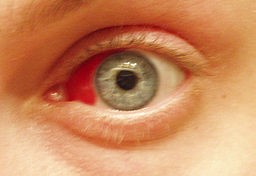
The most common appearance is a flat, bright red patch anywhere in the conjunctiva with sharply defined edges and relatively normal conjunctiva surrounding it.
Overall, subconjunctival haemorrhages are most commonly found in the inferior conjunctiva, but traumatic subconjunctival haemorrhages are more common in the temporal area and tend to be more localised.8
The haemorrhage may spread and become green or yellow, like a bruise. Usually it disappears within two weeks.
Examination of the eye, including pupil responses and visual acuity, is otherwise normal.
It is worth noting that a haemorrhage without a posterior margin (ie extends posteriorly so that the whole extent of the haemorrhage cannot be seen) may be associated with an intracranial bleed or an orbital roof fracture (associated with a black eye) - the history should guide you as to whether to consider this or not.
Subconjunctival haemorrhage: "Red eye"
التشخيص التفريقي
أسباب أخرى لـ acute red eye ,، بما في ذلك:
If it is a persistent haemorrhage (as opposed to the conjunctival injection seen in a red eye), consider rarer causes such as:
Other conjunctival neoplasms.
التحقيقات
Check blood pressure.
No laboratory studies are indicated if it is an isolated problem.
If there is history of trauma, the patient may need referral to rule out more extensive eye injury.
In recurrent cases, investigation for an underlying bleeding disorder may be indicated.9
Subconjunctival haemorrhage treatment
Medical care is not required, unless there is an underlying disorder.
Artificial tears can be used four times per day for mild eye irritation.
Discourage elective use of aspirin products or NSAIDs.
Simultaneous bilateral haemorrhages, and persistent or unexplained recurrence, warrant a referral to the ophthalmologist.
Consider non-accidental injury in infants with bilateral isolated subconjunctival haemorrhages, especially if associated with facial petechiae.
التكهن
Subconjunctival haemorrhage is a benign, self-limiting condition when not associated with systemic illness.
The prognosis is excellent.
There may be a small increased risk of stroke in the three years following a subconjunctival haemorrhage.10
تحديثات حصرية لمتخصصي الرعاية الصحية
ابقَ على اطلاع بأحدث التحديثات السريرية، والرؤى المهنية، والإرشادات المستندة إلى الأدلة. تقوم نشرة Patient Pro الإخبارية بتجميع محتوى أساسي لمتخصصي الرعاية الصحية - يتم تسليمه مباشرة إلى بريدك الوارد.
من خلال الاشتراك، فإنك تقبل سياسة الخصوصية. يمكنك إلغاء الاشتراك في أي وقت. نحن لا نبيع بياناتك أبدًا.
قراءة إضافية ومراجع
- Tarlan B, Kiratli H; Subconjunctival hemorrhage: risk factors and potential indicators. Clin Ophthalmol. 2013;7:1163-70. doi: 10.2147/OPTH.S35062. Epub 2013 Jun 12.
- Hu DN, Mou CH, Chao SC, et al; Incidence of Non-Traumatic Subconjunctival Hemorrhage in a Nationwide Study in Taiwan from 2000 to 2011. PLoS One. 2015 Jul 16;10(7):e0132762. doi: 10.1371/journal.pone.0132762. eCollection 2015.
- Mimura T, Usui T, Yamagami S, et al; Recent causes of subconjunctival hemorrhage. Ophthalmologica. 2010;224(3):133-7. doi: 10.1159/000236038. Epub 2009 Sep 9.
- Sahinoglu-Keskek N, Cevher S, Ergin A; Analysis of subconjunctival hemorrhage. Pak J Med Sci. 2013 Jan;29(1):132-4. doi: 10.12669/pjms.291.2802.
- Lim HY, Puah SH, Ang LJ, et al; Subconjunctival haemorrhage from bronchoscopy: A case report. Respir Med Case Rep. 2015 Sep 3;16:97-100. doi: 10.1016/j.rmcr.2015.08.008. eCollection 2015.
- Mimura T, Yamagami S, Mori M, et al; Contact lens-induced subconjunctival hemorrhage. Am J Ophthalmol. 2010 Nov;150(5):656-665.e1. doi: 10.1016/j.ajo.2010.05.028. Epub 2010 Aug 14.
- Doshi R, Noohani T; Subconjunctival Hemorrhage. StatPearls, Jan 2023.
- Mimura T, Yamagami S, Usui T, et al; Location and extent of subconjunctival hemorrhage. Ophthalmologica. 2010;224(2):90-5. doi: 10.1159/000235798. Epub 2009 Aug 28.
- Cronau H, Kankanala RR, Mauger T; Diagnosis and management of red eye in primary care. Am Fam Physician. 2010 Jan 15;81(2):137-44.
- Wang TJ, Keller JJ, Sheu JJ, et al; A 3-year follow-up study on the risk of stroke among patients with conjunctival haemorrhage. Acta Ophthalmol. 2013 May;91(3):226-30. doi: 10.1111/j.1755-3768.2011.02359.x. Epub 2012 Mar 9.
عن المؤلفعرض السيرة الذاتية الكاملة
تم التحديث بواسطة

الدكتورة سوشيتا شاه، MRCGP
طبيب عام وأخصائي صحة عامة
MRCGP, MPH, MA (Cantab), MPhil, BMBch (Oxon), DCH, DFSRH, DRCOG
الدكتورة سوشيتا شاه هي طبيبة عامة، ومتخصصة في الصحة السكانية والعالمية، وكاتبة، ومحررة، ومعلمة طبية.
حول المراجععرض السيرة الذاتية الكاملة

الدكتور كولين تايدي، MRCGP
طبيب عام، مؤلف طبي
MBBS, MRCGP, MRCP (Paediatrics), DCH
الدكتور كولين تايدي هو طبيب في هيئة الخدمات الصحية الوطنية، ويعمل في أوكسفوردشاير.
تاريخ المقال
المقال متاح أيضًا باللغة الإنجليزية, الألمانية, إسبانية, الفرنسية, إيطالي, البرتغالية, الهندية, العبرية, العربية ,، و السويدية.
المراجعة التالية مستحقة: 2 يونيو 2027
24 Jun 2022 | أحدث إصدار
وصول بسيط إلى العلاجات والخدمات الصحية الموثوقة عبر الإنترنت.
Common conditions
Get help with common conditions through the NHS, without a GP appointment.
 التهاب الجيوب الأنفية الحاد
 التهاب اللوزتين البكتيري
 القوباء
 لدغات الحشرات
 الحزام الناريعدوى المسالك البولية
المزيد في التاريخ والفحص
- شلل البصلة وشلل البصلة الكاذب
- غيبوبة
- الفحص النسائي والتاريخ الطبي
- فتق الحجاب الحاجز
- التاريخ والفحص البدني
- فرط التعرق
- الهلوسات النعاسية
- اليرقان أثناء الحمل
- ألم الخاصرة
- ضعف الإدراك البسيط
- التغفيق والجمدة
- اليرقان الوليدي
- السمنة لدى الأطفال
- تسجيل ذروة التدفق
- التهاب الثدي النفاسي
- مرض رينود
- الفحص للكشف عن الضعف الإدراكي
- مشاكل النوم لدى الأطفال
- تسرع القلب فوق البطيني لدى البالغين
- الأكياس الدرقية اللسانية