Subconjunctival haemorrhage
Peer reviewed by Dr Doug McKechnie, MRCGPLast updated by Dr Toni Hazell, FRCGPLast updated 27 Apr 2025
Meets Patient’s editorial guidelines
- DownloadDownload
- Share
- Language
- Discussion
- Audio Version
- Add to preferred sources on Google
In this series:Eye problemsInfective conjunctivitisAllergic conjunctivitisDry eyesEpiscleritis and scleritisUveitis
A subconjunctival haemorrhage is one common cause of a red eye. It is caused by a small bleed behind the covering of the eye. It can look alarming but it usually causes no symptoms and is usually harmless. The redness usually clears within two weeks.
At a glance
A subconjunctival haemorrhage is bleeding under the thin 'skin' on the front of the eyeball.
It often appears as a bright red patch on the white of the eye but usually has no symptoms.
Most cases have no apparent cause, but injuries or certain medical conditions can contribute.
No treatment is normally needed as the bleed fades and disappears within two weeks.
See your doctor if you suspect an eye injury or have other unusual bleeding or bruising.
What is a subconjunctival haemorrhage?
Subconjunctival haemorrhage: "Red eye"
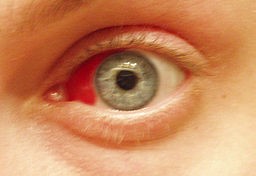
© Standardissue at en.wikipedia,CC BY-SA 3.0, via Wikimedia Commons
The conjunctiva is like a thin 'skin' on the front of the eyeball. It covers the white part of the eye (the sclera) but does not cover the central part of the eye (the cornea).
In between the conjunctiva and the sclera run tiny blood vessels. If you look closely at the sclera you may just be able to see a few tiny blood vessels.
If one of these tiny blood vessels bursts, it bleeds in between the conjunctiva and the sclera. This bleed is called a subconjunctival haemorrhage.
What causes a subconjunctival haemorrhage?
In the vast majority of cases there is no apparent cause. They occur more often in older people and also happen frequently in healthy newborn babies.
Occasionally, a subconjunctival haemorrhage can be caused by an injury to the eye or a head injury. Sometimes they occur after a bout of coughing or being sick (vomiting). They are associated with other medical conditions such as high blood pressure (hypertension),diabetes mellitus and coronary heart disease. If you have a bleeding disorder, such as haemophilia, or if you take anticoagulant medication (blood thinners such as warfarin), you may be more prone to getting a subconjunctival haemorrhage (or other bleeding such as nosebleeds or easy bruising).
What are the symptoms of a subconjunctival haemorrhage?
Usually none. You often do not notice it until someone points it out to you, or you see it in a mirror. It can be alarming, as sometimes a large part of the white of the eye (sclera) appears bright red. This is because the tiny bleed (haemorrhage) spreads between the thin 'skin' on the front of the eyeball (the conjunctiva) and the sclera in a thin film. It looks a lot worse than it really is! Your eye might feel mildly irritated but your vision should be entirely normal. It is not uncommon for it to happen again at a later date.
What is the treatment for a subconjunctival haemorrhage?
Unless there is an underlying medical problem, no treatment is required. It will usually fade and disappear within two weeks. (Like any other bruise, the red colour will go a yellow/brown colour before it fades away.) If your eye feels irritated, you can use artificial tears. It is best to avoid drugs like ibuprofen, which can make bleeding worse. Do mention to your doctor if:
You have not had your blood pressure checked recently.
You suspect an injury to your eye is the cause (for example, a small bit of flying metal from a hammer, chisel, etc).
You have noticed any other unusual bleeding or bruising on your body for no good reason.
How to prevent a subconjunctival haemorrhage
There are some steps you can take to help prevent subconjunctival haemorrhage or indeed, eye injury. These include:
Wear protective eyewear during sports or DIY where debris may enter your eye.
Insert and remove your contact lenses properly and keep them clean.
Get medical advice from your doctor if you suspect you have a bleeding disorder.
Avoid rubbing your eyes.
Patient picks for Eye injuries

Eye health
Corneal injury and foreign bodies
Minor scratches or abrasions to the cornea are common. They can be extremely sore but usually heal in 24-48 hours. A course of antibiotic eye drops or ointment is commonly prescribed to prevent an eye infection from developing. More serious injuries to the eye may occur from sharp objects and from small flying particles hitting the eye at high speed. Serious injury can also result from chemical burns. Always see a doctor for a proper eye examination if you suspect that your eye has been injured from a small flying particle, or from a chemical.
by Dr Mary Elisabeth Lowth, FRCGP

Eye health
Dealing with eye injuries
This leaflet is created from first aid advice provided by St John Ambulance, the nation's leading first aid charity. This advice is no substitute for first aid training - find a training course near you. Eye injuries vary from something very minor, such as getting shampoo in your eye, to something quite serious, such as a cut, which could cause permanent loss of vision.
by St John Ambulance
Frequently asked questions
Can a subconjunctival haemorrhage affect both eyes at the same time?
The article describes a subconjunctival haemorrhage as a burst blood vessel in one eye, leaving the impression that it typically affects one eye at a time. It does not mention simultaneous occurrence in both eyes.
If I wear contact lenses, can they cause a subconjunctival haemorrhage?
The article suggests that improper insertion or removal of contact lenses, or not keeping them clean, could contribute to eye injury. While it doesn't explicitly state that contact lenses directly cause a subconjunctival haemorrhage, it advises proper management of contact lenses as a preventative measure.
Should I be concerned if I get repeated subconjunctival haemorrhages?
The article mentions that it is not uncommon for a subconjunctival haemorrhage to happen again at a later date. If you experience repeated instances, it might be worth mentioning to your doctor, particularly if you also have other symptoms like unusual bleeding or bruising elsewhere on your body, or if you haven't had your blood pressure checked recently, as these can be associated conditions.
Is it possible for a subconjunctival haemorrhage to lead to blindness or long-term vision problems?
The article states that your vision should be entirely normal with a subconjunctival haemorrhage and that it looks a lot worse than it really is. It does not suggest any risk of blindness or long-term vision problems as a result of this condition itself.
Can certain medications other than blood thinners make me more susceptible to a subconjunctival haemorrhage?
The article highlights that anticoagulant medication (blood thinners like warfarin) can make you more prone to bleeding, including subconjunctival haemorrhage. However, it does not mention other specific medications as increasing susceptibility to this condition beyond those that affect blood clotting.
How can I tell the difference between a subconjunctival haemorrhage and another type of 'red eye' condition?
The article describes a subconjunctival haemorrhage as a bright red patch on the white of the eye, often without symptoms other than mild irritation, and with normal vision. It does not provide information on how to distinguish it from other causes of 'red eye'.
Further reading and references
- Cronau H, Kankanala RR, Mauger T; Diagnosis and management of red eye in primary care. Am Fam Physician. 2010 Jan 15;81(2):137-44.
- Tarlan B, Kiratli H; Subconjunctival hemorrhage: risk factors and potential indicators. Clin Ophthalmol. 2013;7:1163-70. doi: 10.2147/OPTH.S35062. Epub 2013 Jun 12.
- Doshi R, Noohani T; Subconjunctival Hemorrhage. StatPearls, Jan 2023.
About the authorView full bio

Dr Toni Hazell, FRCGP
MBBS, BSc, FRCGP, DFSRH, Dip GU med, DRCOG, DCH (London, UK, 2000)
Dr. Toni Hazell qualified from St. Mary’s Hospital Medical School and did her VTS at Northwick Park Hospital.
About the reviewerView full bio

Dr Doug McKechnie, MRCGP
Medical Writer
MA, MBBS, MSc, DRCOG, MRCP(UK), MRCGP(2021), FHEA
Dr Doug McKechnie is an NHS GP working in London. He works full-time clinically and is also the Deputy Lead for the Clinical and Professional Practice module at University College London Medical School.
Article history
The information on this page is written and peer reviewed by qualified clinicians.
Article also available in English, German, Spanish, French, Italian, Portuguese, Hindi, Hebrew, Arabic, and Swedish.
Next review due: 26 Apr 2028
27 Apr 2025 | Latest version
Join the conversation
Share your thoughts or experiences with others in our patient communities.

Ask, share, connect.
Browse discussions, ask questions, and share experiences across hundreds of health topics.

Feeling unwell?
Assess your symptoms online for free
Sign up to the Patient newsletter
Your weekly dose of clear, trustworthy health advice - written to help you feel informed, confident and in control.
By subscribing you accept our Privacy Policy. You can unsubscribe at any time. We never sell your data.
More in eye health
- Allergic conjunctivitis
- Amblyopia (lazy eye)
- Astigmatism
- Cataracts
- Chalazion
- Charles Bonnet syndrome
- Corneal injury and foreign bodies
- Entropion
- Eye floaters, flashes and haloes
- Giant Cell Arteritis
- Hypermetropia
- Idiopathic intracranial hypertension
- Infective conjunctivitis
- Retinal artery occlusion
- Retinal vein occlusion
- Retinoblastoma
- Uveitis
- Vitreous haemorrhage