تصلب الأذن
مراجعة من قبل الدكتور كولين تايدي، MRCGPآخر تحديث بواسطة الدكتورة توني هازيل، زميلة الكلية الملكية للأطباء العامينآخر تحديث ٢٣ سبتمبر ٢٠٢٢
يتوافق مع الإرشادات التحريرية
- تنزيلتنزيل
- مشاركة
- Language
- نقاش
- Ask Patient
- نسخة صوتية
- أضف إلى المصادر المفضلة على جوجل
في هذه السلسلة:فقدان السمعفقدان السمع لدى كبار السنشمع الأذنالتهاب الأذن الوسطى الإفرازيثقب طبلة الأذنورم كوليسترولي
Otosclerosis is a condition of the middle ear and mainly affects the tiny stirrup (stapes) bone. It causes gradual hearing loss.
نظرة سريعة
التصلب الأذني هو حالة تسبب فقدان السمع بسبب تكوين غير طبيعي للعظام في الأذن الوسطى.
عادة ما يؤثر على الأشخاص الذين تتراوح أعمارهم بين 15 و35 عامًا، حيث تتأثر النساء أكثر من الرجال.
تشمل الأعراض فقدان السمع التدريجي، طنين الأذن، التحدث بصوت منخفض، وأحيانًا الدوار.
قد تسمع بشكل أفضل في الأماكن الصاخبة، وهذا ما يسمى بالباراكوسيس.
يتضمن التشخيص إحالة الطبيب إلى أخصائي الأنف والأذن والحنجرة لإجراء اختبارات السمع وربما قياس طبلة الأذن أو التصوير المقطعي.
تشمل خيارات العلاج استخدام أجهزة السمع أو إجراء جراحة لاستبدال عظمة صغيرة تُسمى الركاب.
What is otosclerosis?
Otosclerosis is a common cause of hearing loss. It is caused by a problem with the tiny bones (ossicles) which transmit vibrations through the middle ear so we can hear sound. Usually both ears are affected in otosclerosis but sometimes only one ear is affected.
Otosclerosis affects about 1 or 2 in 100 people in the UK.
It usually first develops between the ages of 15-35 years but sometimes develops in younger children.
Women are affected twice as often as men.
Pregnancy is not a cause but may make the condition worse, so symptoms are commonly first noticed during pregnancy.
Nobody actually knows why otosclerosis happens. However, what is known is that otosclerosis is not caused or worsened by listening to loud music or working in a loud environment.
Otosclerosis happens because there is abnormal bone formation in one of the tiny bones in the middle ear. It is not clear why this happens but it is likely to be caused by a combination of various factors:
Hereditary (genetic) factors.
Complications from having had a virus.
Possible effect of low fluoride levels.
Otosclerosis symptoms
فقدان السمع.
Speaking softly.
Hearing better in noisy surroundings.
Hearing sounds from within your body.
Dizziness and balance problems.
فقدان السمع
Hearing loss is the main symptom of otosclerosis. The hearing loss may remain mild but commonly it gradually becomes worse. It usually affects both ears, but not always. In some people the hearing loss stays mild for a number of years before getting worse. In others the hearing loss quickly becomes worse. Without treatment, in time, the affected ears often become totally deaf.
The hearing loss is usually of lower sounds, whereas age-related hearing loss has more effect on higher-pitched sounds.
Speaking softly
If you have otosclerosis, you may speak unusually quietly. The effect of otosclerosis on your ears is to make your own voice sound loud to you.
Hearing better in noisy surroundings
Paracusis is also common. If you have this, you can hear better when there is a lot of background noise. For example, you seem to hear better when talking to someone in a pub or a café that is full of other people. This may be because other people raise their voices in noisy places.
Hearing sounds from within your body
طنين الأذن is an abnormal noise which you hear but which seems not to come from outside your ear. It occurs in about 4 in 5 people with otosclerosis. Noises heard include ringing, whistles, roaring, machine-type noises, etc. Tinnitus tends to worsen as hearing loss worsens.
Dizziness and balance problems
دوار is a condition where problems with dizziness and balance are experienced. This condition develops in some people with otosclerosis, although it is less common. It occurs when the balance mechanism in the inner ear (the semicircular canals) is affected.
What causes otosclerosis?
Faulty bone formation
Bone is a living tissue and contains cells that make, mould and take back up (resorb) bone. Normally bone is continually being broken down and re-modelled. In otosclerosis, it seems that the re-modelling process of the stirrup (stapes) - one of the tiny bony ossicles in the middle ear - becomes faulty. New bone is not made properly and abnormal bone forms. However, the reason why this occurs mainly in the stapes (and sometimes the cochlea) is not entirely clear.
Have you inherited it?
Hereditary (genetic) factors seem to be important because a tendency for otosclerosis can be inherited. About 2 out of every 3 people with otosclerosis have other family members who also have this condition. However, some people with otosclerosis have no family history.
Could it be a virus?
It is also thought that a virus may play a part and the الحصبة virus has been suggested. Indeed, the number of people diagnosed with otosclerosis seems to have decreased since the measles virus vaccination has been given. It may be that a genetic tendency to develop otosclerosis is inherited by some people. Then a trigger, such as a viral infection, actually causes the condition to develop.
Low levels of fluoride
It is also possible that low levels of fluoride may have something to do with the development of otosclerosis. The number of cases of otosclerosis in the UK went down after fluoride was routinely added to drinking water. However, this possible link with low levels of fluoride is controversial.
How to treat otosclerosis
Hearing aids
At first, when the hearing loss is mild, you may not need any treatment. As the disease progresses and hearing loss becomes worse, hearing aids can make a big difference. However, when the hearing loss becomes severe, hearing aids may not be of much help.
الجراحة
The most common operation that is done is to replace the stapes with an artificial bone made of plastic or metal. The operation is called a stapedectomy (or sometimes a stapedotomy). In most cases, this operation is successful and restores hearing. It may also reduce the chance of otosclerosis progressing to affect your inner ear.
However, it is a very delicate operation. There is a small risk that the operation will fail and cause total deafness in the operated ear. Also, there is a small risk of damaging other nerves during the operation and of causing disturbance to balance or taste. The operation may not cure tinnitus and will not improve hearing in the small number of cases which affect the cochlea. You should ask your surgeon about their success rates for this type of surgery.
So, although the operation is usually successful, it may be a difficult decision about if, or when, to opt for an operation. Because of the small chance of serious complications, some people decide to stick with hearing aids. They do so until their hearing becomes so bad that hearing aids are not helping very much. Other people opt for surgery earlier so as not to need hearing aids. When surgery is decided upon, the ear that is most badly affected is operated on first. This is the ear with most to gain if the operation is successful. It means that the best ear is still preserved in the small number of cases where the operation does not work.
There is debate about whether the second ear should be operated on in the future. Some surgeons feel not, because if anything were to go wrong with the ear already operated on, you would still have the possibility of wearing a hearing aid and hearing something with your second ear. You should discuss this with your surgeon.
الأدوية
In the past, fluoride tablets have been used to treat otosclerosis. However they are not currently recommended because the evidence of benefit is low-quality, and there is a risk of increasing other fractures including those of the hip.
Other tablets called bisphosphonates have also been used in the past, but again the evidence is limited and they are not currently recommended.
Hormone tablets and the contraceptive pill
Some doctors feel that taking the حبوب منع الحمل أو العلاج بالهرمونات البديلة may make otosclerosis worse and some women find that it worsens during pregnancy, possibly due to hormonal changes. If you have otosclerosis and are considering taking hormone treatment such as this, you should discuss the pros and cons fully with your doctor.
What is affected in otosclerosis?
Otosclerosis mainly affects the tiny bone (ossicle) called the stirrup (stapes). To have normal hearing, the ossicles need to be able to move freely in response to sound waves. In otosclerosis, abnormal bone material grows around the stapes bone. The foot of the stapes, where it attaches to the cochlea, is usually where the condition starts. The abnormal bone reduces the movement of the stapes, which reduces the amount of sound that is transferred to the cochlea. The growth of the abnormal bone is very gradual. However, eventually the stapes can become fixed, or fused, with the bone of the cochlea. This can cause severe hearing loss. The hearing loss is known as conductive hearing loss because sound vibrations cannot be conducted (transmitted) from the stapes to the cochlea.
In most cases, it is just the stapes which is affected. However, sometimes, over time, otosclerosis can also affect the bony shell of the cochlea and the nerve cells within it. If this is the case, the damage to the nerve cells means that the transmission of nerve impulses to the brain can be affected. A different type of hearing loss, called sensorineural hearing loss, can then occur.
How do we hear?
The ear is divided into three parts - the outer (external) ear, the middle ear, and the inner ear. The middle ear behind the eardrum is filled with air. Air comes from the back of the nose up a thin channel called the Eustachian tube. In the middle ear there are three tiny bones (ossicles) - the hammer (malleus), anvil (incus) and stirrup (stapes). The inner ear includes the cochlea and semicircular canals.
Human ear anatomy
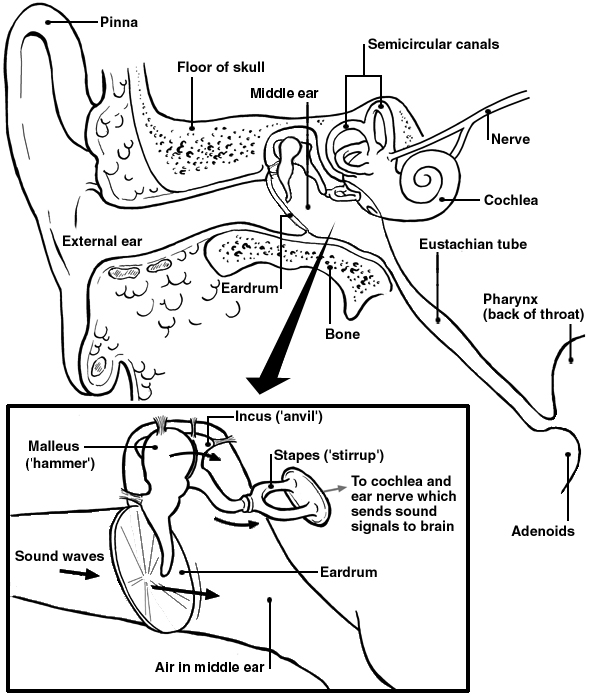
Sound waves come into the outer ear and hit the eardrum.
The sound waves cause the eardrum to vibrate.
The sound vibrations pass from the eardrum to the middle ear bones.
The bones then transmit the vibrations to the cochlea in the inner ear.
The cochlea converts the vibrations to sound signals which are sent along a nerve from the ear to the brain, allowing us to hear.
The semicircular canals in the inner ear contain a fluid that moves around as we move. The movement of the fluid is sensed by tiny hairs in the semicircular canals. These send messages to the brain along the ear (auditory) nerve to the brain to help maintain balance and posture.
How is otosclerosis diagnosed?
If you are worried about hearing loss, make an appointment to see your doctor. They will ask about the symptoms you have been getting and then they will generally look into your ears using an auriscope. This is the common instrument used to look inside your ears if you have earache. In otosclerosis, your eardrum usually looks normal and healthy when your doctor looks inside your ear.
Your doctor may refer you on to an ear, nose and throat specialist who will be able to make the diagnosis of otosclerosis. They will do hearing tests which will show a specific pattern of hearing loss in otosclerosis. The specialist may also use a small device that is placed in your ear, called a tympanometer. This can help them look at the movement of the bones within your ear. In otosclerosis, the stirrup (stapes) will move less. This test is very quick and does not cause any pain.
Sometimes the specialist may decide that you need to have a فحص الأشعة المقطعية which will give them more information about how severe the otosclerosis is.
What happens long-term?
Generally the hearing loss progresses over time, although this may be very slow. If it becomes bad enough for you to need an operation, that is usually very successful at resolving the hearing problems and other symptoms.
اختيارات المرضى لـ مشاكل السمع
الأذن والأنف والحنجرة
فقدان السمع
In this article we talk about the different causes of hearing loss, their different characteristics and what you can do about them. Hearing loss is common. It can be very distressing, particularly if it is getting worse or if it affects both ears. Everyone's hearing gets worse as they get older. However, there are many types of hearing loss and not all are restricted to older people.
بواسطة الدكتورة سورانجي مينديس، MRCGP
الأذن والأنف والحنجرة
خلل في قناة استاكيوس
يمكن أن يسبب خلل في قناة استاكيوس (ETD) ضعف السمع والشعور بالضغط أو الامتلاء في الأذن المصابة. عادة ما يستمر لبضعة أسابيع خلال وبعد نزلة البرد.
بقلم الدكتورة توني هازيل، FRCGP
الأسئلة الشائعة
هل يمكن أن يحدث تصلب الأذن عند الأطفال أم أنه يؤثر فقط على البالغين؟
عادةً ما يتطور تصلب الأذن لأول مرة بين سن 15 و35 عامًا. ومع ذلك، يمكن أن يؤثر أحيانًا على الأطفال الأصغر سنًا.
If I have otosclerosis, does that mean my children will definitely get it too?
التصلب الأذني له عوامل وراثية (جينية)، وحوالي ثلثي الأشخاص المصابين بهذه الحالة لديهم أفراد آخرون من العائلة يعانون منها أيضًا. ومع ذلك، لا يوجد ضمان، حيث يمكن أن يصاب بها بعض الأشخاص دون وجود تاريخ عائلي.
ما هو الفرق بين فقدان السمع التوصيلي وفقدان السمع الحسي العصبي في تصلب الأذن؟
يحدث فقدان السمع التوصيلي عندما يمنع النمو العظمي غير الطبيعي حول عظمة الركاب اهتزازات الصوت من الانتقال بشكل صحيح إلى القوقعة. يمكن أن يحدث فقدان السمع الحسي العصبي إذا تطورت الحالة لتؤثر على الغلاف العظمي للقوقعة والخلايا العصبية داخلها، مما يؤثر على نقل النبضات العصبية إلى الدماغ.
هل يؤثر نظامي الغذائي أو خيارات نمط حياتي، مثل الموسيقى الصاخبة، على تصلب الأذن؟
لا أحد يعرف بالضبط لماذا يحدث تصلب الأذن. ومع ذلك، تم التأكيد على أنه لا يحدث أو يتفاقم بسبب الاستماع إلى الموسيقى الصاخبة أو العمل في بيئات صاخبة. هناك اقتراح مثير للجدل بأن انخفاض مستويات الفلورايد قد يكون عاملاً.
ما هي النتيجة النموذجية طويلة الأمد لشخص مصاب بتصلب الأذن؟
بشكل عام، يتقدم فقدان السمع الناتج عن تصلب الأذن بمرور الوقت، على الرغم من أن هذا قد يكون بطيئًا جدًا. إذا كانت الجراحة ضرورية، فإنها عادة ما تكون ناجحة جدًا في حل مشاكل السمع والأعراض الأخرى.
إذا كنت بحاجة إلى عملية جراحية، أي أذن سيتم إجراء العملية عليها أولاً؟
إذا تم اتخاذ قرار بإجراء الجراحة، يتم إجراء العملية على الأذن الأكثر تضررًا أولاً. وذلك لأنها الأكثر استفادة إذا نجحت العملية، كما أنها تحافظ على الأذن الأفضل في حالة عدم نجاح العملية كما هو متوقع.
قراءة إضافية ومراجع
- Otosclerosis and deafness; British Tinnitus Association
- Hain TC; Otosclerosis treatment, Dizziness and Balance, 2021
- تصلب الأذن; RNID 2016
عن المؤلفعرض السيرة الذاتية الكاملة
تم التحديث بواسطة

Dr Toni Hazell, FRCGP
بكالوريوس الطب والجراحة، بكالوريوس العلوم، زميل الكلية الملكية للأطباء العامين، دبلوم في الصحة الجنسية والإنجابية، دبلوم في طب الجهاز البولي التناسلي، دبلوم الكلية الملكية لأطباء النساء والتوليد، دبلوم في صحة الطفل (لندن، المملكة المتحدة، 2000)
تخرجت الدكتورة توني هازيل من كلية الطب بمستشفى سانت ماري وأكملت تدريبها في مستشفى نورثويك بارك.
حول المراجععرض السيرة الذاتية الكاملة

الدكتور كولين تايدي، MRCGP
طبيب عام، مؤلف طبي
MBBS, MRCGP, MRCP (Paediatrics), DCH
الدكتور كولين تايدي هو طبيب في هيئة الخدمات الصحية الوطنية، ويعمل في أوكسفوردشاير.
تاريخ المقال
المقال متاح أيضًا باللغة الإنجليزية, الألمانية, إسبانية, الفرنسية, إيطالي, البرتغالية, الهندية, العبرية, العربية ,، و السويدية.
المراجعة التالية مستحقة: 22 سبتمبر 2027
٢٣ سبتمبر ٢٠٢٢ | أحدث إصدار
المهنيين الطبيين
Looking for more in-depth clinical detail? Our Professional Reference articles are written for doctors, nurses and other healthcare professionals. They include comprehensive clinical guidance, diagnostic information and UK/European evidence summaries. If you need the clinical version, you can read the Professional Reference article on this topic.
شارك أفكارك أو تجاربك مع الآخرين في مجتمعات المرضى.
وصول بسيط إلى العلاجات والخدمات الصحية الموثوقة عبر الإنترنت.
Common conditions
Get help with common conditions through the NHS, without a GP appointment.
 التهاب الجيوب الأنفية الحاد
 التهاب اللوزتين البكتيري
 القوباء
 لدغات الحشرات
 الحزام الناريعدوى المسالك البولية
اشترك في النشرة الإخبارية للمرضى
جرعتك الأسبوعية من النصائح الصحية الواضحة والموثوقة - مكتوبة لمساعدتك على الشعور بالاطلاع والثقة والتحكم.
من خلال الاشتراك، فإنك تقبل سياسة الخصوصية. يمكنك إلغاء الاشتراك في أي وقت. نحن لا نبيع بياناتك أبدًا.