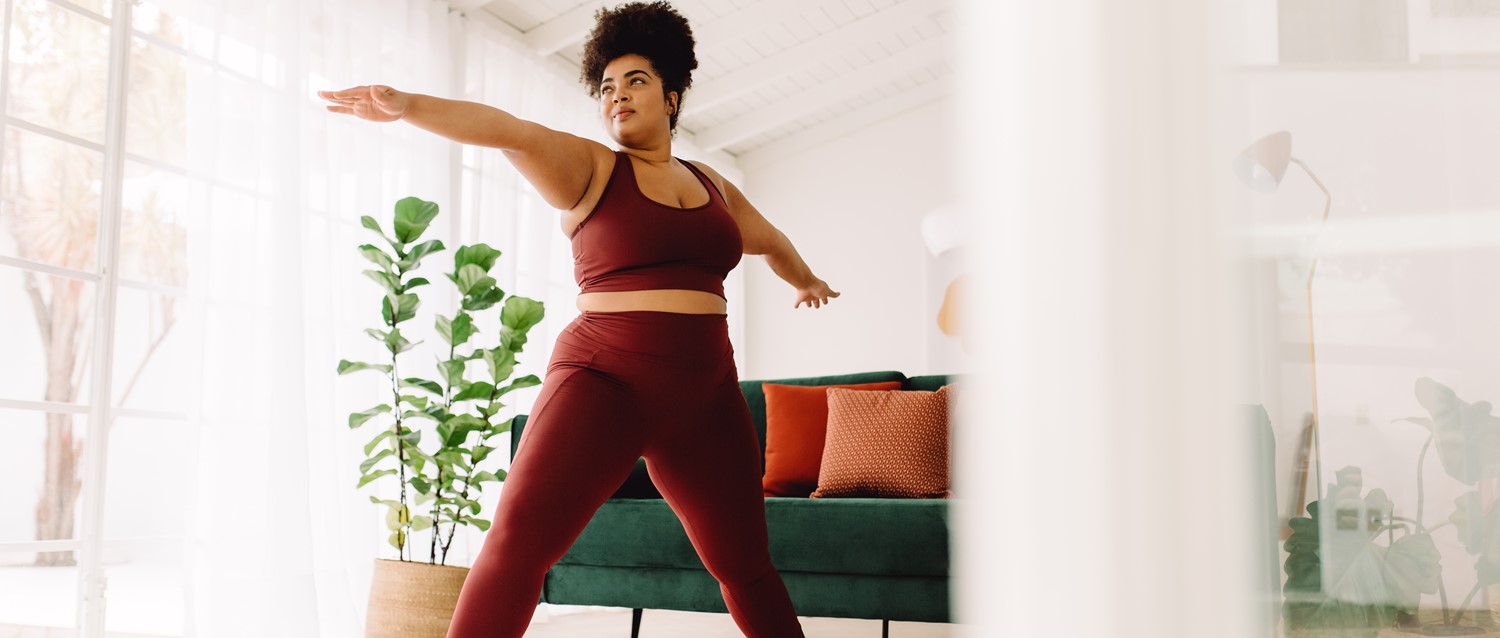
How to do Pilates at home
Peer reviewed by Dr Sarah JarvisLast updated by Emily Jane BashforthLast updated 28 Mar 2022
Meets Patient’s editorial guidelines
- DownloadDownload
- Share
- Language
- Discussion
- Audio Version
- Add to preferred sources on Google
One of the great things about Pilates is that it can be done from your living room or bedroom - you don't need to go to a fancy Pilates studio providing you have plenty of space. If you are doing Pilates at home, it's important to do so safely and, if you are a beginner, you should work your way up to more advanced exercises and positions, rather than pushing yourself straightaway.
What are the best Pilates exercises for a beginner at home?
If you are looking to start Pilates at home, there's a likelihood that you will be a novice. Therefore, you should first assess any possible risks and whether Pilates is right for you. It's also a good idea to book in with a qualified Pilates teacher, many of whom offer online classes. They can demonstrate the technique for each exercise so you can perform them correctly and reduce your risk of injury. If there are any specific areas of your health that you want to work on (such as improving posture or healing from an injury), they can also recommend certain exercises to benefit these.
If you are a beginner, personal trainer and Pilates teacher Beth Davies recommends a selection of main positions to familiarise yourself with. She explains how to master each one, as they will stand you in good stead as you advance through different exercises.
Relaxation position
Focus:body alignment, breathing and releasing overall tension.
How to do the relaxation position in Pilates
Lie on your back on a mat and relax your shoulders and neck. Bend your knees and place your feet flat on the floor. Either place your hands on your lower tummy (which is useful for awareness) or have your arms by your sides with palms on the floor (this is ready for movement position).
Pilates breathing
Focus: rib cage and respiratory muscles.
How to do Pilates breathing
To do this correctly, you should lie on the floor with your knees bent and put your hands on your ribs.
As you breathe in, focus on expanding the back and sides of your rib cage. Try to breathe through your nose and keep your shoulders relaxed.
As you breathe out, feel the air gently being pushed out from your mouth and a gentle drawing in of your lower tummy muscles. Feel your ribs narrowing and pelvic floor engaging.
"This will engage your transverse abdominal muscle (TVA) and internal oblique muscles. It will also exercise your pelvic floor if you ensure your abdominals are engaged throughout the rest of the exercises," adds Pilates teacher Abby McLachlan.
Davies' tips for breathing during Pilates
Avoid holding your breath.
Breathe deeply but without force.
Allow your breath to initiate a movement so it can feel more inflow.
Four-point kneeling
Focus: lumbo-pelvic control.
How to do four-point kneeling in Pilates
Kneel on the mat on all fours. Your hands should be positioned directly under your shoulders and knees directly under your hips. Find neutral for your spine by tilting your pelvis under then up and then find the midpoint, allowing for the natural curvature of your spine.
"Every person's neutral spine may look a little different due to different body shapes and sizes. You can identify whether you are in neutral by placing your hands on your lower belly, in a triangle between your pubic symphysis (the joint found between the left and right pubic bones near the midline of your body at the front) and hip bones on both sides. The triangle should be parallel to the floor and the pubic bone should not be higher or lower than the hip bones," says McLachlan.
Find the mid-position of your shoulder blades so that your chest and front of your shoulders remain open and your upper body isn't sinking down.
Pelvic position
Focus: posture, hip flexors, glutes and quadriceps.
How to do the pelvic position in Pilates
Lie on the floor with your feet hip-distance apart (also known as supine) and notice where your spine and pelvis touch the floor. When your pelvis and spine are in neutral, the normal curve of your lumbar spine (lower back) is present.
From neutral, inhale then use your abdominals to gently flex your lumbar spine, drawing it slightly towards the floor and feeling your ribs move closer to your hip bones.
Your pubic bone should now sit slightly higher than your hip bones. You should continue by matching your breath to movement and cycling between these two pelvic positions. Be sure to also engage your pelvic floor as you exhale, feeling everything draw in.
Davies adds that some functional movements you can do as a beginner include:
A Pilates squat.
Curl ups.
Roll downs.
Arm circles.
Additionally, McLachlan explains that these exercises can be advanced once you become more comfortable and experienced.
What are the best Pilates exercises to do at home?
McLachlan explains some of the best, most simple exercises to do if you want to venture into Pilates from the comfort of your home.
The hundred
Focus: core strength, breathing and stamina.
How to do the hundred in Pilates
Lie flat on your back with your knees in a tabletop position (where legs make a 90° angle with thighs pointing straight up and your shins parallel to the floor) and pelvis imprinted (an ever-so-slight upwards tilt of the posterior pelvis). Inhale to prepare, then nod your head to exhale and come up into flexion (a bending movement that decreases the angle between two points, in this case, bending your knees). Your arms should be alongside your torso.
As you inhale for a count of five, beat your arms alongside your body as if you were bouncing ping pong balls next to your hips. Remember to breathe in for five and out for five, using your full lung capacity.
Use your abdominal muscles (abs) to hold yourself up - don't let your neck and shoulders do all the work.
You can advance this by straightening your legs and holding them at a diagonal angle.
Bridge
Focus: glute strength and spinal articulation.
How to do the bridge in Pilates
Lie with your feet on the floor with your knees bent in a neutral pelvic position (the most natural alignment for your pelvis, where a plate could lie flat on your abdomen).
Take a deep, full inhalation and create space in your spine by imagining it lengthening; then start to exhale slowly through your mouth. As you do so, press into your feet and start to peel your spine up into the bridge position by lifting your hips off the floor.
Feel your gluteal muscles, which wrap around the back of your hips and thighs at the top (your glutes), start to work and feel your heels pulling back towards your buttocks to increase the engagement of the glutes. Make sure your spine is neutral at the top with no extension. Take an inhalation, then slowly return back down, trying to place one vertebra (the individual, interlocking bones that form your spinal column) at a time back on to the floor, back into a neutral position.
You can advance this by trying it on one leg with the other in a tabletop position or extended to the ceiling. Just be sure you can keep your hips level if you take this option.
One leg circle
Focus: abdominals, hamstrings, hip flexors, abductors and adductors.
How to do the one leg circle in Pilates
Lie on your back with both legs straight and a neutral pelvis. Inhale to prepare and on the exhale, lift one leg up in the air (your knee can be slightly bent).
Try to use your core strength to keep your hips stable and draw circles in the air with your leg. Try repeating five times with one leg then swap to the other.
How much space do you need to do Pilates at home?
McLachlan says that, as long as you have a mat, there are plenty of Pilates exercises at home you can do without any additional space at all. You just need to make sure you are comfortable and there is enough room for you to stretch out without risk of injury.
Davies says the fact that many Pilates movements only require yourself, and your mat makes it perfect for those who don't have access to lots of equipment or space. It also makes it less time-consuming as you don't need to set anything up, and less costly as you aren't having to pay for lots of specialist equipment. This is particularly helpful if you just want to give Pilates a try without being certain whether it's for you.
Do you need equipment to do Pilates at home?
Most Pilates exercises will not require any additional equipment, but you could add in various items once you become more skilled.
Weighted balls.
Small inflated balls.
Swiss balls.
Lightweights.
Resistance bands.
How to be safe while doing Pilates at home
Never strain your neck or back.
If an exercise feels painful or uncomfortable, stop.
Start with simple exercises and slowly build up to more challenging ones.
Similarly, start with fewer repetitions before you are strong and more confident, and able to carry on for longer.
Allow enough space for your movements, especially if you are bringing an arm or leg out to the side or back.
Take breaks whenever you need to.
How can you make Pilates at home fun?
Pilates is a different form of exercise in that it doesn't revolve around getting sweaty or pushing yourself too hard. Because of this, you can have fun with it and join in with others to form a community and make friends.
You can also make Pilates enjoyable by:
Creating a Pilates playlist to listen to while you exercise.
Setting yourself targets and goals to achieve.
Partaking in challenges (for example, to progress a particular movement over seven days).
Joining a live-stream class so you feel like part of a group.
Finding an enthusiastic instructor on YouTube.
Joining up with a friend and alternating by working out at each other's homes.
Adding in more of the more fun exercises, such as rolling like a ball.
Incorporating equipment.
Patient picks for Exercise and physical activity
Healthy living
The best resistance band workouts to build muscle
Resistance bands are a great way to improve the quality of your strength training routine. They can be incorporated into numerous exercises, adding extra force so that your muscles have to work harder to perform each task.
by Lynn Stephen
Healthy living
How to work out in a heatwave
When it's hot and humid out, your usual morning run can feel like torture - and ice cream in the shade may seem preferable to hitting the gym. So how can you keep on top of your exercise regime when things heat up outside?
by Lynn Stephen
About the authorView full bio

Emily Jane Bashforth
Feature Writer
NCTJ
Emily is a Feature Writer with Patient, writing articles on a variety of topics relating to health and well-being.
About the reviewerView full bio

Dr Sarah Jarvis
Clinical Consultant
MA (Cantab), BM, BCh (Oxon), DRCOG, FRCGP, MBE
After training in medicine at Cambridge and Oxford, Dr Sarah Jarvis MBE became a GP.
Article history
The information on this page is peer reviewed by qualified clinicians.
Article also available in English, German, Spanish, French, Italian, Portuguese, Hindi, Hebrew, Arabic, and Swedish.
28 Mar 2022 | Latest version
Join the conversation
Share your thoughts or experiences with others in our patient communities.

Ask, share, connect.
Browse discussions, ask questions, and share experiences across hundreds of health topics.

Feeling unwell?
Assess your symptoms online for free
Sign up to the Patient newsletter
Your weekly dose of clear, trustworthy health advice - written to help you feel informed, confident and in control.
By subscribing you accept our Privacy Policy. You can unsubscribe at any time. We never sell your data.
More in healthy living
- 7 morning stretches to get you ready for the day
- Can you really be fit and fat?
- Does eating spicy food help you lose weight?
- Does stress cause weight gain?
- Have a healthy, happy Father's Day
- How gut bacteria affect mood, focus and brain health
- How to fix your sleep schedule with a healthy bedtime routine
- How to get into swimming safely for beginners
- Is getting a sleep divorce the key to better rest?
- Is TikTok's 12-3-30 workout any good?
- Japanese walking: simple steps to a healthier you?
- The conditions that cause unexpected weight gain
- Trouble sleeping? The culprit may be something you ate
- Walk, jog, repeat: what is Jeffing?
- What are the benefits of Pilates?
- What are the dangers of drinking in hot weather?
- What is Reformer Pilates and why is it so popular?
- What is the 6-6-6 walking challenge?
- What to do if you feel lonely
- UpdatedWhat your waist measurement says about your health