التهاب السحايا
مراجعة من قبل الدكتورة هايلي ويلاسي، زميلة الكلية الملكية للأطباء العامين آخر تحديث بواسطة الدكتور كولين تايدي، MRCGPآخر تحديث 10 Feb 2024
يتوافق مع الإرشادات التحريرية
- تنزيلتنزيل
- مشاركة
- Language
- نقاش
- نسخة صوتية
- أضف إلى المصادر المفضلة على جوجل
Meningitis is inflammation of the tissues around the brain. It is a serious condition, caused by various types of bacteria, viruses and fungi. The infection that causes meningitis often causes a blood infection as well (this is known as septicaemia) which can be life-threatening. If you suspect meningitis - obtain medical help immediately.
نظرة سريعة
Meningitis is inflammation of the lining around the brain and spinal cord, typically from a bacterial or viral infection.
Bacterial meningitis is serious, with around 500-700 cases yearly in the UK, while viral meningitis is more common but usually less severe.
Symptoms often develop quickly and can include leg pains, cold hands/feet, and pale skin around the lips.
A distinctive rash that does not fade when a glass is pressed on it is a sign of sepsis and needs urgent medical help.
If meningitis is suspected, seek medical help immediately, as early treatment, especially antibiotics for bacterial forms, is crucial.
Immunisation is available against certain causes of meningitis, with some vaccines part of the routine UK schedule.
What is meningitis?
Meningitis is an inflammation of the lining covering the brain and spinal cord (the meninges). It is usually caused by the germs from a bacterial or viral infection. As a result there are two main types of meningitis - bacterial, and viral. Much more rarely, meningitis can be due to other causes such as severe types of fungal infection or tuberculosis.
ما مدى شيوع التهاب السحايا؟
Bacterial meningitis and associated sepsis (septicaemia) have become less common over the past few decades. It is a serious illness and well known due to the media coverage when outbreaks occur. There are around 500-700 cases of bacterial meningitis in the UK every year.
Overall in the UK, Neisseria meningitidis (meningococcus), المكورات الرئوية العقدية (pneumococcus), and Haemophilus influenzae type b (Hib) are the most common causes of acute bacterial meningitis in children aged 3 months or older and adults.
In babies younger than 1 month of age (neonates), Streptococcus agalactiae, Escherichia coli, S. pneumoniae ,، و Listeria monocytogenes (listeriosis) are the most common causes.
In children aged 3 months or older, N. meningitidis, S. pneumoniae ,، و Hib are the most common causative organisms.
In adults, S. pneumoniae is the most common cause of bacterial meningitis.
Viral meningitis is more common than bacterial meningitis but exact figures are not known. It is a complication of various viral illnesses. Viral meningitis is usually less serious than a bacterial cause. Most people who develop viral meningitis make a full recovery.
Other types of germs (infections) such as fungi and السل (TB) are rare causes of meningitis.
What causes meningitis?
Bacterial meningitis
Neisseria meningitidis (meningococcus) is a common germ (bacterium), living harmlessly in the nose and throat of about 1 in 4 people. These people are called carriers. This bacterium does not survive outside the body. Close contact is needed to pass it on to others, such as intimate kissing, coughing or sneezing near to others.
Rarely, this bacterium overcomes the body's immune system and gets into the blood to cause meningitis and/or septicaemia. It is not clear why a few people are prone to serious illness and many other people are carriers of the same bacterium but have no ill effect.
Most cases of meningococcal infection are isolated cases. The risk of others catching it is low, as many people are carriers and/or have natural immunity. Sometimes small outbreaks occur when two or more people in the same household or community are affected.
المكورات الرئوية العقدية (pneumococcus) is a less common cause of bacterial meningitis. This too is carried in the nose or throat by many people, with no ill effect. Again, meningitis probably occurs due to a breakdown in the immune system. It most commonly occurs in people aged over 45 years and in babies. Meningitis due to this bacterium is not thought to be passed on through touching (it is not contagious).
Other bacteria which less commonly cause meningitis include المستدمية النزلية type b (Hib), Escherichia coli (الإشريكية القولونية), Listeria monocytogenes and TB. The infection with meningitis from these germs may occur for various reasons, such as a complication of an infection in another part of the body.
Viral meningitis
A variety of germs (viruses) can travel to the lining that covers the brain and spinal cord (the meninges) and cause inflammation. For example, mumps, herpes, chickenpox, influenza and many other viral infections are sometimes the cause of viral meningitis.
Meningitis symptoms
People with meningitis may suffer from one or more of the following symptoms. Note that not all symptoms may occur. For example, the classic symptoms of neck stiffness and rash may not occur. If you suspect meningitis, look at our meningitis symptoms checklist and get medical help immediately.
Common early warning symptoms
Many children who are developing meningitis have nonspecific symptoms such as just feeling or looking generally unwell. These symptoms may include having a high temperature (fever), being more tired than usual and feeling sick.
However, three symptoms that commonly develop early on - often before the more classic symptoms listed later - are:
Leg pains. The pains can become severe and prevent a child from standing or walking.
Cold hands or feet - even if the child has a high temperature.
Pale, dusky or blue colour of the skin around the lips.
Meningitis rash
A typical rash is common with meningococcal infection but does not always occur. The rash is red or purple. Small spots develop at first and may occur in groups anywhere on the body. They often grow to become blotchy and look like little bruises. One or two may develop at first but many may then appear in different parts of the body.
The spots/blotches do not fade when pressed (unlike many other rashes). To check for this do the glass test. Place a clear glass firmly on one of the spots or blotches. If the spot/blotch does not fade and you can still see it through the glass, get medical help immediately.
اختبار الزجاج لطفح التهاب السحايا
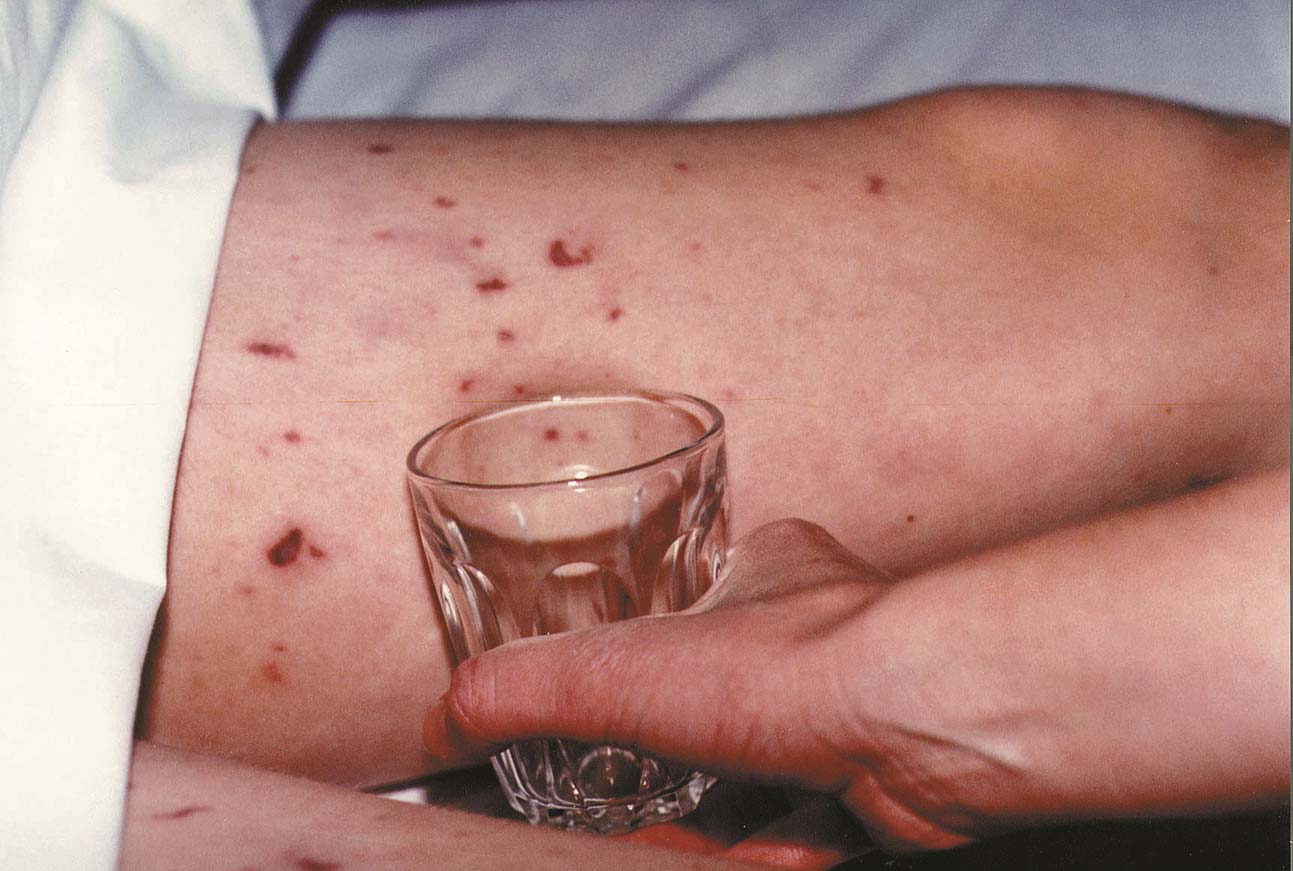
Reproduced with permission from Meningitis Now
The rash is a sign of تعفن الدم. It may not occur with meningitis alone.
Other symptoms of meningitis that may occur in babies
تشمل هذه الأشياء:
Excessive crying - often high-pitched or moaning and different to their usual cry.
التنفس السريع, or unusual patterns of breathing.
ارتفاع درجة الحرارة - but the baby may not look hot and the skin may look pale or blotchy, or turn blue. The hands and feet may feel cold. The baby may shiver.
Will not take feeds - sometimes, repeatedly being sick (vomiting).
Being irritable - especially when picked up and handled.
Drowsiness or sleepiness - does not wake easily.
A bulging fontanelle sometimes develops. The fontanelle is the soft spot on the baby's head.
Jerky movements may occur and the body may appear stiff. Sometimes the opposite occurs and the body appears quite floppy. Fits or seizures (convulsions) sometimes develop.
Other symptoms that may occur in older children and adults
تشمل هذه الأشياء:
High temperature and shivering - however, the hands and feet often feel cold.
Stiff neck - cannot bend the neck forward.
صداع - which can become severe.
التنفس السريع.
Aches and pains in muscles or joints - the pains can become quite severe.
The skin may look pale or blotchy, or turn blue.
Dislike of bright lights - will shut the eyes and turn away from the light.
Drowsiness or confusion - may appear vacant.
Repeated vomiting. Sometimes, tummy (abdominal) pain and diarrhoea.
The course of symptoms
The symptoms often develop quickly, over a few hours or so. Symptoms can occur in any order and not all may occur. Sometimes symptoms develop more slowly, over a few days. The symptoms may suggest a less serious illness at first. For example, high temperature, headaches and vomiting are common with many viral illnesses such as flu. Therefore, even if you think it was flu to start with, if symptoms become worse then it may be meningitis.
How is meningitis diagnosed?
Any person with possible meningitis needs admission to hospital. Tests will include blood tests, a lumbar puncture, and scans (التصوير المقطعي المحوسب (CT) أو فحص التصوير بالرنين المغناطيسي (MRI)). Read more about البزل القطني.
What is the treatment for meningitis?
Bacterial meningitis
Meningitis needs to be treated quickly with antibiotic injections. These may be started before admission to hospital - for example, your GP may give them while waiting for an ambulance. However it is essential to get to hospital for investigations and to start antibiotic treatment as soon as possible.
In hospital, further blood tests and a sample of the fluid that surrounds the spinal cord (a lumbar puncture) may be taken. These tests aim to confirm the diagnosis and to see which germ (bacterium) is causing the infection. The antibiotic may be changed depending on the results of the tests.
Intensive care is often needed, as the infection may cause shock and problems throughout the body. It is likely that fluids will need to be given directly into the veins (a drip). Oxygen is also often given through a mask on the face.
Steroid injections are also sometimes given. These work by reducing some of the inflammation that occurs with meningitis. Steroid medication has been shown in some studies to reduce the risk of developing hearing problems and other complications.
Viral meningitis
Antibiotics may be given at first when the cause of the meningitis is not known. The antibiotics are stopped if the cause of the meningitis is found to be viral. Antibiotics don't kill viruses. The body's immune system usually clears most viral infections.
What is the outlook for meningitis?
Bacterial causes
The outlook (prognosis) often depends on how soon antibiotics are given after the illness starts. Most people make a good recovery if treated early enough. Without treatment, most people will die.
A difficulty is that bacterial meningitis can develop quickly and can copy (mimic) other illnesses when symptoms first begin. Treatment may be delayed if the cause of early symptoms is not clear at first.
In some cases, a person can be well in the morning, develop flu-like symptoms by the afternoon and be critically ill or dead by the evening.
There are several complications that may occur after having meningitis. These include:
فقدان السمع. This is the most common complication. It is common to have a hearing test after you have recovered from meningitis.
Learning problems. There is a small risk of your child developing problems with their learning and behaviour. Some children will require extra support and understanding in their schools.
الصرع. A small proportion of children have brain injury after meningitis, which can lead to epilepsy.
مشاكل الكلى. A small number of children have kidney problems if their kidneys are affected as part of the septicaemia.
Joint or bone problems. The septicaemia can cause some damage to different tissues in the body. This can lead to scarring to the legs, arms and body. Some people experience joint or bone problems which may develop several years after having meningitis.
Limb amputation. Sometimes the blood supply to one or more arms or legs is so bad that the arm or leg dies and has to be amputated.
Viral meningitis
This can cause an unpleasant illness. However, most affected people make a full recovery. In a small number of cases, some brain injury occurs.
ملاحظة المحرر
الدكتور كريشنا فاخاريا, 9th January 2025
The National Institute for Health and Care Excellence (NICE) has set out some guidance to ensure patient safety. It has advised that all people who are clinically assessed and found ليست to have bacterial meningitis or meningococcal disease are given safety netting advice so they know which symptoms to watch out for and when to seek further help.
It has further advised that all patients need intravenous antibiotics (antibiotics given via a vein) within 1 hour of their arrival at hospital if they are suspected to have bacterial meningitis or suspected meningococcal disease.
All patients who have had meningitis or meningococcal disease should have follow up to test their hearing at 4 weeks and a follow up in secondary care after 6 weeks of discharge from the hospital.
Can meningitis be prevented?
Meningitis vaccine and immunisation
You can help prevent meningitis by being immunised with the meningitis vaccine. Children are routinely immunised against certain causes of meningitis. These include المستدمية النزلية type b (Hib), group B and C meningococcus, pneumococcus and mumps. See the separate leaflet called Immunisation.
The vaccine for Group B meningococcus became part of the normal UK immunisation schedule from September 2015. A vaccine protecting against types A, C, W and Y is available for those aged 17-18 years and those in their first year at university.
Other vaccines may be used for travellers going to meningitis-prone countries.
اقرأ المزيد عن meningococcal immunisation.
Contacts
Close contacts of a person with meningococcal infection have an increased risk of developing the illness. However, the risk is still low. Close contacts usually means household members, or intimate kissing contacts within the previous seven days. These people are offered a short course of antibiotics to prevent possible infection.
If group C meningococcus is the cause then immunisation is also offered to close contacts. Occasionally, an outbreak of two or more cases of meningococcal infection occurs in the same school, college, or similar community. Antibiotics and/or immunisation may then be offered to a wider group of people.
اختيارات المرضى لـ التهاب السحايا وتسمم الدم
العدوى
الإنتان
Sepsis is a reaction to severe infection. It can involve many different parts of the body. The germs causing the infection are usually bacteria, but less often can be viruses or fungi.
بقلم الدكتور كولين تايدي، MRCGP

العدوى
عدوى المكورات السحائية
Neisseria meningitidis, also known as meningococcus, is a germ (bacterium). Infection with meningococcus is uncommon but is very serious and can be life-threatening.
بقلم الدكتور كولين تايدي، MRCGP
الأسئلة الشائعة
Do meningitis spots hurt or itch?
The article does not state that meningitis spots are painful or itchy. The characteristic rash consists of red or purple spots or blotches that do not fade when pressed, indicating a sign of sepsis.
Can meningitis come on slowly with mild symptoms at first?
Yes, sometimes symptoms develop more slowly, over a few days. Initially, symptoms might suggest a less serious illness like the flu, such as a high temperature, headaches, and vomiting. However, if these symptoms worsen, it could indicate meningitis.
What happens after discharge from the hospital for meningitis?
After being discharged from the hospital, all patients who have had meningitis or meningococcal disease should have their hearing tested at 4 weeks. Additionally, a follow-up appointment in secondary care is recommended after 6 weeks.
Why do healthcare professionals perform a lumbar puncture to diagnose meningitis?
A lumbar puncture is performed to collect a sample of the fluid that surrounds the spinal cord. This test helps to confirm the diagnosis of meningitis and identify which germ (bacterium or virus) is causing the infection, guiding appropriate treatment.
Why are steroid injections sometimes given in cases of bacterial meningitis?
Steroid injections are sometimes administered because they help to reduce some of the inflammation associated with bacterial meningitis. Studies have shown that steroid medication can reduce the risk of developing complications such as hearing problems.
قراءة إضافية ومراجع
- Meningitis (bacterial) and meningococcal disease: recognition, diagnosis and management; NICE guidance (March 2024)
- Meningitis - bacterial meningitis and meningococcal disease; NICE CKS, December 2024 (UK access only)
- الإنتان - التعرف عليه، التشخيص والإدارة المبكرة; إرشادات NICE (يوليو 2016 - تم التحديث في يناير 2024)
- التطعيم ضد الأمراض المعدية - الكتاب الأخضر (الإصدار الأحدث); وكالة الأمن الصحي في المملكة المتحدة.
- مرض المكورات السحائية: الإرشادات والبيانات والتحليل; وكالة الأمن الصحي في المملكة المتحدة (آخر تحديث أبريل 2022)
عن المؤلفعرض السيرة الذاتية الكاملة

الدكتور كولين تايدي، MRCGP
طبيب عام، مؤلف طبي
MBBS, MRCGP, MRCP (Paediatrics), DCH
الدكتور كولين تايدي هو طبيب في هيئة الخدمات الصحية الوطنية، ويعمل في أوكسفوردشاير.
حول المراجععرض السيرة الذاتية الكاملة

الدكتورة هايلي ويلاسي، زميلة الكلية الملكية للأطباء العامين
طبيب عام، مؤلف طبي
MBChB (1992), DRCOG, DFFP, MRCOG (Part 1) MRCGP (2007), DFSRH (2013), MSc - medical education (2020)
كانت الدكتورة هايلي ويلاسي طبيبة عامة في هيئة الخدمات الصحية الوطنية تعمل في شمال غرب إنجلترا، وتقاعدت من الممارسة السريرية في عام 2022 بعد 30 عامًا.
تاريخ المقال
تمت كتابة المعلومات على هذه الصفحة ومراجعتها من قبل أطباء مؤهلين.
المقال متاح أيضًا باللغة الإنجليزية, الألمانية, إسبانية, الفرنسية, إيطالي, البرتغالية, الهندية, العبرية, العربية ,، و السويدية.
المراجعة التالية مستحقة: 9 فبراير 2027
10 Feb 2024 | أحدث إصدار
آخر تحديث بواسطة
الدكتور كولين تايدي، MRCGPمراجعة من قبل
الدكتورة هايلي ويلاسي، زميلة الكلية الملكية للأطباء العامين

اسأل، شارك، تواصل.
تصفح المناقشات، اطرح الأسئلة، وشارك التجارب عبر مئات المواضيع الصحية.

هل تشعر بتوعك؟
قم بتقييم أعراضك عبر الإنترنت مجانًا
اشترك في النشرة الإخبارية للمرضى
جرعتك الأسبوعية من النصائح الصحية الواضحة والموثوقة - مكتوبة لمساعدتك على الشعور بالاطلاع والثقة والتحكم.
من خلال الاشتراك، فإنك تقبل سياسة الخصوصية. يمكنك إلغاء الاشتراك في أي وقت. نحن لا نبيع بياناتك أبدًا.
المزيد في العدوى
- التهاب القصيبات
- السعال ونزلات البرد عند الأطفال
- كوفيد-19
- الخناق
- التهاب المثانة عند النساء
- عدوى فطرية في الفخذ
- لقاح التهاب الكبد ب
- لقاح فيروس الورم الحليمي البشري
- داء البريميات ومرض فايل
- لقاح المكورات السحائية للالتهاب السحائي
- مذيبات البلغم
- النكاف
- نوروفيروس
- داء الكلب ولقاح داء الكلب
- التهاب المثانة المتكرر لدى النساء
- التهاب المفاصل الإنتاني
- داء المشعرات
- التهاب المسالك البولية عند الأطفال
- عدوى الخميرة