Type 2 diabetes diet
Peer reviewed by Dr Doug McKechnie, MRCGPLast updated by Dr Colin Tidy, MRCGPLast updated 19 Dec 2024
Meets Patient’s editorial guidelines
- DownloadDownload
- Share
- Language
- Discussion
- Audio Version
- Add to preferred sources on Google
In this series:Type 2 diabetesType 2 diabetes treatment
The first-line treatment for type 2 diabetes involves making changes to your lifestyle, through diet, weight control and physical activity.
At a glance
Healthy eating is important for managing blood sugar levels if you have diabetes.
Eating at least five portions of fruit and vegetables daily is recommended.
Sugary and starchy carbohydrates can significantly raise blood sugar levels.
Prioritise wholemeal or wholegrain complex carbohydrates over refined ones.
Reduce intake of sugar, junk food, and highly processed foods.
Controlling portion sizes and losing weight if overweight can improve blood sugar levels.
Foods labelled 'suitable for diabetics' offer no special benefit and are not recommended.
Sign up for our free 10-week Diabetes course!
Each week, we'll explore a different topic to help you better understand and manage your diabetes, including everyday living and medicines, to mental wellbeing, the latest in diabetes tech, and nutrition.
By subscribing you accept our Privacy Policy. You can unsubscribe at any time. We never sell your data.
Regular check-ups and medication for diabetes (whether in tablet or injection form) definitely aren't the only way to control your blood sugar (glucose) levels. In fact, there is evidence that many people who lose weight and adopt a low-carbohydrate diet can control their blood sugar enough to be able to reduce or even stop their medication.
The food you eat on a daily basis plays an important role in managing your diabetes, as well as ensuring you keep well and have enough energy for your daily activities. The same healthy-eating principles apply whether you have diabetes or not. In fact, getting the whole family to eat this sort of balanced diet if you have diabetes can benefit their health as well as yours.
See also the separate leaflet called Healthy eating.
Fruit and vegetables
Rich in fibre, vitamins and minerals. Low in calories and fat.
Aim to eat at least five portions of fruit and vegetables per day.
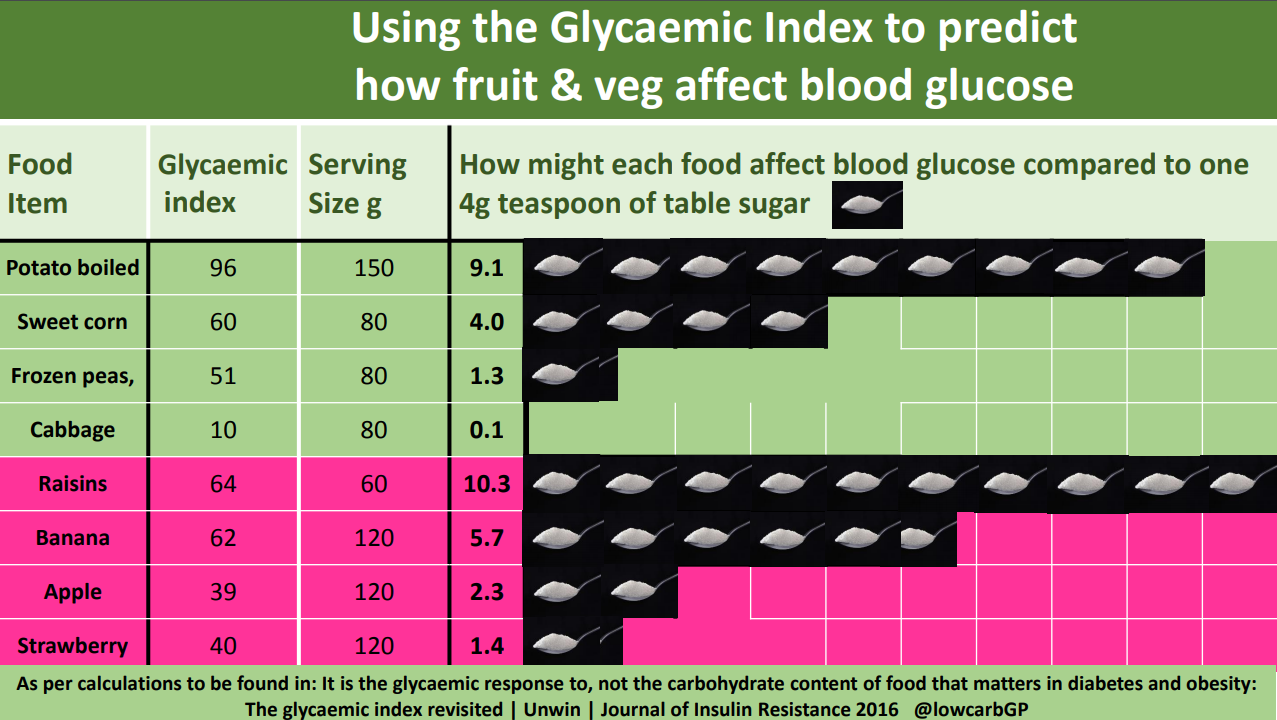
Potatoes are very high in carbohydrates, so don't 'count' as a vegetable in terms of your five a day.
Try to 'eat a rainbow' - combine several different vegetables or fruits of different colours to get the maximum vitamins and minerals.
These can be fresh, frozen, canned or dried (remember 30 g is a portion of dried fruit - some people can find it easy to eat too much).
Remember that on the whole, vegetables have less impact on your blood sugar (glucose) than fruits.
Limit your intake of fruit juice or smoothies to 150 ml per day, as these drinks have their fibre and carbohydrates already broken down. This means they can cause your blood sugar (glucose) to rise more quickly. They are also very easy to drink so you can end up having too much, which means extra calories, carbohydrate and sugar!
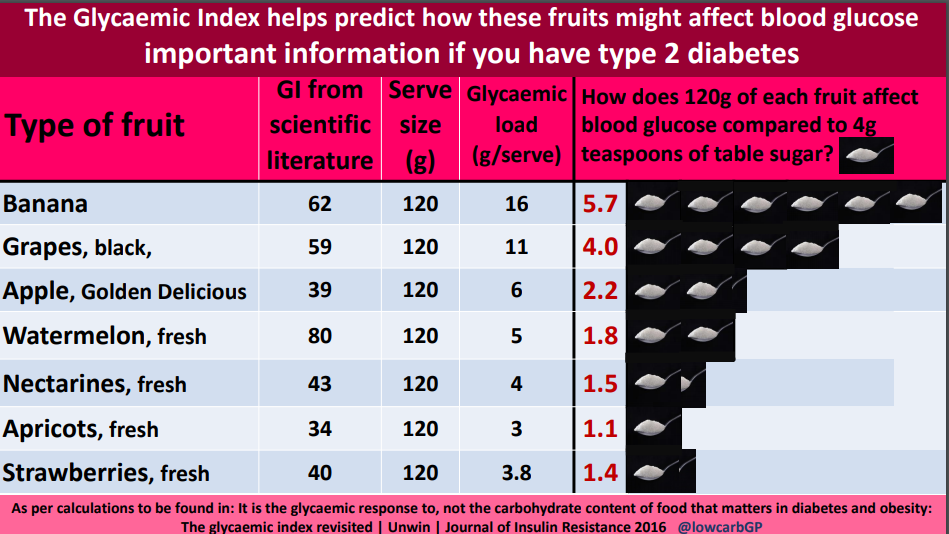
Try to avoid the more sugary (high glycaemic index - see below) tropical fruits like bananas, oranges or pineapples (particularly in juiced form). Instead, eat lower glycaemic index fruits like blueberries, strawberries or raspberries.
Instead of eating a banana, snack on an apple, which has less impact on your blood glucose.
It can be helpful to consider how much food affects your blood sugar (glucose) compared to eating table sugar. You can see some examples below:
Fruit & vegetables impact on blood sugar compared to table sugar
Various fruits impact on blood sugar compared to table sugar
One portion is:
Three heaped tablespoons of cooked vegetables, beans or pulses.
One medium onion or tomato.
A small bowl of salad.
One piece of medium-sized fruit (banana, apple, orange, etc).
Two pieces of small fruit (satsumas, plums, kiwi fruit, etc).
One handful of grapes.
Practical suggestions
Prepare some chopped vegetables for an afternoon snack - for example, carrot, pepper or celery.
Add sliced fruit or berries to porridge oats for breakfast.
Choose 2-3 vegetables to add to each meal you cook - for example, onions and pepper to a stir-fry or curry.
Replace rice or pasta with raw spinach leaves or cauliflower rice (easy to make at home and much cheaper than shop-bought versions).
Sugar and junk food
The good news is you can usually reduce the level of your blood glucose and HbA1c if you improve your diet. Because the central problem in diabetes is high levels of sugar (glucose) in your system, it is logical to make a significant cut in the amount of sugar in your diet.
Sugar is 'empty' calories - it has no nutritional value at all. Highly processed food, sometimes called 'junk' food, is also high in sugar as well as 'refined' carbohydrates, which are rapidly absorbed into your system and raise your blood sugar.
You should try to cut out as much sugar and junk food as you can from your diet. There are lots of ideas in this leaflet for tasty, healthier alternatives which do not need to be much more expensive.
Starchy carbohydrates
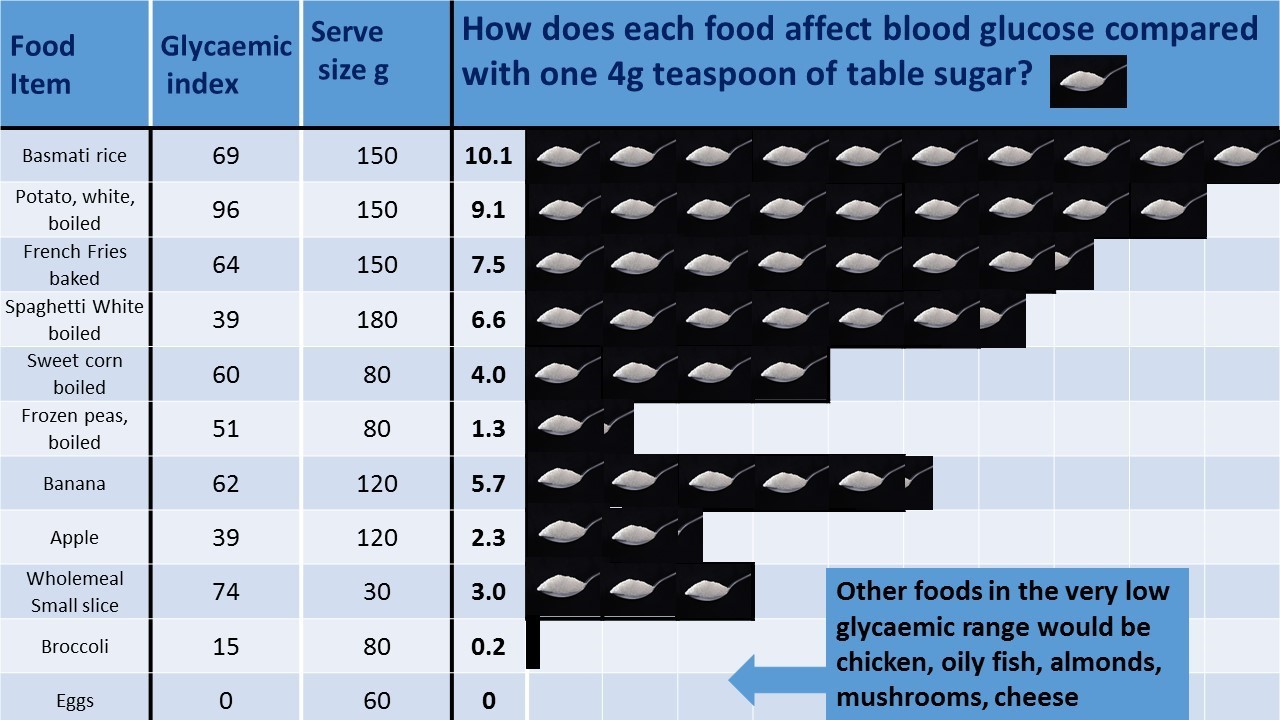
What many people don't realise is that starchy carbs like bread, potatoes or breakfast cereals digest down into a surprisingly large amount of sugar. For example:
A small (30 g) slice of white bread has the same impact on your blood sugar as almost four teaspoons of table sugar.
A 150 g bowl of rice affects your blood sugar to the same extent as ten teaspoons of table sugar.
150 g of boiled potato raises your blood sugar as much as nine teaspoons of table sugar.
By contrast, 150 g of broccoli or cabbage have less impact on your blood sugar than half a teaspoon of sugar.
A breakfast of plain yoghurt and berries or a cheese omelette will represent far less glucose than toast or cereals.
Common foods impact on blood sugar compared to table sugar
The National Institute for Health and Care Excellence (NICE) recommends that healthcare professionals should "Encourage high-fibre, low-glycaemic-index sources of carbohydrate in the diet, such as fruit, vegetables, whole grains and pulses."
Where you do include carbohydrates in your diet, always opt for wholemeal or wholegrain 'complex' carbohydrates. These are absorbed more slowly into your system than refined carbs (white flour, bread, pasta, etc) and do not tend to cause the same spikes in your blood sugar. In addition, they provide dietary fibre, which is important for gut health.
Dairy and dairy alternatives
Rich in calcium and other vitamins and minerals. Full-fat versions are higher in calories but may help keep you feeling full for longer.
Practical suggestions
Choose semi-skimmed or skimmed milk rather than full-fat milk.
Top fresh fruit with natural or low-fat Greek yoghurt for a healthy breakfast or snack idea.
Top baked potatoes or wholegrain crackers with cottage cheese instead of a regular hard cheese.
Grate cheese rather than using slices, as you tend to eat smaller amounts this way.
Meats, fish, eggs, beans, pulses, nuts and other proteins
High in protein for building and repairing processes in the body. A source of iron. One portion of meat or fish is about the size of your palm.
Include this food group daily.
Eat two portions of oily fish per week to promote heart health.
Reduce intake of processed meat; choose leaner cuts of meat and try to replace meat with beans, pulses and lentils on some days. This will reduce fat and boost fibre intake.
Whether you're vegetarian or not, try substituting tofu for meat in stir-fries and stews.
Practical suggestions
Eggs any way are a great way to start the day - boiled, scrambled, poached, dry fried or in an omelette.
Grill meat (including poultry), fish or meat alternative and serve with mixed vegetables for dinner.
Snack on a handful of nuts and seeds if feeling hungry, or sprinkle them on salads.
Add extra beans and pulses to meals to add bulk or replace meats - for example, kidney beans, lentils, chickpeas.
Fluid
Keeps you hydrated.
Aim to drink at least 6-8 glasses of fluid per day. Include plenty of non-fizzy and no-added-sugar drinks - water is best and is calorie-free!
Practical suggestions
Caffeinated drinks up to 400 mg caffeine a day (about eight cups of tea or four cups of coffee) don't carry health risks and can contribute to your daily fluid intake. If you're pregnant, you shouldn't have more than 200 mg caffeine a day.
Beware the calorie count of your favourite full-fat latte!
Always carry a bottle of water with you.
Switch from full-sugar fizzy drinks to sugar-free alternatives - or better still, water.
Drink 1-2 glasses of water 15 minutes before a meal to help with hydration and portion control.
Salt
Lowering your intake can reduce blood pressure and risk of stroke and heart disease.
Reduce intake of processed foods and ready meals, which tend to have a high salt content.
Prepare foods freshly where possible, as this gives you control of the amount of salt in the foods.
Practical suggestions
Remove the salt from the table to resist the temptation to add extra to foods before eating.
Use other flavourings in cooking, such as dried herbs and spices - for example, paprika, cumin seeds, chilli flakes.
Try to cook from fresh and make home-made sauces and marinades where possible.
Limit your intake of processed meats like bacon and salami, which are high in salt.
Choose low-salt stock cubes to use in soups and in gravy, and for cooking.
Because it is the sodium in salt which raises your blood pressure, consider a reduced-sodium alternative to traditional table salt. Consult with your doctor before switching if you have kidney problems.
Foods high in fat and sugar
While we all need some fat in our diets, most of us get far more than we need. High-sugar and high-fat food and drink can contribute to weight gain, and sugary foods can cause sharp rises in your blood glucose levels. If you do eat these foods, keep them as an occasional treat.
Practical suggestions
Reduce amount and swap type of fat to unsaturated alternatives such as vegetable, rapeseed or olive oil in cooking.
Try swapping butter for an olive-based spread.
Try using a spray oil instead, as you generally use less and some can be as low as 1 kcal per spray.
Start looking at food labels and choose lower-fat varieties (less than 3 g total fat per 100 g and less than 1.5 g saturated fat per 100 g).
What is the glycaemic index?
The glycaemic index (GI) of a food tells you how quickly the food is digested and absorbed, and how quickly your blood sugar (glucose) levels rise (low GI = slowly, high GI = quickly).
Foods with a lower GI release energy more slowly, helping you to feel fuller for longer. They also help reduce sharp fluctuations in blood glucose levels.
Healthy lower GI foods include pulses, beans, lentils, fruit and vegetables. The GI of foods should not be the only focus of your diet.
This is because unhealthy low GI options do exist - chocolate being an obvious example. You probably won't be surprised to hear that if you eat these in large quantities, lower GI foods will still cause a large rise in your blood glucose levels. The focus should remain on general healthy eating principles and portion control.
Why is food portion size important?
Controlling your portion size can be a really helpful way to stabilise or lose weight. It can also help you to manage your blood sugar (glucose) levels better. Top tips for portion control include:
Use smaller-sized plates.
Measure out portion sizes.
Fill your plate with low-calorie food, such as salads and vegetables, before adding other types of food.
Drink a glass or two of water about 15 minutes before a meal.
Eat slowly. It takes about 20 minutes for your brain to register how much you've eaten, so if you eat fast you may have overeaten long before your brain tells you you're full.
Don't do anything else while you're eating. Research shows we all tend to eat more if we're distracted (for example, watching television or playing on a computer).
Resist the temptation to return for seconds.
Example portions: 30 g cheese, a palm-sized piece of meat/fish/poultry, 2-3 tablespoons rice, pasta or cereals, 1 slice of bread. You can find fruit and vegetable portions above.
What are the benefits of weight loss if you're overweight?
Losing weight if you're overweight can greatly improve your blood sugar (glucose) levels. Losing weight can also help reduce your blood pressure and cholesterol levels. This in turn helps to reduce risk of stroke and heart disease.
Weight loss of 5-10% of your current body weight is enough to gain significant health benefits. Whether you lose weight through diet, physical activity or a combination of both, it doesn't matter. The key to success is finding out what works for you and sticking to it.
Do 'diabetic foods' need to be included in your diet?
Foods labelled as 'suitable for people with diabetes' on the supermarket shelves do not provide you with any special benefit above that of ordinary foods and so are not recommended. These foods are often more expensive, high in calories and still able to cause your blood sugar (glucose) levels to rise.
Five take home messages
Carbohydrates, whether sugary or starchy, raise your blood sugar (glucose) more than any other foods.
Your diet should be high in fibre with plenty of fruit and vegetables, low in fat (particularly saturated fat), low in sugar and low in salt.
Be mindful of the portion size of foods you eat - portions which are too large can contribute to weight gain and lead to poorer management of blood glucose levels.
If you're overweight, aim for 5-10% weight loss - using a method you are likely to stick to.
'Diabetic foods' offer no additional benefit above 'normal' foods and so are not advised.
Patient picks for Diabetes
Diabetes
Type 2 diabetes
Type 2 diabetes can occur at any age, including during childhood, but it occurs mainly in people aged over 40. The first-line treatment is diet, weight control and physical activity. The good news is that many people can stay well using these lifestyle measures. However if the blood sugar (glucose) level remains high then tablets to reduce the blood glucose level are usually advised. Insulin injections are needed in some cases. Other treatments include reducing blood pressure if it is high, lowering high cholesterol levels, and also other measures to reduce the risk of complications.
by Dr Colin Tidy, MRCGP
Diabetes
HbA1c converter
Use this HbA1c converter to switch results between the mmol/mol units used in the UK and the percentage (%) units still used in some other countries and older test reports. HbA1c reflects your average blood glucose levels over the past 2–3 months and is commonly used to diagnose and monitor diabetes. Open the calculator.
by Patient infomatics team
Frequently asked questions
Are there any specific foods I should avoid entirely with type 2 diabetes?
The article recommends significantly cutting down on sugar and junk food due to their high sugar content and rapid absorption, which raises blood sugar. It also advises limiting processed meats and refined carbohydrates like white bread and pasta. Fruits and vegetables like tropical fruits (bananas, oranges, pineapples) and potatoes are highlighted as having a higher impact on blood sugar compared to other vegetables and lower glycaemic index fruits.
How can I tell if a food is high in glycaemic index?
The glycaemic index (GI) indicates how quickly a food is digested and absorbed, and how rapidly it raises your blood sugar. Foods with a low GI release energy slowly, helping you feel fuller for longer and reducing sharp fluctuations in blood glucose. The article suggests that fruits and vegetables generally have less impact on blood sugar than table sugar, and specifically mentions that lower GI fruits include blueberries, strawberries, and raspberries. Processed foods and refined carbohydrates tend to be higher GI.
How can I make sure my diabetes diet is affordable?
The article notes that many tasty, healthier alternatives do not need to be much more expensive. For instance, making cauliflower rice at home is cheaper than buying it pre-made. Preparing meals freshly and using herbs and spices for flavour instead of relying on pre-made sauces and marinades can also be more economical and allow for better control over ingredients like salt.
What are some healthy seasoning options for cooking instead of salt?
To reduce salt intake, the article suggests using other flavourings in cooking such as dried herbs and spices. Examples given include paprika, cumin seeds, and chilli flakes. Cooking from fresh and making homemade sauces and marinades can also help you control the amount of salt used.
Further reading and references
- Type 1 diabetes in adults: diagnosis and management; NICE Guidelines (August 2015 - last updated August 2022)
- Type 2 diabetes in adults: management; NICE Guidance (December 2015 - last updated February 2026)
- Diabetes - type 1; NICE CKS, June 2026 (UK access only)
- Diabetes - type 2; NICE CKS, July 2026 (UK access only)
- Information prescriptions - living well; Diabetes UK
- Diabetes in pregnancy - management from preconception to the postnatal period; NICE Clinical Guideline (February 2015 - last updated December 2020)
- Diabetes (type 1 and type 2) in children and young people: diagnosis and management; NICE Guidelines (Aug 2015 - updated May 2023)
About the authorView full bio

Dr Colin Tidy, MRCGP
General Practitioner, Medical Author
MBBS, MRCGP, MRCP (Paediatrics), DCH
Dr Colin Tidy is an NHS Doctor, based in Oxfordshire.
About the reviewerView full bio

Dr Doug McKechnie, MRCGP
Medical Writer
MA, MBBS, MSc, DRCOG, MRCP(UK), MRCGP(2021), FHEA
Dr Doug McKechnie is an NHS GP working in London. He works full-time clinically and is also the Deputy Lead for the Clinical and Professional Practice module at University College London Medical School.
Article history
The information on this page is written and peer reviewed by qualified clinicians.
Article also available in English, German, Spanish, French, Italian, Portuguese, Hindi, Hebrew, Arabic, and Swedish.
Next review due: 18 Dec 2027
19 Dec 2024 | Latest version
Join the conversation
Share your thoughts or experiences with others in our patient communities.

Ask, share, connect.
Browse discussions, ask questions, and share experiences across hundreds of health topics.

Feeling unwell?
Assess your symptoms online for free
Sign up to the Patient newsletter
Your weekly dose of clear, trustworthy health advice - written to help you feel informed, confident and in control.
By subscribing you accept our Privacy Policy. You can unsubscribe at any time. We never sell your data.
More in diabetes
- Blood glucose test (blood sugar) and HbA1c
- Dealing with hyperglycaemia
- Diabetes
- Diabetes and high blood pressure
- Diabetes and illness
- Diabetes and pregnancy
- Diabetes in children
- Diabetic amyotrophy
- Diabetic foot ulcers
- Diabetic kidney disease
- Diabetic retinopathy
- Driving and diabetes
- Glucose tolerance test
- HbA1c converter
- Hypoglycaemia
- Insulin
- Non-diabetic hyperglycaemia (pre-diabetes)
- Type 1 diabetes
- Type 2 diabetes
- Type 2 diabetes treatment