حصى الكلى
مراجعة من قبل الدكتور كريشنا فاخاريا، MRCGPآخر تحديث بواسطة الدكتور كولين تايدي، MRCGPآخر تحديث 18 مايو 2023
يتوافق مع الإرشادات التحريرية
- تنزيلتنزيل
- مشاركة
- Language
- نقاش
- نسخة صوتية
- أضف إلى المصادر المفضلة على جوجل
Kidney stones are hard stones that can cause severe pain in your side along with blood in your urine, and nausea and vomiting. You are more likely to develop kidney stones if you eat a Western diet, don't drink enough fluids or are overweight. Once you have had one episode they are likely to recur but there are several kidney stone treatment options available.
نظرة سريعة
Kidney stones are hard lumps that can form in your kidneys, ureters, or bladder.
They are common, affecting up to 1 in 7 people.
Symptoms can include severe pain in the abdomen, blood in urine, or urine infections.
Most small stones pass out naturally, but drinking plenty of fluids can help.
Larger stones may need treatments like shock waves, keyhole surgery, or an operation.
If you have kidney stone symptoms, your doctor may arrange urine, blood tests, or scans.
What are kidney stones?
Kidney stones are hard stones that can form in the kidney, in the tube (the ureter) draining urine from the kidney, or in the bladder.
Renal (kidney) stones with indication of size
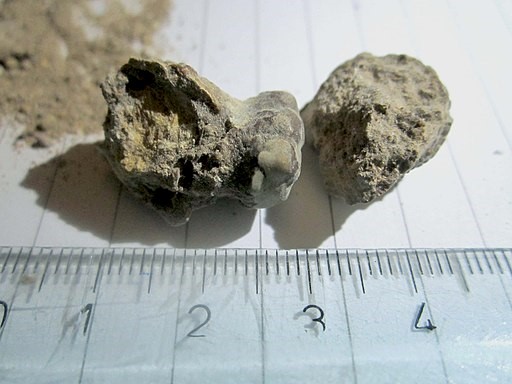
© Jakupica, CC BY-SA 4.0, via Wikimedia Commons
Our kidneys remove many different chemicals from our body. This is really important to keep us healthy. These chemicals are passed from our kidneys to our bladder and out of our body. Occasionally these chemicals can join together and form kidney stones.
How common are kidney stones?
Kidney stones are common and occur in up to 1 in 7 people.
Each year 1 or 2 people in every 1,000 will have symptoms caused by kidney stones.
About 1 in 8 men and 1 in 16 women will have an episode of pain caused by kidney stones at some time in their lives.
If you have a kidney stone there is about a 1 in 2 chance of having another stone within the following five years.
Kidney stones are more common in people who are تعاني من زيادة الوزن, or have السكري ,، أو ارتفاع ضغط الدم.
What causes kidney stones?
Diagram with kidney cross-section
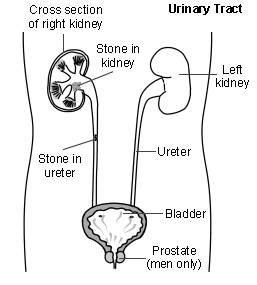
The kidneys filter the blood and remove excess water and waste chemicals to produce urine. Urine travels from each kidney down the tube (the ureter) draining urine from the kidney into the bladder. This is called the urinary tract.
Many waste chemicals are dissolved in the urine. The chemicals sometimes form tiny crystals in the urine which clump together to form a small stone. Most kidney stones are small and pass out with the urine. Some stones become stuck in a kidney or in the ureter.
In most cases, there is no known reason why a stone is formed. Most stones are made of calcium. However, in most cases, the amount of calcium and other chemicals in the urine and blood is normal.
Kidney stone symptoms
For some people, a kidney stone may just stay in a kidney and cause no symptoms. Other kidney stones may travel out of your body in your urine without you knowing anything about it. If kidney stone symptoms do occur, they include:
Pain from a kidney. A stone that is stuck in a kidney may cause pain in the side of your abdomen (loin). This pain can be very severe and cause you to feel sweaty and be sick (vomit).
Renal colic:
This is a severe pain which is caused by a stone that passes into the tube (the ureter) draining urine from the kidney.
The stone becomes stuck. The ureter squeezes the stone towards the bladder, which causes intense pain in the side of your tummy (abdomen).
The pain caused by renal colic may last from a few minutes to a few hours. The pain comes in spasms and between these spasms there may be intervals of no pain or just a dull ache.
The pain may spread down into the lower abdomen or groin. You may sweat, feel sick or even vomit because the pain can be very bad.
Blood in your urine. You may see blood in your urine (the urine turns red). This is caused by a stone rubbing against the inside of your ureter.
Urine infection. Urine infections are more common in people with kidney stones. Urine infections may cause high temperature (fever), pain on passing urine (dysuria) and a need to pass urine more often.
What makes kidney stones more likely?
You are more likely to form a kidney stone if your urine is concentrated. For example, if you exercise vigorously, if you live in a hot climate or if you work in a hot environment when you may lose more fluid as sweat and less as urine.
You are also more prone to develop kidney stones if you have:
Repeated (recurrent) urine infections.
An abnormal kidney - for example, with scars or cysts on it.
A close relative who has had a kidney stone.
Underlying causes are uncommon
In a small number of cases, a medical condition causes the kidney stone. Various uncommon conditions can lead to high levels of chemicals in the body, such as calcium, oxalate, uric acid and cystine. If the level of these chemicals is high enough in the urine, they can form into stones.
Do some medicines make kidney stones more likely?
Taking certain medicines can make you more prone to making kidney stones. Examples include:
Some chemotherapy medicines for cancer.
Some medicines used to treat فيروس نقص المناعة البشرية.
However, many people safely take these medicines without developing kidney stones. If you think that a medicine you are taking is the cause of your kidney stone, you should not stop taking the medicine but discuss it with your doctor.
Diagnosing kidney stones
Your doctor may arrange some initial urine and blood tests if you display kidney stone symptoms:
اختبار دم to check that the kidneys are working properly.
You may also have other blood tests to check the level of certain chemicals that may cause kidney stones if the level is high. Examples include calcium and uric acid.
اختبارات البول to check for infection and for certain crystals.
If you have kidney stone symptoms, special X-rays or scans of the kidneys and the tubes (the ureters) draining urine from the kidneys may be done. These tests may start with an الأشعة السينية و الموجات فوق الصوتية. A فحص الأشعة المقطعية may also be needed. These tests are used to detect a stone, to find out exactly where it is and to check that a stone is not blocking the flow of urine.
What can be done to rule out or confirm an underlying cause?
Kidney stones are common and they are not caused by any known underlying disease for most people. However, some tests may be recommended to rule out an underlying problem. In particular, tests are more likely to be advised if:
You have repeated (recurring) kidney stones.
You have symptoms of an underlying condition.
You have a family history of a particular condition.
A stone forms in a child or young person.
You may be asked to catch a stone so that it can be analysed. This will help to find out if there may be an underlying cause for the kidney stone. To catch a stone, you will need to pass urine through gauze, a tea strainer or a filter such as a coffee filter.
Kidney stone treatment
Most stones that cause renal colic are small and pass out with the urine in a day or so. You should drink plenty of fluids to encourage a good flow of urine. مسكنات الألم القوية are often needed to ease the pain until you pass the stone. No other treatment is usually needed.
Some stones become stuck in a kidney or in one of the tubes (the ureters) draining urine from a kidney and cause persistent symptoms or problems. In these cases, the pain usually becomes severe and you may need to be admitted to hospital. There are various kidney stone treatment options, including:
Extracorporeal shock wave lithotripsy (ESWL) uses high-energy shock waves which are focused on to the stones from a machine outside the body to break up stones. You then pass out the tiny broken fragments when you pass urine.
Percutaneous nephrolithotomy (PCNL) is used for stones not suitable for ESWL. A thin telescope-like instrument (a nephroscope) is passed through the skin and into the kidney. The stone is broken up and the fragments of stone are removed via the nephroscope. This procedure is usually done under general anaesthetic.
Ureteroscopy is another treatment that may be used. In this procedure, a thin telescope is passed up into the ureter via the urethra and bladder. Once the stone is seen, a laser is used to break up the stone. This technique is suitable for most types of kidney stones.
الجراحة to remove the stone. This is only needed in a very small number of cases where the above, newer techniques have not worked or are not possible. It may be done if you have a very large stone in your kidney.
Another option for a purely uric acid stone (about 1 in 20 stones) is to dissolve the stone. This can be done by drinking plenty of fluids and making the urine alkaline with medication.
How to prevent kidney stones
There are various kidney stone treatment options available, but about half of people who have a kidney stone develop another one at a later time in their lives. Drinking plenty of water each day may help in preventing kidney stones in future.
For the few people who have a high level of certain chemicals in the body, further advice and treatment to reduce the amount of these chemicals may be needed.
Kidney stone complications
Complications from kidney stones are uncommon. Rarely, a large stone can completely block the flow of urine passing down one of the tubes (ureters) draining urine from the kidney. This may lead to infection or even damage to the kidney (إصابة الكلى الحادة أو مرض الكلى المزمن).
This is now very uncommon because X-rays or scans will usually detect any blockage so that large stones can be removed before they cause any damage to your kidneys.
اختيارات المرضى لـ Kidney disorders

الكلى والمسالك البولية
مرض الكلى المتعدد الكيسات
Polycystic kidney disease (PKD) causes many fluid-filled sacs (cysts) to develop in the kidneys.
بقلم الدكتور كولين تايدي، MRCGP
الكلى والمسالك البولية
مرض الكلى المزمن
Chronic kidney disease means that the kidneys are not working as well as would be expected. Various conditions can cause chronic kidney disease. Severity can vary but most cases are mild or moderate, occur in older people and do not cause symptoms. Chronic kidney disease tends to become worse gradually over months or years.
بقلم الدكتورة فيليبا فينسنت، MRCGP
الأسئلة الشائعة
Where do kidney stones go once they pass?
Most kidney stones that are small simply pass out of the body with your urine. You may not even notice them leaving. If a stone has been analysed, it's usually because you were asked to collect it after it passed.
Why would I feel sick or vomit when I have a kidney stone?
The pain associated with kidney stones, particularly renal colic, can be very severe. This intense pain can lead to feelings of sickness (nausea) and cause you to vomit.
Are kidney stones dangerous?
Complications from kidney stones are uncommon. Rarely, a very large stone could completely block the flow of urine from a kidney, which could potentially lead to infection or damage to the kidney itself. However, such blockages are usually detected by scans, allowing for the stone to be removed before it causes any harm.
What is the typical timeframe for passing a kidney stone?
Most small stones that cause renal colic are passed out with the urine within about a day or so. Drinking plenty of fluids helps to encourage a good flow of urine, which can assist in this process.
How can I prevent kidney stones from returning?
About half of people who have had one kidney stone will develop another one later in life. A key preventative measure is to drink plenty of water every day. If you have high levels of certain chemicals in your body that contribute to stone formation, further advice and treatment might be needed to reduce these levels.
قراءة إضافية ومراجع
- CUA guideline on the evaluation and medical management of the kidney stone patient; Canadian Urological Association (November 2016)
- Renal or ureteric colic - acute; NICE CKS، أكتوبر 2024 (الوصول متاح فقط في المملكة المتحدة)
- تحصي المسالك البولية; European Association of Urology (2023)
- Khan SR, Pearle MS, Robertson WG, et al; Kidney stones. Nat Rev Dis Primers. 2016 Feb 25;2:16008. doi: 10.1038/nrdp.2016.8.
- Fontenelle LF, Sarti TD; Kidney Stones: Treatment and Prevention. Am Fam Physician. 2019 Apr 15;99(8):490-496.
عن المؤلفعرض السيرة الذاتية الكاملة

الدكتور كولين تايدي، MRCGP
طبيب عام، مؤلف طبي
MBBS, MRCGP, MRCP (Paediatrics), DCH
الدكتور كولين تايدي هو طبيب في هيئة الخدمات الصحية الوطنية، ويعمل في أوكسفوردشاير.
حول المراجععرض السيرة الذاتية الكاملة

الدكتور كريشنا فاخاريا، MRCGP
كبير المسؤولين الطبيين للصحة، أوبتوم المملكة المتحدة
MBChB, MRCGP(2013), BMedSci (hons), DFSRH, DRCOG, PGDipDerm (Distn)
الدكتورة كريشنا فاخاريا هي طبيبة عامة في هيئة الخدمات الصحية الوطنية. كما أنها ممتحنة منتظمة لدبلوم الدراسات العليا في الأمراض الجلدية العملية في جامعة كارديف، بالإضافة إلى كونها كبيرة المسؤولين الطبيين للصحة في Optum UK.
تاريخ المقال
تمت كتابة المعلومات على هذه الصفحة ومراجعتها من قبل أطباء مؤهلين.
المقال متاح أيضًا باللغة الإنجليزية, الألمانية, إسبانية, الفرنسية, إيطالي, البرتغالية, الهندية, العبرية, العربية ,، و السويدية.
المراجعة التالية مستحقة: 12 مايو 2028
18 مايو 2023 | أحدث إصدار

اسأل، شارك، تواصل.
تصفح المناقشات، اطرح الأسئلة، وشارك التجارب عبر مئات المواضيع الصحية.

هل تشعر بتوعك؟
قم بتقييم أعراضك عبر الإنترنت مجانًا
اشترك في النشرة الإخبارية للمرضى
جرعتك الأسبوعية من النصائح الصحية الواضحة والموثوقة - مكتوبة لمساعدتك على الشعور بالاطلاع والثقة والتحكم.
من خلال الاشتراك، فإنك تقبل سياسة الخصوصية. يمكنك إلغاء الاشتراك في أي وقت. نحن لا نبيع بياناتك أبدًا.
المزيد في الكلى والمسالك البولية
- التبول اللاإرادي
- دواء التبول اللاإرادي - ديسموبريسين
- أنظمة مكافآت التبول اللاإرادي
- دم في البول
- التهاب المثانة عند النساء
- تنظير المثانة
- مرض الكلى السكري
- النظام الغذائي في مرض الكلى المزمن
- الكيتونات في البول
- خزعة الكلى
- سرطان الكلى
- زرع الكلى
- مرض الكلى المتعدد الكيسات
- بيلة بروتينية
- التهاب المثانة المتكرر لدى النساء
- اختبار دم روتيني لوظائف الكلى
- سلس البول
- التهاب المسالك البولية لدى كبار السن
- التهاب المسالك البولية أثناء الحمل
- تصوير المثانة والإحليل أثناء التبول