
التهاب البروستاتا الحاد
مراجعة من قبل الدكتورة فيليبا فينسنت، MRCGPآخر تحديث بواسطة الدكتورة توني هازيل، زميلة الكلية الملكية للأطباء العامينآخر تحديث 22 مايو 2023
يتوافق مع الإرشادات التحريرية
- تنزيلتنزيل
- مشاركة
- Language
- نقاش
- Ask Patient
- نسخة صوتية
- أضف إلى المصادر المفضلة على جوجل
When the prostate gland becomes infected with a germ (a bacterial infection), the condition is known as acute prostatitis. 'itis' means inflammation, so prostatitis is inflammation of the prostate - not all forms of prostatitis are bacterial, but this leaflet will mainly cover bacterial prostatitis. Symptoms include pain, mainly at the base of the penis and around the anus. A bladder infection commonly occurs at the same time. Treatment includes a four-week course of antibiotic medication.
نظرة سريعة
التهاب البروستاتا الحاد هو عدوى في غدة البروستاتا لدى الرجال.
عادةً ما تتطور الأعراض بسرعة ويمكن أن تشمل الألم والحمى ومشاكل في التبول.
قد يشعر بالألم في قاعدة القضيب، حول فتحة الشرج، فوق عظم العانة، أو في أسفل الظهر.
غالبًا ما يتم علاجه بدورة من المضادات الحيوية، تستمر عادةً لمدة أربعة أسابيع.
تناول الدورة الكاملة من المضادات الحيوية مهم لمنع العدوى من أن تصبح مستمرة.
Acute prostatitis symptoms
In acute prostatitis, symptoms develop quickly - typically over a few days or so. It usually occurs at the same time as a urine infection. Therefore, you may also have a bladder infection (cystitis). Germs (bacteria) are found in your urine if a urine sample is taken. Symptoms include:
Pain from your prostate, which may be severe. You feel this mainly at the base of your penis, around your anus, just above your pubic bone and/or in your lower back. Pain may spread to your penis and testicles (testes). Passing stools (faeces) can be painful.
Symptoms of a urine infection. For example: pain when you pass urine, passing urine frequently, an urgent desire to pass urine, and sometimes having blood in your urine. Some people can develop problems so that they are unable to pass urine and the urine builds up in the bladder (this is called urinary retention). See the separate leaflet called Urinary Retention.
ارتفاع درجة الحرارة (الحمى). General aches and pains. You generally feel ill.
A small amount of thick fluid (discharge) may come out of your penis from your urethra.
Your prostate feels tender if a doctor examines it with a gloved finger in your back passage (rectum) - this is known as a digital rectal examination, a type of physical examination.
What is the prostate gland?
Cross-section diagram of the prostate and nearby organs
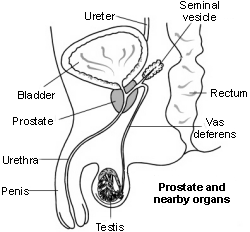
Only men have a prostate gland (just referred to as the 'prostate' from now on here). It lies just beneath the bladder. It is normally about the size of a chestnut. The urethra is the tube that urine travels along from the bladder to the outside and it runs through the middle of the prostate and then through the penis. The prostate helps to make semen but most semen is made by another gland nearby (the seminal vesicle).
Causes of acute prostatitis
Infection by germs (bacteria) that normally live in your bowel
Some bacteria that live harmlessly in the bowel commonly get on to the skin near to the anus when we pass stools (faeces). In some people they may then multiply. Some of these bacteria may then travel up the urethra and cause infection anywhere in the urinary tract - that is, the kidneys, bladder, prostate, or urethra. This is called a 'عدوى الجهاز البولي'.
A prostate infection may also occur with or without other parts of the urinary tract being infected. Some conditions that cause pooling or blockage of urine increase the risk of a urinary tract infection. For example, having an enlarged prostate gland أو حصى الكلى. This is because bacteria often thrive and multiply quickly in pooled urine.
Less common causes
Damage to the prostate makes it more prone to infection - for example, after prostate surgery.
A thin, flexible, hollow tube (a catheter) passed into the bladder through the urethra may sometimes let bacteria travel to the prostate. This can also happen after a telescopic instrument is passed through the urethra into the bladder (as happens during investigation of the prostate gland and the bladder).
Sometimes the prostate is infected by bacteria in the bloodstream that have travelled from other infections in the body.
Acute prostatitis is not considered a sexually transmitted infection, so a sexual partner is not at risk.
How common is acute prostatitis?
Symptoms of prostatitis affect around 8% of men at some point in their life, but only about 10% of these have a proven bacterial cause, though it is possible that more are bacterial but we never find out exactly which bacteria it is.
Diagnosing acute prostatitis
Diagnostic tests to assess for infection will likely include:
A urine test may detect germs (bacteria) if you have acute prostatitis and should definitely be positive if you have a عدوى الجهاز البولي. Your doctor will usually be able to do a quick test on your urine in the surgery (a dipstick urine test). This can show if infection is likely to be present. They may then send your urine sample to the laboratory to be tested further and to confirm infection.
اختبارات أخرى such as an الموجات فوق الصوتية أو التصوير المقطعي المحوسب (CT) أو فحص الرنين المغناطيسي may be advised following acute prostatitis. This is to rule out any problem with your urinary tract that may have contributed to causing the infection. CT and MRI scans are usually arranged by a hospital consultant rather than the GP.
اختبارات الدم may or may not be done, depending on your exact symptoms. Sometimes this may include a prostate specific antigen (PSA) test, which is more usually done when concerned about prostate cancer. If it is raised, this does not necessarily mean that you have cancer - the test may become normal after you have antibiotics.
Acute prostatitis can produce similar symptoms to a sexually transmitted infection. For this reason, if you are at risk of a sexually transmitted infection, your doctor may suggest that you have some swab or urine tests to exclude this. ملاحظة: acute prostatitis is not a sexually transmitted infection.
Acute prostatitis treatment
المضادات الحيوية. A four-week course is usually needed, though the recommendation is for an initial two-week course and then a review and consideration of giving another two weeks' worth. Antibiotics are generally started before the confirmatory urine test results are back. The first antibiotic may be changed after the result of the urine test is back. The urine test may find exactly which germ (bacterium) is causing the infection and the best antibiotic to treat it, but this does not always happen - sometimes the result is less specific. Four weeks of antibiotics are thought to be necessary to reduce the chance that you develop persistent (chronic) prostatitis. If you are very unwell, you may need to go into hospital to have the antibiotics given through a vein.
الباراسيتامول أو الإيبوبروفين ease pain and high temperature (fever). They are best taken regularly rather than now and then. Stronger painkillers are sometimes needed.
المُلينات can keep your stools (faeces) soft, if needed. They may help to ease pain if you have hard stools in your back passage (rectum), pressing on your infected prostate.
Complications of acute prostatitis
Rarely, apart from chronic bacterial prostatitis, other complications of acute prostatitis can occur. These include:
Sudden-onset (acute) urinary retention. Because it may be so painful to pass urine, urine can build up in your bladder, causing pain in your lower tummy (abdomen) and inability to pass urine at all. To relieve this, a thin, flexible, hollow tube (a catheter) is needed. This is usually inserted through a small cut in your tummy (abdomen) directly into your bladder to drain the urine. The catheter can usually be removed once the antibiotics have started working and the infection of the prostate is clearing.
Prostate abscess. If the antibiotics do not effectively treat the prostate infection, rarely you can develop an خراج of your prostate. Your doctor may suspect this if your symptoms do not improve despite antibiotic treatment. Further tests are needed to confirm a prostate abscess, such as an ultrasound or CT scan of your prostate. If an abscess is present, an operation is needed to drain it.
Outlook (prognosis)
Acute prostatitis usually clears with a course of antibiotics. However, it is important to take the full course to clear the infection completely. There is a risk that an acute infection may become a persistent (chronic) infection if you do not take the full course of antibiotics - this can lead to chronic pelvic pain syndrome. See the separate leaflet called Chronic Prostatitis for further details.
اختيارات المرضى لـ Prostate disorders
صحة الرجال
التهاب البروستاتا المزمن
Prostatitis means that you have inflammation of your prostate gland. There are two main types of prostatitis: short-lived (acute) or persistent (chronic). It can also be caused by an infection (infective) or be non-infective. Less than 1 in 10 cases of prostatitis are due to bacterial infection. For the diagnosis of chronic prostatitis, symptoms need to have been present for at least three months. In acute prostatitis, symptoms usually come on and go away much more quickly. About 9 in 10 men with chronic prostatitis have chronic prostatitis/chronic pelvic pain syndrome (CPPS). About 1 in 10 men with chronic prostatitis have chronic bacterial prostatitis.
بقلم الدكتورة توني هازيل، FRCGP

صحة الرجال
مشاكل البروستاتا
Prostate and urethral problems can affect the smooth flow of urine in men. This leaflet will give you a brief explanation of the different prostate and urethral conditions and how the urine system can be affected.
بقلم الدكتورة راشيل هدسون، MRCGP
الأسئلة الشائعة
هل يمكن الخلط بين التهاب البروستاتا الحاد وعدوى منقولة جنسياً؟
نعم، يمكن أن تسبب التهاب البروستاتا الحاد أعراضًا مشابهة لعدوى منقولة جنسيًا (STI). لهذا السبب، إذا كنت معرضًا لخطر الإصابة بعدوى منقولة جنسيًا، قد يقترح طبيبك بعض الفحوصات مثل المسحة أو اختبارات البول لاستبعاد الإصابة بعدوى منقولة جنسيًا، على الرغم من أن التهاب البروستاتا الحاد نفسه لا يُعتبر عدوى منقولة جنسيًا.
ما هو الغرض من استخدام الملينات في علاج التهاب البروستاتا الحاد؟
يمكن استخدام الملينات للحفاظ على ليونة البراز إذا لزم الأمر. هذا يساعد في تخفيف الألم، خاصة إذا كان لديك براز صلب في الممر الخلفي (المستقيم) قد يضغط على البروستاتا المصابة لديك.
لماذا يعتبر إكمال دورة كاملة من المضادات الحيوية مهمًا لالتهاب البروستاتا الحاد؟
من الضروري تناول الدورة الكاملة من المضادات الحيوية للقضاء تمامًا على العدوى. هناك خطر أن تتحول العدوى الحادة إلى عدوى مستمرة (مزمنة) إذا لم يتم إكمال الدورة الكاملة من المضادات الحيوية، مما يمكن أن يؤدي إلى متلازمة الألم الحوضي المزمن.
ماذا يحدث إذا لم تنجح المضادات الحيوية في علاج التهاب البروستاتا الحاد؟
إذا لم تعالج المضادات الحيوية عدوى البروستاتا بشكل فعال، فقد يتطور خراج البروستاتا نادرًا. قد يشتبه طبيبك في ذلك إذا لم تتحسن الأعراض لديك على الرغم من العلاج بالمضادات الحيوية. ستكون هناك حاجة إلى اختبارات إضافية، مثل الموجات فوق الصوتية أو التصوير المقطعي المحوسب، لتأكيد وجود خراج، وإذا كان موجودًا، فستكون هناك حاجة إلى عملية لتصريفه.
لماذا قد يتم استخدام القسطرة إذا لم أتمكن من التبول؟
إذا كنت تعاني من احتباس بولي مفاجئ بسبب ألم التهاب البروستاتا الحاد، فقد تحتاج إلى قسطرة. هذه أنبوب رفيع ومرن يتم إدخاله من خلال قطع صغير في بطنك مباشرة إلى مثانتك لتصريف البول. يمكن عادةً إزالته بمجرد أن تبدأ المضادات الحيوية في العمل وتختفي العدوى.
قراءة إضافية ومراجع
- Coker TJ, Dierfeldt DM; Acute Bacterial Prostatitis: Diagnosis and Management. Am Fam Physician. 2016 Jan 15;93(2):114-20.
- Prostatitis - acute; NICE CKS، أغسطس 2021 (الوصول متاح فقط في المملكة المتحدة)
- الالتهابات البولية; الجمعية الأوروبية لجراحة المسالك البولية (2022 - محدثة 2024)
عن المؤلفعرض السيرة الذاتية الكاملة
تم التحديث بواسطة

Dr Toni Hazell, FRCGP
بكالوريوس الطب والجراحة، بكالوريوس العلوم، زميل الكلية الملكية للأطباء العامين، دبلوم في الصحة الجنسية والإنجابية، دبلوم في طب الجهاز البولي التناسلي، دبلوم الكلية الملكية لأطباء النساء والتوليد، دبلوم في صحة الطفل (لندن، المملكة المتحدة، 2000)
تخرجت الدكتورة توني هازيل من كلية الطب بمستشفى سانت ماري وأكملت تدريبها في مستشفى نورثويك بارك.
حول المراجععرض السيرة الذاتية الكاملة

الدكتورة فيليبا فينسنت، MRCGP
طبيب عام، مؤلف طبي
MB BS, Bsc, MRCGP (2000), DCH, DFSRH, DRCOG
الدكتورة فيليبا فينسنت هو طبيب عام في هيئة الخدمات الصحية الوطنية يعمل في شمال لندن.
تاريخ المقال
المقال متاح أيضًا باللغة الإنجليزية, الألمانية, إسبانية, الفرنسية, إيطالي, البرتغالية, الهندية, العبرية, العربية ,، و السويدية.
المراجعة التالية مستحقة: 14 أبريل 2028
22 مايو 2023 | أحدث إصدار
المهنيين الطبيين
Looking for more in-depth clinical detail? Our Professional Reference articles are written for doctors, nurses and other healthcare professionals. They include comprehensive clinical guidance, diagnostic information and UK/European evidence summaries. If you need the clinical version, you can read the Professional Reference article on this topic.
شارك أفكارك أو تجاربك مع الآخرين في مجتمعات المرضى.
وصول بسيط إلى العلاجات والخدمات الصحية الموثوقة عبر الإنترنت.
Common conditions
Get help with common conditions through the NHS, without a GP appointment.
 التهاب الجيوب الأنفية الحاد
 التهاب اللوزتين البكتيري
 القوباء
 لدغات الحشرات
 الحزام الناريعدوى المسالك البولية
اشترك في النشرة الإخبارية للمرضى
جرعتك الأسبوعية من النصائح الصحية الواضحة والموثوقة - مكتوبة لمساعدتك على الشعور بالاطلاع والثقة والتحكم.
من خلال الاشتراك، فإنك تقبل سياسة الخصوصية. يمكنك إلغاء الاشتراك في أي وقت. نحن لا نبيع بياناتك أبدًا.