الجدرة
مراجعة من قبل الدكتورة روزالين أدلمان، MRCGPآخر تحديث بواسطة الدكتورة كارولين ويجينز، MRCGP آخر تحديث 1 Jul 2025
يتوافق مع الإرشادات التحريرية
- تنزيلتنزيل
- مشاركة
- Language
- نقاش
- نسخة صوتية
- أضف إلى المصادر المفضلة على جوجل
الجدرة (وتسمى أيضًا ندبة الجدرة) هي نمو زائد للندبة بعد تلف الجلد. إنها نوع غير طبيعي من التئام الجروح. وهي شائعة بشكل خاص لدى الأشخاص ذوي البشرة الداكنة أو الذين لديهم أفراد من العائلة قد أصيبوا بندبات الجدرة.
نظرة سريعة
A keloid is an overgrowth of scar tissue that spreads beyond the original wound.
They are usually smooth, raised, firm, and can be itchy or sore.
Keloid scars are more common in people with black or brown skin, between 10-30 years old.
They often appear on the upper body, especially after ear piercing, chickenpox, or acne.
Surgical removal of keloids is rarely successful and can lead to a larger scar.
Treatment options include steroid injections, cryotherapy, laser, and radiation.
To prevent keloids, avoid unnecessary skin injuries like piercings or tattoos if you are prone to them.
What is a keloid scar?
A keloid scar is an overgrowth of the scar tissue that develops after a wound has healed. It expands beyond the original scar. Rather than stay in a straight line, for example, after a surgical incision, it can spread outwards and also upwards, giving a raised scar.
Who gets keloid scars?
Keloid scars are more common in people with black or brown skin, or white skin that tans after sunburn. Most people who develop a keloid are between 10-30 years old. Half of people with keloids will have members of their family who have also developed keloids.
What causes keloid scars?
We don't yet have a definite answer to explain why some people go on to develop keloid scars after an injury. But we have a pretty good idea of how it happens.
Keloid scars are an overgrowth of scar tissue after a skin injury. The keloid becomes larger than the original wound. When a keloid scar is formed, we know that the process of normal scar tissue being created and gradually fading away, to reveal new, healed skin, is changed. There are many ideas being researched about why this may happen, but at the moment we don't know exactly why.
How does a keloid scar form?
Keloid scars typically starts to develop about three months after the original skin injury though it can occur years later. The first thing you will probably notice is that rubbery scar tissue starts growing beyond the borders of the original injury. The growth is usually slow and once they stop growing they usually stay the same size or they can get a bit smaller.
Typical areas keloid scars develop
Keloid scars occur most often on areas of the body where the skin is stretched, rather than where skin feels looser. They are more common on the upper body, for example:
On the ears, after ear piercing.
On the chest or back after chickenpox, acne, or an injury.
On the upper arms or shoulder.
If a keloid scar is over a joint, such as your elbow, it can restrict your ability to move that joint.
What do keloid scars feel like?
They are usually smooth, slightly shiny, raised, firm skin growths which extend beyond the original skin injury.
They can feel itchy, prickly or sore.
Many people do not notice any itching or pain.
What do keloid scars look like?
The image below shows a woman's ear affected by keloid scarring:
Keloid scarring on ear
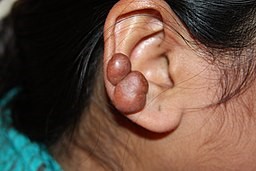
© Htirgan (Own work), CC BY-SA 3.0, via Wikimedia Commons
How does a doctor diagnose a keloid scar?
There is no particular test for a keloid scar. It is diagnosed by a healthcare professional who will listen to what has happened, ask questions and examine the scar. They may want to look at scars you have elsewhere on your body to compare if this one is different to other ones you have.
Occasionally a keloid scar can mimic other skin tumours.
In that case, a biopsy will need to be taken by a specialist. A خزعة is a procedure where a sample of tissue is taken for further analysis.
The biopsy will be looked at under a microscope and a specialist (histopathologist) will be able to see the typical microscopic features of a keloid scar.
ملاحظة: a biopsy is hardly ever necessary because the history - that is, the patient's story - and the appearance of the skin growth allow the healthcare professional to diagnose a keloid without this test.
How to treat keloid scars
Many patients ask for their keloid scar to be 'cut out' (surgically excised). This is hardly ever successful and in fact can result in an even bigger keloid scar coming back. If surgical excision is tried it must be done by a specialist doctor such as a dermatologist or plastic surgeon and will usually be done in combination with another treatment.
Keloid scars can be difficult to treat and treatments can have side effects. It is important to be clear what you would like to achieve with treatment. Some people they want the itch or pain to improve, others want it to look more like the skin around the keloid. The medical team can then consider what treatment options are most likely to achieve what is important to you.
How to reduce keloid scars without surgery
One of the most common methods is injecting steroid (triamcinolone acetonide) and local anaesthetic into the keloid scar itself. The injections are done with a tiny needle, but can be a bit sore. This is called 'intralesional corticosteroid injection treatment':
The steroids and anaesthetic can help to stop the proliferation of the skin cells in the keloid scar.
The injections are usually given once a month for 4-6 months.
Side-effects of the steroids include the skin becoming thin, easily damaged, changing colour to become darker (hyperpigmentation) or lighter (hypopigmentation) than the surrounding skin, or being able to see many tiny blood vessels in the thinned skin.
New research suggests that combining the steroid injections with another form of treatment may reduce the possible side effects from the steroids and still improve the keloid. Many of these options are very new and the research is in small numbers of people and can give conflicting results. Further research is recommended before they are offered as standard treatments.
Other injection options may now include 5-FU, bleomycin, verapamil, hyaluronic acid and hyaluronidase, botulinum toxin, and collagenase.
Other treatment options include cryotherapy (using freezing temperatures), laser, radiofrequency ablation, radiation, and shock-wave therapy.
Sometimes steroids can be applied to the skin as an ointment under a dressing, or in a tape impregnated with steroids. can dampen down a keloid scar. Silicone dressings and compression dressings are also areas of research which have suggested they may help.
How to prevent keloid scars
If you have a keloid scar then it is more likely future skin injuries will develop into a keloid scar. The best way to stop more keloids developing is to prevent unnecessary skin injuries.
People who are prone to keloid scars are advised to avoid body piercings, tattoos and ideally any surgery unless essential. Steer clear too of unnecessary procedures such as cosmetic surgery, especially in those areas of the body that are prone to keloids.
If you get acne, seek effective treatment at an early stage so the spots do not scar. If you are identified as being at risk of keloid and need an operation, your surgeon may offer you dressings, steroid injections or other treatments to reduce the risk of keloid developing.
اختيارات المرضى لـ حالات جلدية أخرى

صحة الجلد والأظافر والشعر
وحمة نبيذية
A port-wine stain is a differently coloured patch of skin that a baby is born with. It is usually over their face, neck or scalp, and looks pink or pale purple. It is often called a port-wine birthmark now.
بقلم الدكتورة هايلي ويلاسي، FRCGP

صحة الجلد والأظافر والشعر
الصدفية النقطية
الصدفية النقطية هي حالة جلدية تسبب ظهور بقع حمراء فاتحة ومتقشرة منتشرة على معظم أجزاء الجسم. غالبًا ما تحدث بعد بضعة أسابيع من الإصابة بعدوى في الحلق بسبب جرثومة معينة (بكتيريا) تُسمى المجموعة A من المكورات العقدية الحالة للدم بيتا.
بقلم الدكتور كولين تايدي، MRCGP
الأسئلة الشائعة
Can keloid scars stop growing naturally?
Yes, keloid scars typically start growing about three months after the original skin injury. However, their growth is usually slow, and once they stop growing, they often remain the same size or may even decrease slightly.
Is it possible for keloid scars to appear years after an injury?
While keloid scars typically begin to develop around three months after a skin injury, it is possible for them to appear much later, even years after the initial wound has healed.
What is the likelihood of a keloid scar recurring after non-surgical treatment?
The article mentions that surgical removal is hardly ever successful and can result in an even bigger keloid scar. For non-surgical treatments like steroid injections, while they can help to stop the proliferation of skin cells, the article does not specifically detail the recurrence rate after these various non-surgical interventions.
Can certain activities worsen or irritate an existing keloid scar?
Keloid scars can feel itchy, prickly, or sore. While the article doesn't explicitly list activities that worsen them, any action that might cause friction or pressure on the scar could potentially increase these sensations. It's also noted that if a keloid is over a joint, it can restrict movement.
Are there any promising new treatments for keloid scars currently being researched?
Yes, new research suggests combining steroid injections with other forms of treatment might reduce steroid side effects and improve keloids. However, many of these options are very new, and further research is recommended before they become standard treatments. Other emerging injection options include 5-FU, bleomycin, verapamil, hyaluronic acid, hyaluronidase, botulinum toxin, and collagenase.
قراءة إضافية ومراجع
- Davidson S, Aziz N, Rashid RM, et al; A primary care perspective on keloids. Medscape J Med. 2009;11(1):18. Epub 2009 Jan 20.
- Limmer EE, Glass DA 2nd; A Review of Current Keloid Management: Mainstay Monotherapies and Emerging Approaches. Dermatol Ther (Heidelb). 2020 Oct;10(5):931-948. doi: 10.1007/s13555-020-00427-2. Epub 2020 Jul 23.
- Thornton NJ, Garcia BA, Hoyer P, et al; Keloid Scars: An Updated Review of Combination Therapies. Cureus. 2021 Jan 30;13(1):e12999. doi: 10.7759/cureus.12999.
- Keloid and hypertrophic scar; ديرم نت.
- Ekstein SF, Wyles SP, Moran SL, et al; Keloids: a review of therapeutic management. Int J Dermatol. 2021 Jun;60(6):661-671. doi: 10.1111/ijd.15159. Epub 2020 Sep 9.
عن المؤلفعرض السيرة الذاتية الكاملة

الدكتور لورانس نوت
طبيب عام، مؤلف طبي
بكالوريوس (مع مرتبة الشرف) في الكيمياء الحيوية، بكالوريوس الطب والجراحة
الدكتور لورانس نوت تأهل في عام 1973 ولديه خبرة واسعة كطبيب عام.
حول المراجععرض السيرة الذاتية الكاملة

الدكتورة روزالين أدلمان، MRCGP
MRCGP
الدكتورة روزالين أدلمان، طبيبة عامة في هيئة الخدمات الصحية الوطنية تعمل في شمال لندن.
تاريخ المقال
تمت كتابة المعلومات على هذه الصفحة ومراجعتها من قبل أطباء مؤهلين.
المقال متاح أيضًا باللغة الإنجليزية, الألمانية, إسبانية, الفرنسية, إيطالي, البرتغالية, الهندية, العبرية, العربية ,، و السويدية.
المراجعة التالية مستحقة: 30 يونيو 2028
1 Jul 2025 | أحدث إصدار
25 May 2011 | نُشر في الأصل
كتبه:
الدكتور لورانس نوت

اسأل، شارك، تواصل.
تصفح المناقشات، اطرح الأسئلة، وشارك التجارب عبر مئات المواضيع الصحية.

هل تشعر بتوعك؟
قم بتقييم أعراضك عبر الإنترنت مجانًا
اشترك في النشرة الإخبارية للمرضى
جرعتك الأسبوعية من النصائح الصحية الواضحة والموثوقة - مكتوبة لمساعدتك على الشعور بالاطلاع والثقة والتحكم.
من خلال الاشتراك، فإنك تقبل سياسة الخصوصية. يمكنك إلغاء الاشتراك في أي وقت. نحن لا نبيع بياناتك أبدًا.