حمامى عقدية
مراجعة من قبل الدكتور كولين تايدي، MRCGPآخر تحديث بواسطة الدكتورة هايلي ويلاسي، زميلة الكلية الملكية للأطباء العامين آخر تحديث 10 أبريل 2025
يتوافق مع الإرشادات التحريرية
- تنزيلتنزيل
- مشاركة
- Language
- نقاش
- نسخة صوتية
- أضف إلى المصادر المفضلة على جوجل
الحمامى العقدية هي حالة تسبب تكوّن كتل حمراء مستديرة (عقيدات) تحت سطح الجلد، وغالبًا ما تظهر على السيقان. في معظم الأشخاص، لا يمكن العثور على سبب أو محفز محدد. ولكن في بعض الأشخاص يمكن تحديد محفز (عادةً عدوى المكورات العقدية أو الساركويد). عادةً ما تلتئم العقيدات في غضون ستة إلى ثمانية أسابيع دون الحاجة إلى علاج. ومع ذلك، من المهم البحث عن محفز كامن محتمل، حيث قد يحتاج هذا إلى علاج.
نظرة سريعة
Erythema nodosum is an inflammation of the fat layer under the skin.
It causes tender red lumps, most commonly on the shins.
Over half of cases have no known cause, but triggers can include infections, medicines, and other conditions.
Symptoms can include flu-like feelings and painful lumps that may resemble bruises as they fade.
Diagnosis is often based on appearance, and tests may be done to find an underlying trigger.
Treatment for the lumps can include painkillers, rest, and supportive bandages.
The lumps usually resolve on their own within six weeks without scarring.
What is erythema nodosum?
Erythema nodosum is a type of panniculitis. Panniculitis occurs when there is inflammation of subcutaneous fat (the layer of fat lying underneath the skin). The inflammation causes rounded, tender red bumps (nodules) to form just below the skin surface. Erythema nodosum most commonly affects both shins.
What causes erythema nodosum?
In over half of people who develop erythema nodosum, no cause for the inflammation is found. Doctors call this idiopathic erythema nodosum (as idiopathic means of unknown cause).
However, in some people there may be something that triggers the inflammation. In such cases it is thought that erythema nodosum is caused by the immune system over-reacting (becoming hypersensitive) to the trigger. Such triggers include various infections and other conditions. So, sometimes erythema nodosum may be the first sign of a serious underlying condition that needs to be identified and treated.
Some of the more common triggers for erythema nodosum include:
A streptococcal infection. This is a type of germ (bacterial) infection. It is the most common trigger for erythema nodosum in children. A streptococcal sore throat is the usual infection. Streptococcal infections are also a common trigger for erythema nodosum in adults.
الساركويد. This is a condition where inflammation causes tiny lumps of cells to form in various organs in your body, most commonly in the lungs and lymph glands. The lumps are called granulomas. Sarcoidosis is another common trigger for erythema nodosum in adults. See the separate leaflet called Sarcoidosis for more details.
السل (TB). This is a bacterial infection that usually affects the lungs. In addition to causing the symptoms of infection, TB can also trigger erythema nodosum. See the separate leaflet called Tuberculosis for more details.
التهابات أخرى. Infections such as chlamydia, Mycoplasma pneumoniae, Yersinia enterocolitica (a bacterial infection that causes diarrhoea and tummy (abdominal) pain), Salmonella spp. and Campylobacter spp., are other, less common, triggers.
Certain medicines. A reaction to certain medicines may trigger erythema nodosum in some people - for example, reactions to some antibiotics or the combined oral contraceptive pill.
Inflammatory bowel disease (IBD). People with an inflammatory bowel condition such as ulcerative colitis and Crohn's disease may also develop erythema nodosum. See the separate leaflets called التهاب القولون التقرحي و مرض كرون لمزيد من التفاصيل.
الحمل. Occasionally, pregnancy (particularly the later stages) can trigger erythema nodosum.
Certain cancers, including lymphoma and leukaemia, can also be triggers.
Who develops erythema nodosum?
Erythema nodosum is rare. It affects between 2 and 3 in every 10,000 people per year. It is most common in women between the ages of 20 and 40 years but it can occur at any age. In children, it affects boys and girls equally.
What are the symptoms of erythema nodosum?
أعراض مشابهة للإنفلونزا
Before the rounded lumps (nodules) appear, you may feel generally unwell for a few weeks. You may have a high temperature (fever), a cough and may lose weight during this time. You may also have aching joints, stiffness and general aches and pains. Your joints may become swollen. Ankle, knee and wrist joints are most commonly affected but any joint can be painful. Aching legs and joints can last for a number of weeks, or even months, after the nodules have appeared.
Painful nodules
The nodules that occur in erythema nodosum can measure between 2-6 cm across. The outlines (margins) of the nodules are not very well defined. The shins are the most common site. Other common sites are on the arms, thighs and trunk but nodules can occur anywhere on the body.
Erythema nodosum on legs
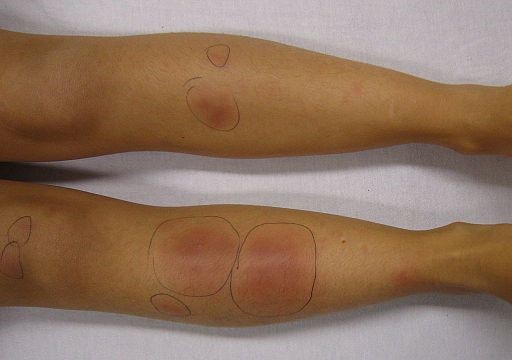
© جيمس هيلمان، دكتور في الطب، CC BY-SA 3.0، عبر ويكيميديا كومنز
Each nodule tends to last for about two weeks but new nodules can continue to appear for up to six weeks. When the nodule first appears it is usually red, hot and firm to the touch. It then becomes squashy (fluctuant). As the nodule begins to fade, it looks more like a bruise, turning blue and then yellowish. It usually takes some weeks for the nodules to heal completely. They do not leave any scarring.
You may have as few as two nodules, or as many as 50 or more.
Symptoms due to the underlying trigger
These depend on the trigger. For example, the nodules of erythema nodosum can appear two to three weeks after a streptococcal throat infection. People with inflammatory bowel disease may have tummy (abdominal) pain and diarrhoea. People with TB may have a cough and breathing problems.
How is erythema nodosum diagnosed?
Diagnosis of erythema nodosum is through its typical appearance. However, if they are unsure, your doctor may suggest that they refer you to a specialist for a خزعة. During a biopsy, a small sample of tissue is taken from one of the rounded lumps (nodules). The tissue sample is then sent to the laboratory to be examined under a microscope. Erythema nodosum has a typical appearance under a microscope and the diagnosis can usually be confirmed.
Investigations to look for any underlying trigger
If your doctor diagnoses erythema nodosum, they will usually suggest some tests to look for an underlying trigger. The tests that they suggest may depend on any other symptoms that you may have. Tests may include:
Tests for streptococcal infection. For example, a sample (swab) may be taken from your throat. The swab is then sent to the laboratory to see if infection is present. A special blood test can also show if you have had a recent streptococcal infection.
أشعة سينية للصدر. If your doctor suspects that you may have TB or sarcoidosis, they may suggest that you have a chest X-ray.
Other investigations for TB. Your doctor may suggest a special test called a tuberculin skin test. The test involves having a small injection into your arm. It is used to see if you have TB. If you have a cough, your doctor may suggest that a sample of your phlegm (sputum) be sent to the laboratory to look for TB infection.
Other investigations for sarcoidosis. If your doctor suspects that you may have sarcoidosis, they may refer you to a lung specialist for further investigations. These may include special tests that look at your breathing (respiratory function tests). They may also include a فحص الأشعة المقطعية أو فحص الرنين المغناطيسي of your lungs or a bronchoscopy. During a bronchoscopy a special camera is inserted through your nose and mouth to look at your airways and lungs.
Stool (faeces) specimens. These can detect infections such as Salmonella spp. and Campylobacter spp. Your doctor may suggest these tests if you have erythema nodosum and diarrhoea or tummy (abdominal) pain.
Bowel investigations. If your doctor suspects that you may have underlying inflammatory bowel disease such as ulcerative colitis or Crohn's disease, they may suggest that you have investigations to look for this. For example, you may have an examination of your bowel with a camera (a colonoscopy).
What is the treatment for erythema nodosum?
Treatment for the nodules of erythema nodosum
The rounded lumps (nodules) of erythema nodosum tend to go away by themselves and often do not need any treatment. However, they may be very tender or painful and certain treatments may be suggested to help relieve these symptoms.
So, treatments may include:
Painkiller medication. الأدوية المضادة للالتهابات غير الستيرويدية (NSAIDs) - على سبيل المثال،, الإيبوبروفين - are commonly used to help relieve pain. Sometimes مسكنات ألم أقوى are needed.
Bed rest and keeping your legs raised above the level of your heart may help with pain relief.
Wearing firm, supportive bandages or stockings on your legs is another option. You can ask your doctor to advise about this.
Cool wet compresses over the nodules may also help to relieve pain.
Potassium iodide. In some people with erythema nodosum, this liquid taken by mouth may help relieve the pain in the nodules and also the joint pains. It is not certain exactly how this works and it is not effective in everyone.
الستيرويدات. Steroid tablets are sometimes used provided erythema nodosum is not thought to have been triggered by an infection or a cancer. Steroids work by reducing inflammation. However, most of the time steroid treatment is not needed.
Treatment of any underlying trigger
If an underlying trigger for erythema nodosum has been found, this may need to be treated. The treatment depends on the trigger.
How long does erythema nodosum last?
For most people with erythema nodosum the rounded lumps (nodules) tend to resolve spontaneously and heal with no scarring, within six weeks. However, in some people with idiopathic erythema nodosum, nodules may last for up to six months or more.
What is the outlook (prognosis) for erythema nodosum?
Generally, the outlook for erythema nodosum is very good and most people do not have further problems. Persistent (chronic) or repeated (recurrent) erythema nodosum can occur in some people but this is rare.
As mentioned above, erythema nodosum may be the first sign of an underlying condition such as inflammatory bowel disease or sarcoidosis that needs specific treatment. Each of these conditions has a different outlook.
اختيارات المرضى لـ حالات جلدية أخرى
صحة الجلد والأظافر والشعر
قضمة الصقيع
قضمة الصقيع هي إصابة ناتجة عن تعرض أجزاء من الجسم للبرد. هناك درجات مختلفة من قضمة الصقيع. في حالة قضمة الصقيع السطحية، يمكن للجلد أن يتعافى تمامًا مع العلاج السريع. ومع ذلك، إذا كانت قضمة الصقيع عميقة، يمكن أن يكون الضرر في الأنسجة دائمًا وقد يحدث فقدان للأنسجة. الطريقة الأهم لمنع قضمة الصقيع هي الابتعاد عن البرد. إذا كنت معرضًا للبرد، تأكد من ارتداء ملابس واقية كافية.
بقلم الدكتورة توني هازيل، FRCGP
صحة الجلد والأظافر والشعر
الثآليل الدهنية
الثآليل الدهنية هي نموات ثؤلولية غير سرطانية (حميدة) تحدث على الجلد. عادةً لا تحتاج إلى أي علاج.
بقلم الدكتور كولين تايدي، MRCGP
الأسئلة الشائعة
Can erythema nodosum leave a scar?
No, the nodules associated with erythema nodosum typically heal without leaving any scarring on the skin.
Is erythema nodosum dangerous?
Erythema nodosum itself is generally not dangerous and the nodules tend to resolve on their own. However, in some cases, it can be a sign of a more serious underlying condition that needs to be identified and treated, such as specific infections, inflammatory bowel disease, sarcoidosis, or rarely, certain cancers. The outlook is usually very good once any underlying cause is addressed.
How quickly do the nodules of erythema nodosum appear?
You may experience flu-like symptoms for a few weeks before the rounded lumps, or nodules, appear. After their initial appearance, each nodule typically lasts for about two weeks, but new ones can continue to develop for up to six weeks.
Can erythema nodosum return after it has cleared up?
While the outlook for erythema nodosum is generally very good and most people do not have further problems, it is possible for some individuals to experience persistent (chronic) or repeated (recurrent) erythema nodosum. However, this is considered rare.
Do I always need tests if I am diagnosed with erythema nodosum?
If you are diagnosed with erythema nodosum, your doctor will usually suggest some tests. These investigations aim to look for any potential underlying trigger for the condition, especially since erythema nodosum can sometimes be the first sign of another issue that requires treatment. The specific tests will depend on any other symptoms you might have.
قراءة إضافية ومراجع
- Hafsi W, Badri T; Erythema Nodosum.
- Dermnetz; Erythema Nodosum
- Perez-Garza DM, Chavez-Alvarez S, Ocampo-Candiani J, et al; Erythema Nodosum: A Practical Approach and Diagnostic Algorithm. Am J Clin Dermatol. 2021 May;22(3):367-378. doi: 10.1007/s40257-021-00592-w. Epub 2021 Mar 8.
عن المؤلفعرض السيرة الذاتية الكاملة

الدكتورة هايلي ويلاسي، زميلة الكلية الملكية للأطباء العامين
طبيب عام، مؤلف طبي
MBChB (1992), DRCOG, DFFP, MRCOG (Part 1) MRCGP (2007), DFSRH (2013), MSc - medical education (2020)
كانت الدكتورة هايلي ويلاسي طبيبة عامة في هيئة الخدمات الصحية الوطنية تعمل في شمال غرب إنجلترا، وتقاعدت من الممارسة السريرية في عام 2022 بعد 30 عامًا.
حول المراجععرض السيرة الذاتية الكاملة

الدكتور كولين تايدي، MRCGP
طبيب عام، مؤلف طبي
MBBS, MRCGP, MRCP (Paediatrics), DCH
الدكتور كولين تايدي هو طبيب في هيئة الخدمات الصحية الوطنية، ويعمل في أوكسفوردشاير.
تاريخ المقال
تمت كتابة المعلومات على هذه الصفحة ومراجعتها من قبل أطباء مؤهلين.
المقال متاح أيضًا باللغة الإنجليزية, الألمانية, إسبانية, الفرنسية, إيطالي, البرتغالية, الهندية, العبرية, العربية ,، و السويدية.
المراجعة التالية مستحقة: 9 أبريل 2028
10 أبريل 2025 | أحدث إصدار
آخر تحديث بواسطة
الدكتورة هايلي ويلاسي، زميلة الكلية الملكية للأطباء العامينمراجعة من قبل
الدكتور كولين تايدي، MRCGP

اسأل، شارك، تواصل.
تصفح المناقشات، اطرح الأسئلة، وشارك التجارب عبر مئات المواضيع الصحية.

هل تشعر بتوعك؟
قم بتقييم أعراضك عبر الإنترنت مجانًا
اشترك في النشرة الإخبارية للمرضى
جرعتك الأسبوعية من النصائح الصحية الواضحة والموثوقة - مكتوبة لمساعدتك على الشعور بالاطلاع والثقة والتحكم.
من خلال الاشتراك، فإنك تقبل سياسة الخصوصية. يمكنك إلغاء الاشتراك في أي وقت. نحن لا نبيع بياناتك أبدًا.
المزيد في صحة الجلد والأظافر والشعر
- المهق
- بق الفراش
- مرض بوين
- الحروق والجروح الناتجة عن السوائل الساخنة
- الأكزيما عند الأطفال
- عضات الإنسان
- القوباء
- الظفر الناشب
- إزالة الشعر بالليزر
- سرطان الجلد غير الميلانيني
- اختبار الرقعة لالتهاب الجلد التماسي
- طفح ضوئي متعدد الأشكال
- Pompholyx
- القوباء الحلقية
- التهاب الجلد الدهني
- الثآليل الدهنية
- تصلب الجلد الجهازي
- الستيرويدات الموضعية للأكزيما