Fine-needle aspiration
مراجعة من قبل Dr Hannah Gronow, MBACPآخر تحديث بواسطة الدكتور روجر هندرسون، بكالوريوس الطب والجراحةآخر تحديث 22 Nov 2018
يتوافق مع الإرشادات التحريرية
- تنزيلتنزيل
- مشاركة
- Language
- نقاش
- نسخة صوتية
- أضف إلى المصادر المفضلة على جوجل
تم أرشفة هذه الصفحة.
لم يتم مراجعته مؤخرًا وليس محدثًا. قد لا تعمل الروابط والمراجع الخارجية بعد الآن.
In fine-needle aspiration a thin, hollow needle is used to take a sample of cells from an organ or lump under the skin. The cells are then analysed under a microscope.
ملاحظة: the information below is a general guide only. The arrangements and the way tests are performed, may vary between different hospitals. Always follow the instructions given by your doctor or local hospital.
نظرة سريعة
Fine-needle aspiration uses a thin needle to take cell samples from a lump or organ.
This test can help to identify the type of cells in a lump, including detecting cancer.
It is commonly used for breast lumps or the thyroid gland in your neck.
A doctor inserts a thin needle into the lump, sometimes guided by a scan.
You may feel a little sore or get a bruise, but serious complications are uncommon.
في هذه المقالة:
اختيارات الفيديو لـ اختبارات وتحقيقات أخرى
تابع القراءة أدناه
What is fine-needle aspiration?
Fine-needle aspiration involves using a thin, hollow needle to remove samples of cells from tissue or fluid in an organ or a lump. It is not quite the same as a biopsy, which takes a very small chunk of tissue away. Once the samples of cells have been removed, they are sent to the laboratory for further testing.
Fine-needle aspiration is usually done to identify the type of cells inside a lump or to see how well treatment of an existing lump is working.
It is commonly used to investigate lumps found in the breast أو a gland found in your neck (the thyroid). However, it can also be used in other parts of the body. It is a very useful way of detecting cancer.
How does fine-needle aspiration work?
العودة إلى المحتوياتA very thin, hollow needle is gently inserted through the skin into the lump or organ below. Often there is a syringe attached to the needle. The doctor can use the syringe to help 'suck' some of the cells into the needle by gently pulling on the plunger.
Usually, the test can be done without the need to make a cut in the skin. This helps to minimise any discomfort for the person having the test, as well as the risk of infection or other complications.
If the lump being tested is very small it might be necessary to use a scanning machine to help guide the needle to the right place. This may be done by an الموجات فوق الصوتية, a التصوير المقطعي المحوسب (CT) or an X-ray of the breast (a mammogram).
تابع القراءة أدناه
What happens?
العودة إلى المحتوياتThe doctor will clean the skin where the needle is to be inserted. In some cases you will also be given a local anaesthetic to numb the area. This may not be necessary if the lump is very close to the surface of your skin.
The doctor will hold the lump steady with one hand and insert a thin needle (which may be attached to a syringe) into the lump.
Fine-needle aspiration
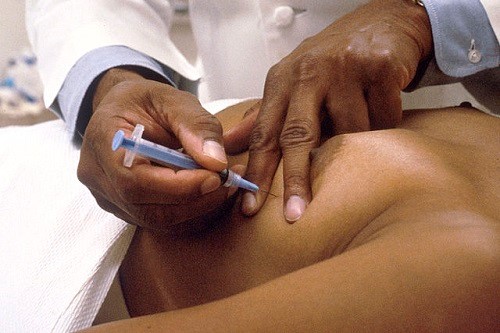
© By Linda Bartlett (photographer), National Institutes of Health, via Wikimedia Commons
They may move the needle in and out of the area to make sure of getting enough tissue or fluid. If there is a syringe attached they will gently pull back on the plunger to help remove the tissue or fluid. The process takes a few seconds to a few minutes. The needle will then gently be removed and your doctor may apply some pressure to help stop any bleeding.
If the doctor cannot easily feel the lump, you may have an imaging test, such as a CT scan, ultrasound scan, or mammogram to see where to put the needle. In this case, a doctor known as a radiologist may do the aspiration. The radiologist may do the investigation but they will not know the result immediately.
If the lump is a fluid-filled sac (a cyst), the fluid is removed and the lump usually goes away.
After the test is over, the cells taken from the needle are sent to the laboratory. It may take a few days to get the results of the test back, depending on what part of your body has been tested.
What should I do to prepare for a fine-needle aspiration?
العودة إلى المحتوياتThis depends on what part of your body is being tested. Your local hospital should give you information on what is required. Usually very little preparation is necessary.
ملاحظة: if you take a blood-thinning medicine (an anticoagulant) such as warfarin, you may be asked to stop taking this for a few days before the procedure.
تابع القراءة أدناه
What can happen after a fine-needle aspiration?
العودة إلى المحتوياتMost fine-needle aspirations are carried out without any problems.
Commonly, you may feel a little sore for a couple of days after the test. You may develop a bruise at the site where the needle was inserted. Complications are uncommon but can include:
Bleeding or bruising. This should stop and heal quickly.
Infection at the point where the needle went in.
Other complications specific to the site of needle insertion.
اختيارات المرضى لـ اختبارات وتحقيقات أخرى

الفحوصات والتحقيقات
تخطيط كهربية الدماغ
An electroencephalograph is a useful test to help diagnose epilepsy. It records the electrical activity of the brain. However, a normal result does not rule out epilepsy. Note: the information below is a general guide only. The arrangements, and the way tests are performed, may vary between different hospitals. Always follow the instructions given by your doctor or local hospital.
بقلم الدكتور كولين تايدي، MRCGP

الفحوصات والتحقيقات
Genetic testing
Genetic testing is a type of medical test that identifies changes in chromosomes, genes or proteins. Genetic tests examine a person's DNA in a variety of ways to assess a person's genetic health. They are all designed to identify a particular gene that may cause a genetic disorder. We all have 46 chromosomes in our cells. Chromosomes are made from DNA (deoxyribonucleic acid). Genes are short sections of DNA and each chromosome contains hundreds to thousands of genes. Genes contain the information our bodies need to make chemicals called proteins. Proteins form the structure of our bodies and play an important role in the processes that keep us alive. It is the differences in our genes that makes us all individuals. Sometimes a gene may change (this is called a mutation) and either cause or increase the risk of a disease or disorder. Note: the information below is a general guide only. The arrangements, and the way tests are performed, may vary between different hospitals. Always follow the instructions given by your doctor or local hospital.
بقلم الدكتور كولين تايدي، MRCGP
الأسئلة الشائعة
What is the difference between a fine-needle aspiration and a biopsy?
A fine-needle aspiration uses a thin, hollow needle to collect samples of cells, while a biopsy takes a small piece of tissue. Both are sent for laboratory testing, but the aspiration collects individual cells rather than a solid piece of tissue.
Will I feel pain during a fine-needle aspiration?
The doctor may clean the area and, in some cases, give you a local anaesthetic to numb it, especially if the lump is not very close to the skin's surface. This helps minimise discomfort. After the procedure, you might feel a little sore for a couple of days.
How long does a fine-needle aspiration procedure take?
The actual process of inserting the needle and collecting cells typically takes only a few seconds to a few minutes.
How long will it take to get the results back after a fine-needle aspiration?
It may take a few days to receive the results of the test, and the exact time can depend on which part of your body has been tested.
قراءة إضافية ومراجع
- Karadeniz Cakmak G, Emre AU, Tascilar O, et al; Diagnostic adequacy of surgeon-performed ultrasound-guided fine needle aspiration biopsy of thyroid nodules. J Surg Oncol. 2012 Jul 5. doi: 10.1002/jso.23212.
- Yu YH, Wei W, Liu JL; Diagnostic value of fine-needle aspiration biopsy for breast mass: a systematic review and meta-analysis. BMC Cancer. 2012 Jan 25;12:41.
- VanderLaan PA; Fine-needle aspiration and core needle biopsy: An update on 2 common minimally invasive tissue sampling modalities. Cancer Cytopathol. 2016 Dec;124(12):862-870. doi: 10.1002/cncy.21742. Epub 2016 May 16.
تابع القراءة أدناه
عن المؤلفعرض السيرة الذاتية الكاملة

الدكتور روجر هندرسون، بكالوريوس الطب والجراحة
طبيب عام، مؤلف طبي
MBBS, LMSSA
Dr Roger Henderson qualified as a GP in 1985 and has authored for EMIS since early 2013.
حول المراجععرض السيرة الذاتية الكاملة

Dr Hannah Gronow, MBACP
General Practitioner
MB, ChB, MBACP
Hannah qualified as a GP in 1997. She joined EMIS (Patient) as a peer reviewer in August 2006.
تاريخ المقال
تمت كتابة المعلومات على هذه الصفحة ومراجعتها من قبل أطباء مؤهلين.
22 Nov 2018 | أحدث إصدار

اسأل، شارك، تواصل.
تصفح المناقشات، اطرح الأسئلة، وشارك التجارب عبر مئات المواضيع الصحية.

هل تشعر بتوعك؟
قم بتقييم أعراضك عبر الإنترنت مجانًا
اشترك في النشرة الإخبارية للمرضى
جرعتك الأسبوعية من النصائح الصحية الواضحة والموثوقة - مكتوبة لمساعدتك على الشعور بالاطلاع والثقة والتحكم.
من خلال الاشتراك، فإنك تقبل سياسة الخصوصية. يمكنك إلغاء الاشتراك في أي وقت. نحن لا نبيع بياناتك أبدًا.