سرطان الخلايا الحرشفية في الجلد
SCC
مراجعة من قبل الدكتورة توني هازيل، زميلة الكلية الملكية للأطباء العامينآخر تحديث بواسطة الدكتورة فيليبا فينسنت، MRCGPآخر تحديث 30 يوليو 2026
يتوافق مع الإرشادات التحريرية
- تنزيلتنزيل
- مشاركة
- Language
- نقاش
- Ask Patient
- نسخة صوتية
- أضف إلى المصادر المفضلة على جوجل
المهنيين الطبيين
تم تصميم مقالات المراجع المهنية لاستخدامها من قبل المتخصصين في الرعاية الصحية. يتم كتابتها بواسطة أطباء من المملكة المتحدة وتستند إلى أدلة بحثية وإرشادات المملكة المتحدة وأوروبا. قد تجد أنواع سرطان الجلد مقالة أكثر فائدة، أو واحدة من مقالاتنا الأخرى مقالاتنا الصحية.
What is squamous cell carcinoma?
Primary cutaneous squamous cell carcinoma (SCC) is a malignant tumour that arises from the keratinising cells of the epidermis or its appendages. It is locally invasive and has the potential to metastasise to other organs of the body.1
How common is squamous cell carcinoma? (Epidemiology)
Skin cancers are the most common cancers diagnosed and incidence is rising across the world.
There has been almost a 3-fold increase in incidence in the United States between the 1970s and the 2000s, with an incidence of incidence of 140 per 100,000 American men and 50 per 100,000 American women in 2012.2
SCC is the second most common skin cancer (behind basal cell carcinoma (BCC)).1
Incidence varies by country, skin colour, and outdoor behaviour, and is highest in Australia with an incidence of between 271 and 593 per 100,000 population.3
Cutaneous squamous cell carcinomas are increasing worldwide.4
Risk factors for squamous cell carcinoma2
UV exposure is the most significant risk factor.
Increased susceptibility to UV light exposure occurs in people with type 1 or 2 skin.
Male sex.
زيادة العمر.
Environmental exposure to other carcinogens including arsenic, polycyclic aromatic hydrocarbons, nitrosamines, alkylating agents, and ionizing radiation.
تثبيط المناعة.
Pre-existing lesions, for example, chronic wounds, الحزاز المتصلب, الحزاز المسطح, فيروس الورم الحليمي البشري, cutaneous lupus erythematosus, actinic keratosis.
Genetic conditions - for example, جفاف الجلد المصطبغ و albinism.
Drugs - a variety of drugs from immunosuppressive agents such as mycofenalate, azathioprine and cyclosporin to diuretics such as hydrochlorothiazide have been associated with an increased risk of cutaneous squamous cell carcinoma. Vismodegib, a hedgehog pathway inhibitor indicated for advanced or metastatic basal cell carcinoma (BCC), was previously shown to have an 8-fold increase of cSCC, but this conclusion has not been reproducible in recent studies.5
Squamous cell carcinoma symptoms126
Squamous cell carcinomas usually arise within a pre-existing actinic keratosis.
They often grow over weeks or months; they vary from a few mm in size to several cm.
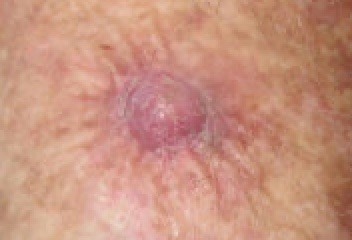
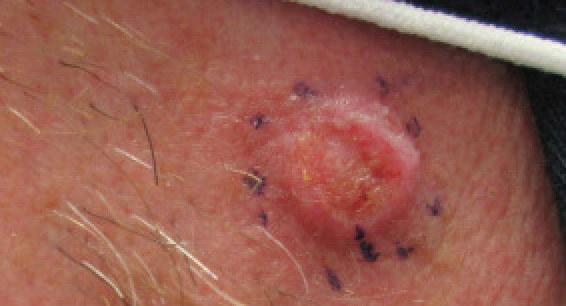
They are typically characterised by a scaly, erythematous, or hyperpigmented papule or plaque.
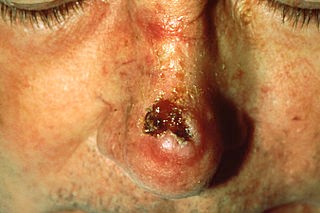
There may be ulceration or fungation; they are often tender or painful.
They often arise on sun-exposed areas such as the face, forearms, ear, hands and lower legs.
SCC may give rise to local metastases or spread to local lymph nodes.7
Squamous cell carcinoma - forearm
Squamous cell carcinoma - cheek
Squamous cell carcinoma - nose
التشخيص التفريقي
There are a number of important conditions which can produce similar-looking skin lesions:
الورم القرني (can be difficult to differentiate even histologically).
BCC.
الورم الميلانيني الخبيث (particularly amelanotic malignant melanomas).
الثآليل الدهنية (especially if traumatised or infected).
Plantar warts أو verrucas (beware periungual SCC).
Diagnosing squamous cell carcinoma (investigations)
Investigation in general practice is primarily by visual inspection and dermoscopy.
إحالة
Make a suspected cancer pathway referral (for an appointment within two weeks) for people with a skin lesion that raises the suspicion of squamous cell carcinoma.8
The Scottish Intercollegiate Guidelines Network (SIGN) guideline recommends prompt early referral if there have been high levels of cumulative psoralen plus ultraviolet A photochemotherapy, rapid tumour growth, poorly defined clinical margins or pain/dysaesthesia.9
مزيد من التحقيقات
In advanced stages of disease, further investigations to assess the extent of disease may be required (by the dermatologist):
Imaging including CT scanning (bone or soft tissue spread, particularly cervical lymph nodes) and MRI scanning (particularly for head and neck spread, perineural invasion).
Clinically enlarged nodes should be examined histologically - for example, by fine-needle aspiration or excisional biopsy.
مرحلة التجهيز6
Cutaneous squamous cell carcinoma is characterised as low- or high-risk depending on the chance of metastases or recurrence.
High-risk cSCC is defined as:
Diameter of 2cm or larger
Located on the ear, vermilion of the lip, central face, hands, feet or genitalia
Occurring in an elderly or immunosuppressed patient
Histological thickness greater than 2 mm, poorly differentiated histology or where there is invasion of subcutaneous tissue, nerves or blood vessels.
In 2011, a new staging system was developed for cSCC:
Tumour staging for cutaneous SCC
TX: Th Primary tumour cannot be assessed
T0: No evidence of a primary tumour
Tis: Carcinoma in situ
T1: Tumour ≤ 2cm without high-risk features
T2: Tumour ≥ 2cm; or; Tumour ≤ 2 cm with high-risk features
T3: Tumour with the invasion of maxilla, mandible, orbit or temporal bone
T4: Tumour with the invasion of axial or appendicular skeleton or perineural invasion of skull base
Nodal staging for cutaneous SCC
NX: Regional lymph nodes cannot be assessed
N0: No regional lymph node metastasis
N1: Metastasis in one local lymph node ≤ 3 cm
N2: Metastasis in one local lymph node ≥ 3 cm; or; Metastasis in >1 local lymph node ≤ 6 cm
N3: Metastasis in lymph node ≥ 6 cm
Squamous cell carcinoma treatment and management10
There should be two levels of multidisciplinary teams: local hospital skin cancer multidisciplinary teams (LSMDTs) and specialist skin cancer multidisciplinary teams (SSMDTs).
All patients with a possible SCC should be referred urgently to a doctor trained in the specialist diagnosis of skin malignancy, normally a dermatologist, who is a member of either an LSMDT or an SSMDT.
In England, the target for patients with SCC referred through the two-week urgent GP referral route is that they must start their first definitive treatment within 62 days of GP referral. For all other patients with SCC in England, the target is that they must start their first definitive treatment within 31 days of the decision to treat.11
Patients with a high risk of recurrence of skin cancer or of new primary cancers should be followed up in hospital but should still be instructed in self-examination and provided with written and photographic information.
Management options
الجراحة:
The standard effective treatment is complete surgical excision and all excised specimens should be sent for histopathological examination. Mohs micrographic surgery shows significant benefit over standard excision with a recurrence rate at 5 years of 3.1% compared with 8.1%. Where the treatment is for a locally recurrent lesion (that had been treated previously), Mohs surgery has a further recurrence rate of 10% compared with 23.3%.2
Where surgery is contra-indicated then other treatment options include superficial radiation therapy, 5-fluorouracil cream, imiquimod cream, cryotherapy, photodynamic therapy, and/or ablative laser therapy but these have higher recurrence rates than surgery.
Curettage and cautery/electrodesiccation:
Performed using a curette to remove soft material from the tumour. The base of the tumour is then destroyed, using either hyfrecation or cautery.
This is generally only used for low risk tumours on the limbs or trunk.6
Cryotherapy/cryosurgery:
Can be used for very small low-risk tumours.6
Radiotherapy:
Is only recommended for patients where surgery is contra-indicated (either because the patient is unsuitable for surgery or because the tumour is inoperable).
Is occasionally used as an adjuvant treatment.
Immunotherapy:
Cemiplimab is a human immunoglobulin G4 monoclonal antibody, which binds to the programmed death-1 (PD-1) receptor. This potentiates an immune response to tumour cells.
It has been recommended since July 2022 as an option in the UK for treating metastatic or locally advanced cutaneous squamous cell carcinoma in adults when curative surgery or curative radiotherapy is not suitable.12
It can be used for up to 24 months but should be stopped earlier if the disease progresses.
A recent study suggests benefit from cemiplimab with disease control in 62% of patients.13
Squamous cell carcinoma prognosis2
The overall mortality rate of cutaneous squamous cell carcinoma metastasis is low (1-2%).
However the mortality rate is higher in some regions, for example, the southern United States.
Approximately 3% of squamous cell carcinomas will metastasise, most commonly to lymph nodes.
There is a 5-year survival rate of 90% in patients with a single lymph node involvement.
Prevention of squamous cell carcinoma
Avoiding sun exposure is the key to prevention, including:
البقاء في الداخل أو في الظل قدر الإمكان بين الساعة 11 صباحًا و3 مساءً.
ارتداء الملابس وقبعة واسعة الحواف عند الخروج في الشمس.
Applying high sun protection factor sunscreen which also has high ultraviolet A (UVA) protection
Secondary prevention by early detection and effective management is also very important.
تحديثات حصرية لمتخصصي الرعاية الصحية
ابقَ على اطلاع بأحدث التحديثات السريرية، والرؤى المهنية، والإرشادات المستندة إلى الأدلة. تقوم نشرة Patient Pro الإخبارية بتجميع محتوى أساسي لمتخصصي الرعاية الصحية - يتم تسليمه مباشرة إلى بريدك الوارد.
من خلال الاشتراك، فإنك تقبل سياسة الخصوصية. يمكنك إلغاء الاشتراك في أي وقت. نحن لا نبيع بياناتك أبدًا.
قراءة إضافية ومراجع
- Squamous cell carcinoma of the skin; ديرم نت نيوزيلندا
- Squamous Cell Carcinoma; British Association of Dermatologists, 2022
- Hadian Y, Howell JY, Ramsey ML, et al; Cutaneous Squamous Cell Carcinoma.
- The hidden Australian skin cancer epidemic, high-risk cutaneous squamous cell carcinoma: a narrative review; A Dettrick et al; Pathology
- Huang S, Jiang J, Wong HS, et al; Global burden and prediction study of cutaneous squamous cell carcinoma from 1990 to 2030: A systematic analysis and comparison with China. J Glob Health. 2024 May 3;14:04093. doi: 10.7189/jogh.14.04093.
- Cutaneous Squamous Cell Carcinoma: An Updated Review; R Jiang et al; Cancers
- Cutaneous squamous cell carcinoma; A Oakley, DermNet
- Corchado-Cobos R, Garcia-Sancha N, Gonzalez-Sarmiento R, et al; Cutaneous Squamous Cell Carcinoma: From Biology to Therapy. Int J Mol Sci. 2020 Apr 22;21(8). pii: ijms21082956. doi: 10.3390/ijms21082956.
- الاشتباه في السرطان: التعرف والإحالة; إرشادات NICE (2015 - آخر تحديث أبريل 2026)
- Management of Primary Cutaneous Squamous Cell Carcinoma; Scottish Intercollegiate Guidelines Network - SIGN (June 2014)
- Maubec E; Update of the Management of Cutaneous Squamous-cell Carcinoma. Acta Derm Venereol. 2020 Jun 3;100(11):adv00143. doi: 10.2340/00015555-3498.
- سرطان الجلد; British Association of Dermatologists
- Cemiplimab for treating advanced cutaneous squamous cell carcinoma; إرشادات تقييم التكنولوجيا من NICE، يونيو 2022
- Real-world evidence study on the early use of cemiplimab in the UK: REACT-CEMI (Real World evidence of advanced CSCC treatment with cemiplimab); A Challapalli et al; Frontiers in Immunology
عن المؤلفعرض السيرة الذاتية الكاملة
تم التحديث بواسطة

الدكتورة فيليبا فينسنت، MRCGP
طبيب عام، مؤلف طبي
MB BS, Bsc, MRCGP (2000), DCH, DFSRH, DRCOG
الدكتورة فيليبا فينسنت هو طبيب عام في هيئة الخدمات الصحية الوطنية يعمل في شمال لندن.
حول المراجععرض السيرة الذاتية الكاملة

Dr Toni Hazell, FRCGP
بكالوريوس الطب والجراحة، بكالوريوس العلوم، زميل الكلية الملكية للأطباء العامين، دبلوم في الصحة الجنسية والإنجابية، دبلوم في طب الجهاز البولي التناسلي، دبلوم الكلية الملكية لأطباء النساء والتوليد، دبلوم في صحة الطفل (لندن، المملكة المتحدة، 2000)
تخرجت الدكتورة توني هازيل من كلية الطب بمستشفى سانت ماري وأكملت تدريبها في مستشفى نورثويك بارك.
تاريخ المقال
المقال متاح أيضًا باللغة الإنجليزية, الألمانية, إسبانية, الفرنسية, إيطالي, البرتغالية, الهندية, العبرية, العربية ,، و السويدية.
Next review due: 30 Jan 2031
30 يوليو 2026 | أحدث إصدار
وصول بسيط إلى العلاجات والخدمات الصحية الموثوقة عبر الإنترنت.
Common conditions
Get help with common conditions through the NHS, without a GP appointment.
 التهاب الجيوب الأنفية الحاد
 التهاب اللوزتين البكتيري
 القوباء
 لدغات الحشرات
 الحزام الناريعدوى المسالك البولية
المزيد في الأمراض الجلدية
- الأكزيما الجافة
- سرطان الخلايا القاعدية
- داء الفيلاريات في تجاويف الجسم
- بقعة كامبل دي مورغان
- عدوى فيروس كوكساكي
- مصطلحات وصفية جلدية
- سعفة الجلد
- الأكزيما القرصية (النملية)
- الإكثيما
- الوحمة الجلدية ومتلازماتها
- Erythema chronicum migrans
- حمامى صلبة
- الفقاع الحميد العائلي
- مرض دودة غينيا
- النمش
- التهاب الجلد حول الفم
- التهاب المفاصل الصدفي
- الحمى القرمزية
- الحزام الناري