Urine dipstick test
Peer reviewed by Dr Doug McKechnie, MRCGPLast updated by Dr Philippa Vincent, MRCGPLast updated 4 Jun 2024
Meets Patient’s editorial guidelines
- DownloadDownload
- Share
- Language
- Discussion
- Audio Version
- Add to preferred sources on Google
A urine dipstick test tests the urine using a special strip of paper that is dipped into a sample of urine. The result is available almost immediately. It is sometimes called a rapid urine test.
At a glance
A urine dipstick test quickly checks a urine sample for abnormal chemicals.
A specially treated paper strip is dipped into the urine.
The strip has squares that change colour if certain substances are present.
Results are usually available within 2 minutes.
It can be used to screen for conditions like diabetes or check for infection.
You need to provide a sterile midstream urine sample for the test.
If the test is abnormal, the sample may be sent for further lab tests.
Urine contains waste chemicals from all of the millions of chemical reactions that go on in the body all the time.
However, in some conditions, chemicals that shouldn't normally be present in urine get through the filtering systems in the kidneys and pass into the urine. Normally these chemicals would be dealt with by the kidneys and return to the blood stream.
Urine dipstick tests can be used to see if those chemicals are present.
What is a urine dipstick test?
A urine dipstick test is the quickest way to test urine. It involves dipping a specially treated paper strip into a sample of urine. This can be done during an appointment with a health professional.
The results are usually available within 60-120 seconds. The sample doesn't need to be sent to a laboratory for a urine dipstick test although if the test is abnormal, the sample may be sent to a laboratory for further tests.
What do you need to do for a urine dipstick test?
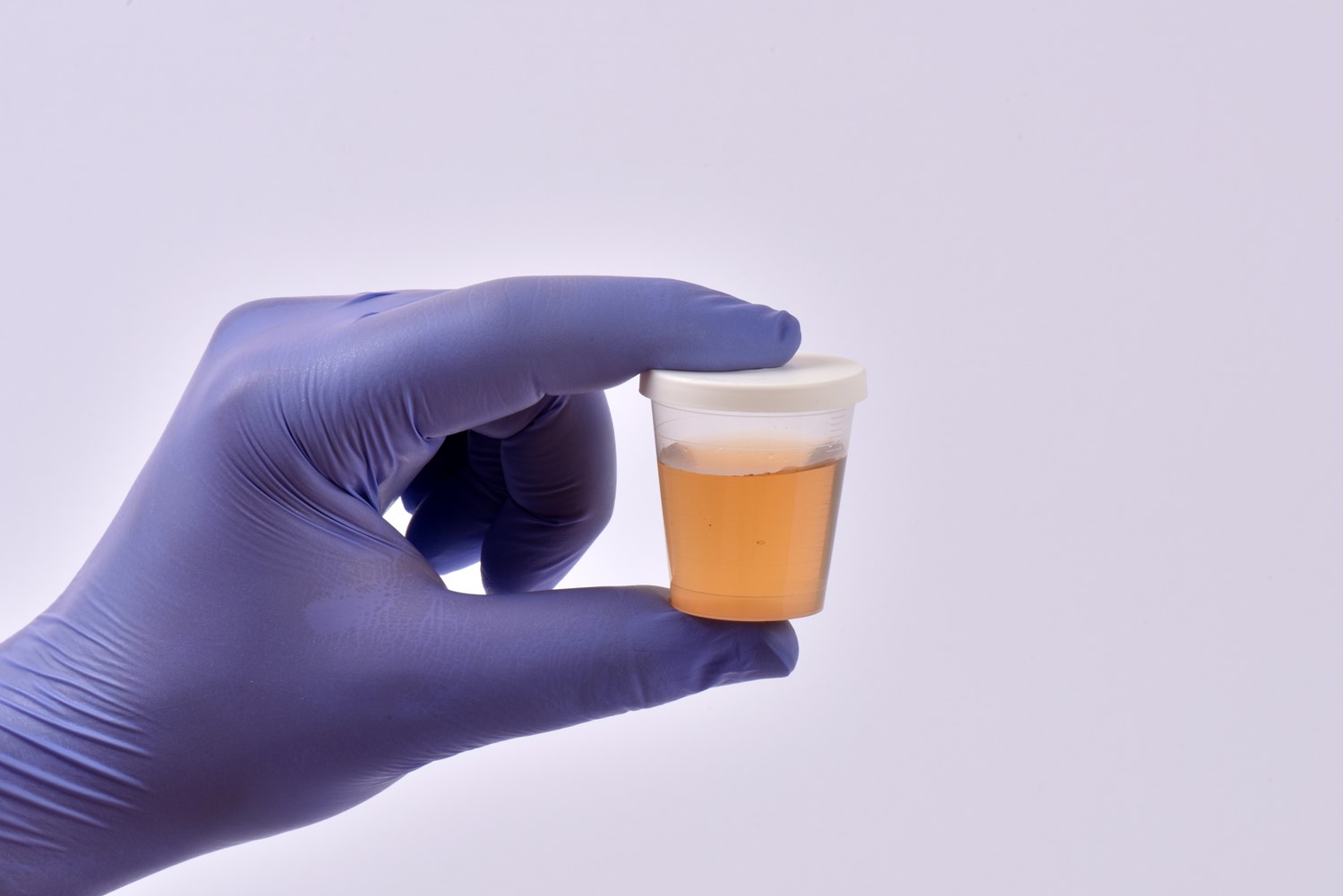
A sample of urine will need to be provided in a sterile container. Ideally the urine should be produced straight into the pot. Peeing into another container and then transferring it stops it being a sterile sample so is not recommended.
The best sample is one which is called a midstream specimen of urine (MSU). This means starting to pee, then passing the open pot into the stream of urine and then taking it away again when enough urine has been collected. The lid should then be replaced tightly on the pot and then both hands and the pot washed carefully.
How is a urine dipstick test done?
A health professional will use a urine testing strip to test the urine. There are several different kinds of urine testing strips that test for different things in the urine. The strip has squares on it that change colour in the presence of certain substances.
The strip will then be compared to a chart on the side of the urine testing strip package. Often the more intense the colour change, the more of the substance there is in the urine.
How to read a urine dipstick
Some urine dipsticks test for just one or two of the abnormalities below. Others test for many of these substances.
To read the dipstick, this involves:
Taking a urine sample as above.
Dipping one of the sticks into the sample, making sure all the test zones on the stick are submerged.
Removing the stick, tapping to remove excess urine and holding it horizontally so urine doesn't drip.
After the relevant time (usually between 30 seconds and 2 minutes), holding the dipstick up against the colour chart on the dipstick bottle.
Each test will be colour-coded and there will be several different shades of that colour. A darker shade indicates that there is more of the relevant substance - blood, glucose etc - in the urine.
Recording the result.
Why is a urine dipstick test done?
A urine dipstick test is done for lots of different reasons, such as:
A routine check during pregnancy to check for glucose, protein or signs of bacteria.
To screen for diabetes.
If a urine infection is suspected.
To look for blood in the urine (haematuria).
It may be done in people with some types of abdominal or back pain to look for kidney or bladder problems.
The first thing that a health professional will do is look at the urine. Normal urine varies in colour from colourless to dark yellow. Various things can affect the way urine looks, from how much fluid has been drunk to what has been eaten recently. The smell can also vary widely and is not a good gauge of illness.
What are the results of a urine dipstick test?
A urine dipstick test can look for the following:
Blood
Blood is not normally found in the urine.
It may be present if there is an infection.
It can be due to significant underlying disease, such as cancer, in the bladder or kidney.
In women, it may be due to contamination if menstruating at the time of doing the sample.
Will usually need to be confirmed by sending the sample for a full laboratory test, as the dipstick test can show a false positive.
Protein
Protein is normally found in the urine in tiny amounts but these tiny amounts are usually too small to be picked up on a urine dipstick test.
Protein may be found in larger amounts if there is an infection.
It can be seen as one of the signs of pre-eclampsia in pregnancy.
It can be the first sign of kidney disease and is also used as a measure of the severity of kidney disease.
Glucose
Glucose, a type of sugar, is not normally found in the urine.
It can be found in the urine if someone has poorly controlled diabetes or as the first sign of diabetes.
It can also be found in people with particular types of kidney disease, even without diabetes.
There is a rare condition called familial renal glycosuria where glucose is found in the urine without diabetes - this is an inherited condition.
People with type 2 diabetes who are taking a medicine called an SGLT2 inhibitor (such as canagliflozin, dapagliflozin or empagliflozin) can have glucose in the urine due to the fact that these medicines help to reduce blood sugar, partly by reducing the amount of glucose reabsorbed into the system via the kidneys. Glucose in the urine whilst taking one of these medicines is normal.
Ketones
Ketones are chemicals made by the body when it's breaking down fat for energy. This happens when starving and the body has used up all, or nearly all, of its stores of sugar (glucose). This is normal.
Ketones are not usually found in the urine otherwise.
Ketones may be present in diabetes which is not well controlled; levels of glucose in the blood are usually also very high in this scenario. In someone with diabetes, particularly type 1 diabetes, ketones in the urine can indicate a condition called diabetic ketoacidosis. This is a serious emergency and requires urgent treatment in hospital.
Ketones may also be present in women who are pregnant.
Ketones can be a sign of dehydration.
Bilirubin and urobilinogen
Bilirubin and urobilinogen are chemicals produced by the liver. They are not normally found in the urine.
If bilirubin is found in the urine it usually means there's a problem with the liver.
Small amounts of urobilinogen may be found in the urine but large amounts suggest a problem with the liver or with red blood cells being destroyed too quickly.
Leukocyte esterase and nitrite
These are both tests for the presence of infection.
Leukocyte esterase test looks for a reaction that only happens if there are lots of white cells in the urine. White cells get into the urine when there is an infection.
Nitrite is not normally found in the urine but will appear there if there are lots of bacteria in the urine.
Nitrite test can be negative even if there are lots of bacteria in the urine if the urine hasn't been in the bladder for long.
Urine dipstick tests are very accurate at excluding infection but are less reliable for predicting infection - there are more false positive results.
The urine dipstick test also measures how concentrated the urine is and how acidic it is.
Patient picks for Urine and bladder tests

Tests and investigations
Voiding cystourethrogram
A micturating/voiding cystourethrogram (MCUG/VCUG) produces X-ray images of the bladder and urinary tract. Note: the information below is a general guide only. The arrangements, and the way tests are performed, may vary between different hospitals. Always follow the instructions given by your doctor or local hospital.
by Dr Laurence Knott
Tests and investigations
Midstream specimen of urine
A midstream specimen of urine (MSU or MSSU) is usually tested to look for infection, although in some cases, illness other than infection might be diagnosed based partly on what is seen in an MSU.
by Dr Rachel Hudson, MRCGP
Frequently asked questions
Can I do a urine dipstick test at home?
The article states that a urine dipstick test involves dipping a specially treated paper strip into a sample of urine and 'This can be done during an appointment with a health professional.' While the process for obtaining a sample and reading the dipstick is described, it does not explicitly state these tests can or cannot be performed at home. Given the need to interpret results against a colour chart, and that abnormal results may need further laboratory testing, professional guidance is generally implied for these tests.
How quickly do I get the results of a urine dipstick test?
The results of a urine dipstick test are usually available very quickly, within 60-120 seconds. This fast turnaround is one of the benefits of the test, as the sample does not need to be sent to a laboratory for initial analysis.
Does the colour or smell of my urine indicate illness?
Normal urine varies in colour from colourless to dark yellow, and various factors like how much fluid you've consumed or recently eaten foods can affect its appearance. Similarly, the smell of urine can vary widely and is not considered a reliable indicator of illness by itself.
What is meant by 'false positive' results in a urine dipstick test?
A 'false positive' means the dipstick test indicates a substance is present when it isn't, or when the result doesn't accurately reflect a true medical problem. For example, a dipstick test might show blood, but this could be due to menstruation in women rather than a urinary tract issue. Similarly, while dipstick tests are good at ruling out infection, they can show more false positive results when predicting an infection, suggesting a problem that isn't actually there.
If my urine dipstick test is abnormal, what happens next?
If the urine dipstick test shows an abnormal result, the sample may be sent to a laboratory for further, more detailed tests. This is mentioned as a standard follow-up step when initial dipstick results are not normal.
Further reading and references
- BMC Urology; The urine dipstick test useful to rule out infections. A meta-analysis of the accuracy
About the authorView full bio

Dr Philippa Vincent, MRCGP
General Practitioner, Medical Author
MB BS, Bsc, MRCGP (2000), DCH, DFSRH, DRCOG
Dr Philippa Vincent is an NHS GP working in North London.
About the reviewerView full bio

Dr Doug McKechnie, MRCGP
Medical Writer
MA, MBBS, MSc, DRCOG, MRCP(UK), MRCGP(2021), FHEA
Dr Doug McKechnie is an NHS GP working in London. He works full-time clinically and is also the Deputy Lead for the Clinical and Professional Practice module at University College London Medical School.
Article history
The information on this page is written and peer reviewed by qualified clinicians.
Article also available in English, German, Spanish, French, Italian, Portuguese, Hindi, Hebrew, Arabic, and Swedish.
Next review due: 3 Jun 2027
4 Jun 2024 | Latest version
Join the conversation
Share your thoughts or experiences with others in our patient communities.

Ask, share, connect.
Browse discussions, ask questions, and share experiences across hundreds of health topics.

Feeling unwell?
Assess your symptoms online for free
Sign up to the Patient newsletter
Your weekly dose of clear, trustworthy health advice - written to help you feel informed, confident and in control.
By subscribing you accept our Privacy Policy. You can unsubscribe at any time. We never sell your data.
More in tests and investigations
- Biopsy
- Blood tests to detect inflammation
- Bone scan
- Bowel cancer screening
- Cervical screening
- Cystoscopy
- Echocardiogram
- Electrocardiogram
- Electroencephalograph
- ERCP
- Glucose tolerance test
- Hearing tests
- Hyponatraemia
- Mediastinoscopy
- Nasoendoscopy
- Newborn screening test
- NHS screening programme
- STI tests
- Synacthen test
- Thyroid scans and uptake tests