الأكزيما الدواليّة
Gravitational eczema
مراجعة من قبل الدكتورة توني هازيل، زميلة الكلية الملكية للأطباء العامينآخر تحديث بواسطة الدكتورة هايلي ويلاسي، زميلة الكلية الملكية للأطباء العامين آخر تحديث 21 فبراير 2023
يتوافق مع الإرشادات التحريرية
- تنزيلتنزيل
- مشاركة
- Language
- نقاش
- نسخة صوتية
- أضف إلى المصادر المفضلة على جوجل
Varicose eczema is a tightened skin condition that affects the lower legs, mainly occurring in the elderly. It initially causes your skin on the lower legs to become pale red, and then darker red, often becoming stained brown. With varicose eczema the skin on your lower legs also gets slightly thicker and bumpy. It may be very painful but there may be no pain. Itchiness is also variable from mild to severe. Because your skin is red with varicose eczema, it is often mistaken for an infection. The treatment is to keep your legs up when you're sitting down, to stay active and to apply moisturisers. Occasionally steroid ointments are used, which are prescribed by a doctor.
نظرة سريعة
Varicose eczema is a skin condition caused by increased pressure in leg veins.
Symptoms include red, scaly, often rusty or brown skin, which can feel hard or tight.
It mainly affects older people, especially those with varicose veins or a history of DVT.
Treatment involves elevating legs, regular walking, moisturising the skin, and sometimes steroid creams.
Compression stockings are often used to help reduce pressure in the veins.
Always check with your doctor before flying if you have this condition, as it increases DVT risk.
If treatment is not working, your doctor may consider patch testing or a referral to a specialist.
What is varicose eczema?
This is the term used for skin changes that happen when the pressure in the veins of the legs increases. You may also hear it called gravitational eczema, stasis eczema or venous eczema.
What does varicose eczema look like?
This is a photo of varicose eczema in an elderly man. It's an example of long-standing varicose eczema, as seen by the thickened, dark-stained skin:
الأكزيما الدواليّة
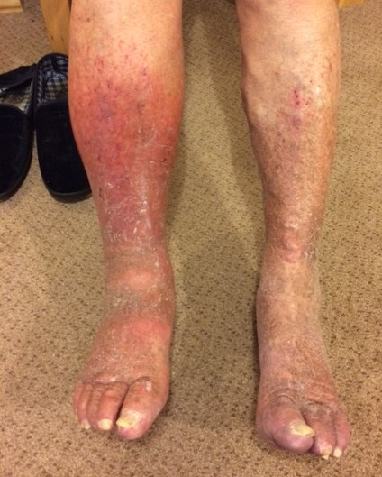
Image featured here with full consent from patient for use by Patient.info
Varicose eczema symptoms
Symptoms of varicose eczema may include:
The skin looks red and can be slightly shiny (which is why some people mistake varicose eczema for an infection).
The skin should feel cool to the touch, not warm.
The skin gets flaky and scaly.
The skin may also look 'rusty' or brown in colour.
The skin, particularly the skin around your ankle, may feel hard or tight.
You can get little raised bumpy 'blisters' in the skin. Sometimes these are hard; other times they might leak a drop of clear fluid if you press them.
Pain and itchiness are variable, ranging from absent to severe.
It can feel like your legs are warm, although they are not warm to the touch.
Generally it all starts in the skin around the inside of your calf, above your ankle.
Some skin may 'break down' into an ulcer. See the separate leaflet called Venous Leg Ulcers for more information on this condition. If the ulcer is small and heals up, it can leave a star-shaped white mark.
Who gets varicose eczema?
Varicose eczema mainly affects older people. As many as one in five people over the age of 70 develop varicose eczema. People most at risk are those who have الدوالي, who have had varicose vein surgery, or who have had a thrombosis in a deep leg vein (deep vein thrombosis - a DVT). Varicose eczema is more common in women.
What causes varicose eczema?
Varicose eczema is caused when pressure increases in the veins running under the skin and in the deep muscles of the legs. This raised pressure is due to leaky valves in the veins. When the valves are not working well, it is difficult for the blood to flow back up the legs against gravity. So they are more full of blood than they should be, which means the pressure inside them is higher.
The increased pressure in the veins makes them leak. Fluid and blood cells leak out of the veins and under the skin. This can sometimes be triggered when you have had surgery or injury to your legs.This sets off a reaction under the skin. The effect of this is inflammation of the skin and then eczema. Over time the affected skin becomes harder and discoloured. Because skin with eczema is scaly and can become broken, it is more prone to developing التقرحات.
Other causes of varicose eczema
تشمل هذه الأشياء:
Pregnancy - this can increase the pressure in your leg veins.
Obesity - more weight can also increase pressure in your leg veins.
Health conditions - varicose eczema can also occur after a blood clot (thrombosis) forms in the deep veins.
What is the best treatment for varicose eczema?
General advice for treating varicose eczema
The most important thing is to put your legs up as high as possible when sitting. Most pouffes or footstools just aren't high enough: it's best to have your feet as high as your hips, or even a bit higher! (When your legs are up, gravity helps the blood flow back up the legs.)
Try to avoid injuring the skin (for example, against furniture).
Keep active and go for regular walks. (When the muscles in your legs are active, they help push the blood in the veins back up the legs.)
Avoid standing still for a long period of time. (In this position there is more pressure on the veins in the legs. The muscles are not squeezing the veins, as they do when you are walking.)
Make sure the skin does not become too dry, by using regular moisturising creams (emollients). See the separate leaflet called Moisturisers (Emollients) for Eczema for more details.
Steroid applied to the skin
If the skin becomes very inflamed, your doctor may prescribe a ستيرويد موضعي (steroid creams or ointments applied to the skin). Topical steroids work by reducing inflammation in the skin. The steroid is applied as an ointment rather than a cream if the skin is very dry. A moderate-strength steroid is usually prescribed unless the skin is very inflamed, in which case a very strong ointment may be needed.
Topical steroids are usually applied once a day (sometimes twice a day - your doctor will advise). Rub a small amount thinly and evenly just on to areas of skin which are inflamed. (This is in contrast to emollients described earlier which are applied generously.)
To work out how much you should use for each dose, squeeze out some ointment from the tube on to the end of an adult finger - from the tip of the finger to the first crease. This is called a fingertip unit. One fingertip unit is enough to treat an area of skin twice the size of the flat of an adult's hand with the fingers together. Gently rub the cream or ointment into the skin until it has disappeared. Then wash your hands.
Compression stockings
Compression stockings are also known as compression hosiery. The stockings work by applying pressure from outside the veins. This helps squeeze the blood in the veins back up the legs. This then makes the pressure inside the veins less. In turn this prevents leakage of blood into the surrounding tissues.
Before compression stockings are advised you will need to have a test to check that the circulation through the arteries of your legs is normal. This is usually done by the practice nurse, with a handheld machine called a Doppler. This measures the pressure in your arteries.
Compression stockings come in light, medium or strong material (class 1, 2 or 3) and are worn below the knee. Most people can tolerate class 2. If class 2 is too uncomfortable or difficult, class 1 is prescribed. If class 2 stockings do not work, it may be necessary to try class 3, although many people find these difficult to wear for any length of time.
These can be prescribed by your doctor and obtained at the chemist. People often do not like wearing these stockings because they are uncomfortable, or difficult to put on, or don't look very nice. But they really help your circulation and can prevent serious problems such as ulcers.
Further tips on support stockings
They are available in different colours, so do ask for the one that suits you best. That way, you are more likely to use them.
They should be removed at bedtime and put on first thing in the morning. It is important to put them on before your legs start to swell in the mornings.
There are open or closed toe options. Open toe stockings may be useful if:
You have painful toes due to arthritis or infection.
You have large feet.
You want to wear socks over your support stockings.
You prefer them.
Stockings should be replaced every 3-6 months. Each time you should be measured again, just in case the size needs to be changed.
You should always have at least two pairs prescribed so that one pair can be washed and dried while the other is worn.
Do not tumble dry support stockings, as this may damage the elastic.
They can be made to measure if the standard sizes don't fit you. This can still be done with a prescription.
Support stocking applicator aids are available if you are unable to get them on. You can discuss this with your pharmacist or nurse.
Can you fly with varicose eczema?
Varicose eczema is seen in people who have الدوالي, or have had a deep venous thrombosis (DVT). These conditions are an increased risk for forming a (further) deep venous thrombosis. This is a blood clot in the leg which can have serious consequences. During a flight this risk increases because you are relatively immobile for long periods of time. It is estimated your risk of having a DVT increases 2-3 times from a long-haul flight.
You can fly but if there is an alternative way to travel where you can walk about more, it would be safer to do so. If you have to fly you should take sensible precautions, such as:
Remaining adequately hydrated.
Exercising the calves.
Spending time out of the seat.
Avoiding excess alcohol.
Avoiding tight-fitting socks or stockings.
Perhaps using graduated compression stockings.
Does varicose eczema go away?
If your condition does not seem to be responding to treatment, your doctor may consider patch testing to check if you have developed التهاب الجلد التماسي. This is a sensitivity to any of the creams, ointments or dressings you have applied to the skin. Patch testing involves putting various chemicals in patches on to the skin to see whether a reaction develops. This is usually done by a skin specialist (dermatologist).
You may also be referred to a dermatologist for more specialised advice about your skin problem.
Lack of progress sometimes means that infection has set in. Antibiotic tablets, such as فلوكلوكساسيلين, may be needed if this is the case.
You may need to be referred to a surgeon who specialises in arteries and veins (a vascular surgeon). You may require an operation if:
Your varicose eczema will only get better if underlying varicose veins are treated.
You have a leg ulcer which is not responding to medical treatment.
You have a blockage in the arteries of the leg.
Can you treat varicose eczema naturally?
Herbal preparations applied to the skin have been known to cause allergic reactions and are best avoided. It may be that a herbal treatment made from horse chestnut seed extract and taken by mouth can help. However, more tests are needed on this to decide on the best dose to take. It cannot be prescribed by your doctor, but may be available from health food shops, etc.
اختيارات المرضى لـ اضطرابات الأوعية الدموية

صحة القلب والأوعية الدموية
الانسداد الرئوي
A pulmonary embolism (embolus) is a serious, potentially life-threatening condition. It is due to a blockage in a blood vessel in the lungs. A pulmonary embolism (PE) can cause symptoms such as chest pain or breathlessness. It may have no symptoms and be hard to detect. A massive PE can cause collapse and death. PE usually happens due to an underlying blood clot in the leg - deep vein thrombosis (DVT). Prompt treatment is important and can be life-saving. Pregnancy, various medical conditions and medicines, immobility and major surgery all increase the risk of a PE. Anticoagulation, initially with heparin and then warfarin, or other oral blood thinning tablets, is the usual treatment for PE.
بقلم الدكتورة راشيل هدسون، MRCGP
صحة القلب والأوعية الدموية
تجلط الأوردة العميقة
A deep vein thrombosis (DVT) is a blood clot in a vein. Blood clots in veins most often occur in the legs but can occur elsewhere in the body, including the arms. This leaflet is about blood clots in leg veins. The most common cause of a blood clot developing in a vein is immobility. A complication can occur in some cases where part of the blood clot breaks off and travels to the lung (pulmonary embolus). This is usually prevented if you are given anticoagulation treatment.
بقلم الدكتورة توني هازيل، FRCGP
الأسئلة الشائعة
Does varicose eczema go away completely?
Varicose eczema may not go away completely without addressing the underlying cause. If the condition doesn't improve with treatment, your doctor might consider patch testing to check for contact dermatitis, or refer you to a dermatologist or a vascular surgeon. Surgery on underlying varicose veins may be necessary if your varicose eczema or leg ulcer isn't responding to medical treatment, or if there's an artery blockage in your leg.
What specifically causes varicose eczema to flare up?
Varicose eczema is caused by increased pressure in the leg veins due to leaky valves, leading to fluid and blood cells leaking under the skin, which triggers inflammation and eczema. This can sometimes be triggered or made worse by surgery or an injury to the legs, pregnancy, obesity, or a past deep vein thrombosis.
Is varicose eczema a dangerous condition?
While uncomfortable, varicose eczema itself is generally not considered dangerous. However, it indicates underlying vein issues like varicose veins or a history of deep vein thrombosis (DVT), which carry risks such as leg ulcers forming, or an increased risk of developing another DVT, especially during long periods of immobility like on a long-haul flight.
How can I prevent varicose eczema from developing or worsening?
To prevent varicose eczema from developing or worsening, it's important to keep your legs elevated as high as possible when sitting, engage in regular walks, and avoid standing still for long periods. You should also keep your skin moisturised with emollients and avoid injuring the skin.
What is a fingertip unit for applying steroid cream and why is it important?
A fingertip unit is a way to measure the correct amount of topical steroid cream to apply. It's the amount of ointment squeezed from the tube from the tip of an adult's finger to the first crease. This unit is important because it ensures you apply a small, thin, and even layer only to inflamed areas, as steroids should not be applied as generously as emollients.
قراءة إضافية ومراجع
- Venous Eczema; ديرم نت
- Venous eczema and lipodermatosclerosis; NICE CKS، مارس 2022 (الوصول متاح فقط في المملكة المتحدة)
- Compression stockings; NICE CKS, May 2022 (UK access only)
- Yao P, Mukhdomi T; Varicose Vein Endovenous Laser Therapy.
عن المؤلفعرض السيرة الذاتية الكاملة
الدكتور لورانس نوت
طبيب عام، مؤلف طبي
بكالوريوس (مع مرتبة الشرف) في الكيمياء الحيوية، بكالوريوس الطب والجراحة
الدكتور لورانس نوت تأهل في عام 1973 ولديه خبرة واسعة كطبيب عام.
حول المراجععرض السيرة الذاتية الكاملة

Dr Toni Hazell, FRCGP
بكالوريوس الطب والجراحة، بكالوريوس العلوم، زميل الكلية الملكية للأطباء العامين، دبلوم في الصحة الجنسية والإنجابية، دبلوم في طب الجهاز البولي التناسلي، دبلوم الكلية الملكية لأطباء النساء والتوليد، دبلوم في صحة الطفل (لندن، المملكة المتحدة، 2000)
تخرجت الدكتورة توني هازيل من كلية الطب بمستشفى سانت ماري وأكملت تدريبها في مستشفى نورثويك بارك.
تاريخ المقال
تمت كتابة المعلومات على هذه الصفحة ومراجعتها من قبل أطباء مؤهلين.
المقال متاح أيضًا باللغة الإنجليزية, الألمانية, إسبانية, الفرنسية, إيطالي, البرتغالية, الهندية, العبرية, العربية ,، و السويدية.
المراجعة التالية مستحقة: 20 فبراير 2028
21 فبراير 2023 | أحدث إصدار
آخر تحديث بواسطة
الدكتورة هايلي ويلاسي، زميلة الكلية الملكية للأطباء العامينمراجعة من قبل
Dr Toni Hazell, FRCGP28 Sept 2011 | نُشر في الأصل
كتبه:
الدكتور لورانس نوت

اسأل، شارك، تواصل.
تصفح المناقشات، اطرح الأسئلة، وشارك التجارب عبر مئات المواضيع الصحية.

هل تشعر بتوعك؟
قم بتقييم أعراضك عبر الإنترنت مجانًا
اشترك في النشرة الإخبارية للمرضى
جرعتك الأسبوعية من النصائح الصحية الواضحة والموثوقة - مكتوبة لمساعدتك على الشعور بالاطلاع والثقة والتحكم.
من خلال الاشتراك، فإنك تقبل سياسة الخصوصية. يمكنك إلغاء الاشتراك في أي وقت. نحن لا نبيع بياناتك أبدًا.
المزيد في صحة القلب والأوعية الدموية
- تمدد الشريان الأورطي البطني
- متلازمة الشريان التاجي الحادة
- حاصرات ألفا
- تمزق الشريان الأورطي
- تضيق الأبهر
- حاصرات بيتا
- حاصرات قنوات الكالسيوم
- فشل القلب الاحتقاني
- تشنج الشريان التاجي
- السكري وارتفاع ضغط الدم
- تخطيط القلب الكهربائي
- فرط السوائل
- التعافي من النوبة القلبية
- أمراض القلب
- ارتفاع ضغط الدم أثناء الحمل
- مدرات البول العروية
- الانسداد الرئوي
- التهاب الوريد الخثاري السطحي
- الدوالي الوريدية
- قرح الساق الوريدية