حصى اللوزتين
Tonsilloliths
مراجعة من قبل الدكتورة توني هازيل، زميلة الكلية الملكية للأطباء العامينآخر تحديث بواسطة الدكتورة فيليبا فينسنت، MRCGPآخر تحديث 17 ديسمبر 2024
يتوافق مع الإرشادات التحريرية
- تنزيلتنزيل
- مشاركة
- Language
- نقاش
- نسخة صوتية
- أضف إلى المصادر المفضلة على جوجل
في هذه السلسلة:التهاب الحلقالتهاب اللوزتيناستئصال اللوزتينالحمى الغدية
Tonsil stones are stones which can form at the back of the throat within the tonsils. They are not serious but can sometimes cause problems with a sore throat or bad breath.
نظرة سريعة
Tonsil stones are white or yellow collections of debris at the back of the throat.
They are made of minerals, cells, tissues, and bacteria that harden in tonsil crevices.
Symptoms can include bad breath, discomfort swallowing, or an irritating cough.
Good oral hygiene, gargling, and avoiding smoking may help prevent them.
Some tonsil stones can be removed at home using gargling or gentle irrigation.
What are tonsil stones?
Tonsil stones, otherwise known as tonsilloliths, are a white or yellow accumulation of debris at the back of the throat. They tend to occur in people who have large or craggy tonsils.
Tonsils are the soft lumps at the back of your throat, one at each side. They are lymph nodes which sometimes enlarge to help fight infection.
Not everyone has visible tonsils - people whose tonsils are not visible are unlikely to develop tonsilloliths. Some people have large tonsils with craggy ridges in them.
كيف تبدو حصى اللوزتين؟
حصى اللوزتين
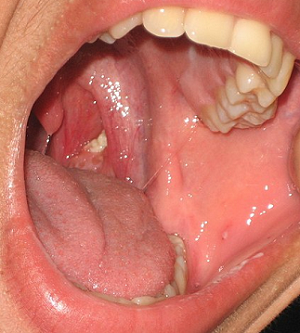
© By Glacko2021 at English Wikipedia, via Wikimedia Commons
They look like small white, yellow or pale grey pebbles, in the nooks and crannies of the tonsils.
ما الذي يسبب حصى اللوزتين؟
Tonsil stones are made up of minerals - mainly calcium salts. Debris from the surrounding cells, tissues and bacteria gets stuck in the crevices of the tonsils and then hardens (becomes calcified). They can be hard, like tiny rocks, or quite soft. They are usually quite small, but can sometimes get bigger.
They are not cancerous growths, and they are not attached to the tissues around them, but instead are stuck in the crevices of the tonsils.
Tonsil stones can actually help the immune system by blocking bacteria and viruses from entering the body.
Tonsilloliths can occur at any age but are more common in adults than in children. Some people just develop one, whereas others can have more than one at a time. In some people, when they get rid of one, another forms somewhere else on their tonsils.
Why do I keep getting tonsil stones?
Some people are more prone than others to developing tonsil stones.
Risk factors include:
التدخين.
Poor oral hygiene.
Recurrent tonsil infections.
Having tonsillar crypts.
Tonsillar crypts are the folds, gaps and crevices found in some people's tonsils. They are more common in larger or craggy-looking tonsils.
ما هي أعراض حصى اللوزتين؟
Often there are no symptoms of tonsil stones at all, though when there are they may include :
A feeling of something being stuck at the back of the throat.
Discomfort swallowing.
A bad taste in the mouth.
An irritating cough.
ألم في الأذن (sometimes a problem in the mouth can 'radiate' to the ear due to the way that the pain signal is carried along nerves).
Are any tests needed for tonsil stones?
Usually tonsil stones (tonsilloliths) can be seen at the back of the mouth and no special tests are needed. Sometimes they are seen coincidentally on X-rays or scans which have been done for other reasons.
How to get rid of tonsil stones
In many cases tonsil stones can be removed at home. Treatment is not necessarily needed, especially if there are no symptoms.
Salt water gargle. Try gargling with mouthwash or a salty water solution. This may dislodge the tonsil stones.
Gentle irrigation. This involves gently shooting water at the back of the mouth to try to dislodge tonsil stones. It is possible to buy a syringe specially for this purpose, which has a curved tip, or an irrigation kit. It is important to follow the instructions carefully, as it is possible to damage the tonsils if too much force is used. This may cause pain and bleeding.
Cotton swabbing. Gently massaging around the tonsils with a cotton swab can push the tonsil stone loose.
الإزالة الجراحية. An ear, nose and throat (ENT) surgeon can remove tonsil stones which are causing problems but this will only be done if the tonsil stones are:
Large in size.
Painful.
Causing repeated bacterial infections and sore throats.
A dentist may be able to help with the problem and can make the referral if needed.
How to prevent tonsil stones
Good oral hygiene helps with preventing tonsil stones. Teeth should be brushed twice a day, as advised by dentists, including the spaces in between them, to stop any debris accumulating.
Consider a tongue scraper to keep the tongue clear of any gunk or germs which might contribute to a stone forming.
Regular gargling with a mouthwash or salt water solution may also help.
Avoid التدخين و excess alcohol which can cause the mouth to be dry and may make tonsilloliths or tonsil stones more likely to build up.
For some people, an operation to flatten the surfaces of the tonsils may help to stop persisting problems with tonsilloliths recurring. This is called cryptolysis and can be done either by laser treatment or another type of treatment called coblation cryptolysis. This may need a general anaesthetic but is not available on the NHS.
Occasionally, removal of the tonsils (tonsillectomy) is recommended to prevent ongoing problems with tonsil stones.
اختيارات المرضى لـ الحلق واللوزتين

الأذن والأنف والحنجرة
الحمى الغدية
Glandular fever (also known as infectious mononucleosis) is a viral infection that most often affects teenagers and young adults. Although it can make some people feel quite ill, full recovery is usual.
بقلم الدكتورة فيليبا فينسنت، MRCGP

الأذن والأنف والحنجرة
التهاب الحنجرة
Laryngitis is an inflammation of the mucus membranes of your voice box (larynx), which causes you to have a hoarse voice. It is most commonly due to an infection, usually a virus.
بقلم الدكتورة روزالين أدلمان، MRCGP
الأسئلة الشائعة
Are tonsil stones a sign of anything serious?
No, tonsil stones are generally not a sign of a serious underlying condition. They are not cancerous growths. They are simply accumulations of debris, minerals, and bacteria that harden in the crevices of your tonsils.
Can tonsil stones be painful?
While many people experience no symptoms, tonsil stones can sometimes cause discomfort. This might include a feeling of something being stuck in the throat, difficulty swallowing, or even earache, as pain signals can radiate through nerves.
How common are tonsil stones?
Tonsil stones can occur at any age, but they tend to be more common in adults than in children. Some individuals may only develop one, while others might have multiple stones at once or experience them recurring after one is removed.
Can a GP remove tonsil stones?
The article does not explicitly state whether a GP can remove tonsil stones. However, it mentions that an ear, nose, and throat (ENT) surgeon can remove problematic tonsil stones and a dentist may also be able to assist or make a referral if needed. For removal at home, methods like gargling, gentle irrigation, or cotton swabbing are suggested.
Do tonsil stones get bigger over time?
Tonsil stones are usually quite small. However, the article notes that they can sometimes get bigger with continued accumulation of minerals and debris.
قراءة إضافية ومراجع
- Bamgbose BO, Ruprecht A, Hellstein J, et al; The prevalence of tonsilloliths and other soft tissue calcifications in patients attending oral and maxillofacial radiology clinic of the university of iowa. ISRN Dent. 2014 Jan 22;2014:839635. doi: 10.1155/2014/839635. eCollection 2014.
- رائحة الفم الكريهة; NICE CKS، سبتمبر 2024 (الوصول متاح فقط في المملكة المتحدة)
- Shikino K, Ikusaka M; Tonsillolith. Clin Case Rep. 2021 Jun 22;9(6):e04243. doi: 10.1002/ccr3.4243. eCollection 2021 Jun.
عن المؤلفعرض السيرة الذاتية الكاملة

الدكتورة ماري هاردينغ، MRCGP
طبيب عام، مؤلف طبي
BA, MA, MB, BChir, MRCGP, DFFP
Dr Mary Harding qualified from Cambridge University medical school in 1989.
حول المراجععرض السيرة الذاتية الكاملة

Dr Toni Hazell, FRCGP
بكالوريوس الطب والجراحة، بكالوريوس العلوم، زميل الكلية الملكية للأطباء العامين، دبلوم في الصحة الجنسية والإنجابية، دبلوم في طب الجهاز البولي التناسلي، دبلوم الكلية الملكية لأطباء النساء والتوليد، دبلوم في صحة الطفل (لندن، المملكة المتحدة، 2000)
تخرجت الدكتورة توني هازيل من كلية الطب بمستشفى سانت ماري وأكملت تدريبها في مستشفى نورثويك بارك.
تاريخ المقال
تمت كتابة المعلومات على هذه الصفحة ومراجعتها من قبل أطباء مؤهلين.
المقال متاح أيضًا باللغة الإنجليزية, الألمانية, إسبانية, الفرنسية, إيطالي, البرتغالية, الهندية, العبرية, العربية ,، و السويدية.
المراجعة التالية مستحقة: 16 ديسمبر 2027
17 ديسمبر 2024 | أحدث إصدار
13 Sept 2018 | نُشر في الأصل
كتبه:
الدكتورة ماري هاردينغ، MRCGP

اسأل، شارك، تواصل.
تصفح المناقشات، اطرح الأسئلة، وشارك التجارب عبر مئات المواضيع الصحية.

هل تشعر بتوعك؟
قم بتقييم أعراضك عبر الإنترنت مجانًا
اشترك في النشرة الإخبارية للمرضى
جرعتك الأسبوعية من النصائح الصحية الواضحة والموثوقة - مكتوبة لمساعدتك على الشعور بالاطلاع والثقة والتحكم.
من خلال الاشتراك، فإنك تقبل سياسة الخصوصية. يمكنك إلغاء الاشتراك في أي وقت. نحن لا نبيع بياناتك أبدًا.
المزيد في الأذن والأنف والحنجرة
- علم السمع
- اضطراب معالجة السمع
- إصابة الأذن بالضغط
- دمل في قناة الأذن
- التهاب الأذن الوسطى الإفرازي
- فقدان السمع
- فقدان السمع لدى كبار السن
- اختبارات السمع
- التهاب الحنجرة
- فقدان حاسة التذوق والشم
- مرض منيير
- احتقان الأنف
- جراحة تصغير الأنف (تجميل الأنف)
- التهاب الأنف المستمر
- الشخير
- التهاب الحلق
- بخاخات الأنف الستيرويدية
- إيقاف نزيف الأنف
- سرطان الحنجرة
- طنين الأذن