الأكزيما القرصية
مراجعة من قبل الدكتور كولين تايدي، MRCGPآخر تحديث بواسطة الدكتورة فيليبا فينسنت، MRCGPآخر تحديث 16 أبريل 2023
يتوافق مع الإرشادات التحريرية
- تنزيلتنزيل
- مشاركة
- Language
- نقاش
- نسخة صوتية
- أضف إلى المصادر المفضلة على جوجل
في هذه السلسلة:الأكزيما التأتبيةمسببات ومهيجات الإكزيماالمرطبات وكريمات الأكزيماالستيرويدات الموضعية للأكزيماPompholyxإكزيما هربسي
Eczema (dermatitis) is a term used to describe conditions where there is inflammation of skin. There are several types of eczema. Discoid eczema is one type which causes round or oval red patches of inflamed skin. The cause is uncertain. Treatment includes regular use of emollients to moisturise your skin, steroid creams to reduce inflammation and treatment of any infection of the affected skin.
نظرة سريعة
الأكزيما القرصية تسبب بقع حمراء دائرية أو بيضاوية على جلدك.
يمكن أن تكون هذه البقع وردية حمراء، جافة، متقشرة، مثيرة للحكة، أو تسبب إحساسًا بالحرقان.
غالبًا ما يبدأ في الساقين ويمكن أن يؤثر على الأشخاص من جميع الأعمار، ولكنه نادر في الأطفال.
السبب الدقيق غير معروف، ولكن العديد من الأشخاص الذين يعانون منه لديهم بشرة جافة بشكل عام.
يتضمن العلاج ترطيب الجلد، وتقليل الالتهاب، ومعالجة أي عدوى.
راجع الطبيب إذا لاحظت زيادة في الاحمرار أو البكاء أو ظهور بثور على البقع.
What is discoid eczema?
Discoid eczema is a type of eczema that causes round- or oval-shaped red patches on the skin. Eczema is also called dermatitis. Dermatitis is a general term which means inflammation of the skin. Discoid refers to the disc shape of the eczema patches. Discoid eczema is sometimes called nummular eczema. Nummular literally means coin-shaped, another way of describing the shape of the patches of eczema.
Discoid eczema symptoms
The most common symptom of discoid eczema is a patch of coin-shaped eczematous lesions on the body. These are:
Pinky-red, dry and scaly patches of skin.
Itchy patches of skin that are often worse at night.
Skin patches that burn or sting.
The skin between the discoid eczema patches looks normal except that, in general, many people with discoid eczema have dry skin.
Discoid eczema often starts on the legs. Some people will only have one or two patches of discoid eczema but others may develop many patches. Discoid eczema can occur anywhere on the body but it is relatively common for it to only be on the legs. It is uncommon on the face and scalp. It tends to become worse in the winter months in cold, dry climates. Sun tends to improve the symptoms in most people. Because of this discoid eczema can sometimes be mistaken for الصدفية.
Sometimes the skin patches can clear in the centre, just leaving a ring of eczema . If this happens, discoid eczema can sometimes be mistaken for السعفة. It is possible for patches of discoid eczema to become infected with germs (bacteria). Signs of infection include:
Increased redness.
Weeping or blistering of the skin patch.
Discoid eczema image
Discoid eczema (also called nummular eczema)
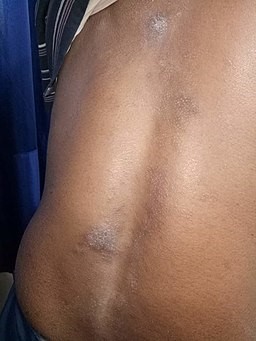
© محمد2018، CC BY-SA 4.0، عبر ويكيميديا كومنز
Discoid eczema causes
The exact cause of discoid eczema is uncertain. However, most people with discoid eczema have generally dry skin. One theory is that the dry skin upsets the normal fatty layer within the outer layer of the skin (the epidermis) which usually helps to protect the skin. Because this protection is lost, special proteins that can cause الحساسية (allergens) can penetrate through the skin. This can lead to an allergic or irritant response in the skin, so leading to the patches of eczema. In fact, some doctors consider discoid eczema as a form of adult-onset atopic (allergic) dermatitis.
Sometimes certain medicines can trigger discoid eczema in some people. For example, medicines used to treat hepatitis C infection (called interferon and ribavirin). لدغات الحشرات or a minor skin injury can also trigger an outbreak of discoid eczema in some people.
Because the fatty, protective layer within the skin is lost, it is thought that some people with discoid eczema may also have an increased risk of developing contact dermatitis. Contact dermatitis is eczema that is caused by your skin reacting to a substance it has come into contact with. Such substances can include nickel in jewellery or belt buckles, cosmetics, preservatives in creams and ointments, additives to leather, etc. See the separate leaflet called Contact Dermatitis for more details.
How common is discoid eczema?
Discoid eczema is quite common and probably affects about 2 in 1,000 people. It seems to be more common in men than in women. Discoid eczema can affect men and women of any age but it most commonly affects people aged between 50 and 65 and women between the ages of 15 and 25. It is rare in children.
Discoid eczema diagnosis
It is diagnosed by the typical skin appearance. If a doctor is uncertain about the diagnosis then they may need to exclude a fungal skin infection. For example, if there has been clearing of the skin rash in the centre (as described above), they may suggest scraping a few skin cells off a skin patch which can then be sent off to the laboratory to look for a fungal infection.
If your doctor feels that this may have contact dermatitis, they may suggest skin patch testing. In this procedure, tiny amounts of up to 25 or more substances are applied as small patches to the skin, usually on your upper back. They are fixed on with non-allergic tape. Some days later, the patches are removed by a dermatology specialist and the skin is examined to see if there is a reaction to any of the tested substances. See the separate leaflet called Patch Testing for Contact Dermatitis for more details.
Discoid eczema treatment
Treatment is aimed at:
Restoring fluid to your skin (called rehydration).
Treating the skin inflammation.
Also treating any infection that may be present.
Medicines are available to help relieve the symptoms and keep the condition under control.
Treatments include:
Skin rehydration treatment
This is done by using emollients. Emollients are often called moisturisers. They are lotions, creams, ointments and bath/shower additives that are applied to the skin to stop it becoming dry. Emollients should be used as soap substitutes when washing as regular soap tends to dry out the skin. After bathing/showering, emollients should be applied to the skin.
Regular use of emollients is the most important part of the day-to-day treatment for people with eczema, including discoid eczema. Emollients prevent skin from becoming dry and help to protect the skin from irritants. They should be used on all skin and not just the areas affected by discoid eczema. It is particularly important to carry on with daily moisturising of the skin even after a flare-up of discoid eczema has healed. This is to help reduce the chance of a further flare-up.
There are many types and brands of emollients, ranging from runny lotions to thick ointments. The difference between lotions, creams and ointments is the proportion of oil (lipid) to water. The lipid content is lowest in lotions, intermediate in creams and highest in ointments. The higher the lipid content, the greasier and stickier it feels and the shinier it looks on the skin. As a general rule, the higher the lipid content (the more greasy and thick the emollient), the better and longer it works but the messier it is to use. See the separate leaflet called Emollients and Eczema Creams for more details.
The use of petroleum jelly is sometimes recommended to keep the skin hydrated.
Topical steroids to reduce inflammation
A topical steroid is a steroid cream or ointment that is applied to the skin. In discoid eczema, topical steroids are applied to the skin patches to reduce inflammation. Ointments tend to be better than creams because they tend to hold water in the skin better and form a better protective barrier for the skin.
Steroid cream or ointment should not be used on normal skin and should only be used when there is a flare-up of the discoid eczema. This is because long-term steroid cream use can have some negative effects on skin, including thinning of your skin. راجع النشرة المنفصلة المسماة الستيرويدات الموضعية للأكزيما لمزيد من التفاصيل.
Sometimes wet wrap treatments are used with a topical steroid to treat discoid eczema. The skin is made wet first with lukewarm water so that it is well hydrated. Then, a steroid ointment is applied to the affected areas of skin. Next, damp pyjamas or bandaging are used to seal in the steroid ointment for around one hour. These treatments would normally be recommended by a dermatologist if needed.
Very rarely, in severe cases, steroid tablets taken by mouth or given by injection may be needed to treat discoid eczema.
ملاحظة: when using both an emollient and a topical steroid, the emollient should be applied first. After applying an emollient, 10-15 minutes should be left before applying a topical steroid. That is, the emollient should be allowed to absorb before a steroid is applied. (The skin should be moist or slightly tacky but not slippery, when applying the steroid.)
Treatment of infection
دواء مضاد حيوي might be needed if there is bacterial infection of discoid eczema patches. This may be in a cream or tablet form depending on the severity of the infection.
Treatment to reduce itching
Antihistamine tablets may help to reduce itching and may be particularly useful at night when trying to sleep. However, some antihistamines can cause drowsiness (even the next day), needing caution with driving or operating machinery.
علاجات أخرى
Tar preparations may be helpful, especially in areas of skin that have been thickened and scaly for a long time.
Tacrolimus و بيميكروليموس are other creams that may be used to help reduce inflammation in some people with discoid eczema. They may be considered in some people if steroid treatment is not working.
Because discoid eczema tends to improve in the sun, ultraviolet (UV) light treatment (phototherapy) can sometimes be helpful as a treatment. The UV radiation helps to reduce the inflammation in the skin. However, care should be taken, as exposure to UV radiation does carry its own risks of skin damage. This includes an increased risk of skin cancers. So, the risks of this type of treatment need to be weighed against the benefits. This type of treatment is usually used if discoid eczema is severe or other treatments have not worked.
Medicines that suppress the immune system may occasionally be needed to treat discoid eczema. They include medicines such as ciclosporin. Again, they are usually only used in severe cases of discoid eczema that are very difficult to treat and have not responded to other treatments.
Discoid eczema complications
As mentioned above, bacterial infection of a patch of discoid eczema can occur and needs to be treated with antibiotics. Also, care should be taken to avoid scratching the itchy patches where possible as scarring can sometimes occur.
After a discoid eczema skin patch has healed, in many people there will be no residual signs. However, in some people there can be some permanent brown discolouration of the skin in the affected area. In others, the affected area of skin can become paler than the surrounding skin.
Outlook for discoid eczema
Once discoid eczema has been successfully treated, a flare-up can occur again in the future. Therefore, it is important to keep the skin well hydrated with emollients to reduce the chance of future flare-ups.
Where possible, it is best to try to avoid anything that may have triggered the eczema, such as hot baths or irritating clothing. A humidifier in the room may help to reduce flare-ups. If flare-ups do occur, they often affect the same areas of skin as before.
اختيارات المرضى لـ الأكزيما

صحة الجلد والأظافر والشعر
Pompholyx
Pompholyx is a type of eczema where there are itchy blisters on the hands and feet, followed by inflamed and dry skin. The condition is usually long-term, with symptoms that come and go at various times. The first step in managing pompholyx is to identify and avoid things that make it worse. Treatment includes creams and ointments to reduce inflammation and irritation. If the symptoms are severe and persistent, a short course of steroid tablets might be helpful.
بقلم الدكتور محمد شريف رضائي، MRCGP

صحة الجلد والأظافر والشعر
الأكزيما التأتبية
Eczema is sometimes called dermatitis which means inflammation of the skin. There are different types of eczema, but most are chronic conditions. The most common type is atopic eczema. In this type of eczema there is a typical pattern of skin inflammation which causes the symptoms. Moisturisers (emollients) and steroid creams or ointments are the common treatments. About 2 in 3 children with atopic eczema grow out of it by their mid-teens.
بقلم الدكتور دوغ مكيتشني، MRCGP
الأسئلة الشائعة
Is discoid eczema contagious?
لا، الأكزيما القرصية ليست معدية. إنها حالة جلدية تسبب بقع حمراء دائرية أو بيضاوية الشكل على الجلد، لكنها لا يمكن أن تنتقل من شخص لآخر.
هل الأكزيما القرصية خطيرة؟
الأكزيما القرصية نفسها ليست خطيرة بشكل عام. ومع ذلك، يمكن أن تصاب البقع بالعدوى البكتيرية، مما يتطلب علاجًا بالمضادات الحيوية. من المهم إدارة الأعراض والحفاظ على صحة الجلد لتجنب المضاعفات.
هل يميل الإكزيما القرصية إلى العودة بعد العلاج؟
نعم، حتى بعد العلاج الناجح، يمكن أن يحدث تفاقم للإكزيما القرصية مرة أخرى في المستقبل. الاستخدام المنتظم للمرطبات للحفاظ على ترطيب الجلد مهم للمساعدة في تقليل فرصة حدوث التفاقمات المستقبلية. غالبًا ما تؤثر التفاقمات المستقبلية على نفس مناطق الجلد.
لماذا تتضمن بعض العلاجات استخدام الأشعة فوق البنفسجية لعلاج الإكزيما القرصية؟
يميل الأكزيما القرصية إلى التحسن مع التعرض لأشعة الشمس، لذا يمكن أن يكون العلاج بالأشعة فوق البنفسجية (UV)، المعروف أيضًا بالعلاج الضوئي، مفيدًا في بعض الأحيان. تساعد الأشعة فوق البنفسجية في تقليل الالتهاب في الجلد. ومع ذلك، فإن هذا العلاج يحمل مخاطر تلف الجلد، بما في ذلك زيادة خطر الإصابة بسرطانات الجلد، وعادة ما يتم الاحتفاظ به للحالات الشديدة أو عندما لا تنجح العلاجات الأخرى.
هل يمكن أن يسبب الإكزيما القرصية تغييرات دائمة في بشرتي؟
في كثير من الحالات، بعد شفاء بقعة الأكزيما القرصية، لا توجد علامات متبقية. ومع ذلك، في بعض الأفراد، قد يحدث تغير دائم في لون الجلد إلى البني في المنطقة المصابة، أو قد يصبح الجلد أفتح من الجلد المحيط.
قراءة إضافية ومراجع
- Fleming C, Parry E, Forsyth A, et al; Patch testing in discoid eczema. Contact Dermatitis. 1997 May;36(5):261-4.
- Leung AKC, Lam JM, Leong KF, et al; Nummular Eczema: An Updated Review. Recent Pat Inflamm Allergy Drug Discov. 2020;14(2):146-155. doi: 10.2174/1872213X14666200810152246.
عن المؤلفعرض السيرة الذاتية الكاملة

الدكتورة فيليبا فينسنت، MRCGP
طبيب عام، مؤلف طبي
MB BS, Bsc, MRCGP (2000), DCH, DFSRH, DRCOG
الدكتورة فيليبا فينسنت هو طبيب عام في هيئة الخدمات الصحية الوطنية يعمل في شمال لندن.
حول المراجععرض السيرة الذاتية الكاملة

الدكتور كولين تايدي، MRCGP
طبيب عام، مؤلف طبي
MBBS, MRCGP, MRCP (Paediatrics), DCH
الدكتور كولين تايدي هو طبيب في هيئة الخدمات الصحية الوطنية، ويعمل في أوكسفوردشاير.
تاريخ المقال
تمت كتابة المعلومات على هذه الصفحة ومراجعتها من قبل أطباء مؤهلين.
المقال متاح أيضًا باللغة الإنجليزية, الألمانية, إسبانية, الفرنسية, إيطالي, البرتغالية, الهندية, العبرية, العربية ,، و السويدية.
المراجعة التالية مستحقة: 14 أبريل 2028
16 أبريل 2023 | أحدث إصدار

اسأل، شارك، تواصل.
تصفح المناقشات، اطرح الأسئلة، وشارك التجارب عبر مئات المواضيع الصحية.

هل تشعر بتوعك؟
قم بتقييم أعراضك عبر الإنترنت مجانًا
اشترك في النشرة الإخبارية للمرضى
جرعتك الأسبوعية من النصائح الصحية الواضحة والموثوقة - مكتوبة لمساعدتك على الشعور بالاطلاع والثقة والتحكم.
من خلال الاشتراك، فإنك تقبل سياسة الخصوصية. يمكنك إلغاء الاشتراك في أي وقت. نحن لا نبيع بياناتك أبدًا.