السلائل الأنفية
مراجعة من قبل الدكتور كولين تايدي، MRCGPآخر تحديث بواسطة الدكتورة توني هازيل، زميلة الكلية الملكية للأطباء العامينآخر تحديث 23 Sept 2022
يتوافق مع الإرشادات التحريرية
- تنزيلتنزيل
- مشاركة
- Language
- نقاش
- نسخة صوتية
- أضف إلى المصادر المفضلة على جوجل
السلائل الأنفية هي تورمات لحمية تنمو داخل الأنف أو الجيوب الأنفية. عادة ما تكون غير سرطانية (حميدة). الأعراض الأكثر شيوعًا التي تسببها هي انسداد الأنف وسيلانه. تُستخدم قطرات الأنف الستيرويدية عادة لتقليص السلائل. قد تكون هناك حاجة أحيانًا لإزالة السلائل جراحيًا. غالبًا ما تعود السلائل الأنفية بعد العلاج، لذا يمكن استخدام بخاخات الأنف الستيرويدية يوميًا لمنع تكرارها.
نظرة سريعة
السلائل الأنفية هي نمو ناعم ولحمي وشائع داخل أنفك، وقد تكون صفراء أو رمادية أو وردية.
يمكن أن تختلف في الحجم وقد تنمو في مجموعات، أو تؤثر على فتحة أنف واحدة أو كلتا الفتحتين.
تشمل الأعراض انسداد أو سيلان الأنف، وانخفاض في حاسة الشم والتذوق، وتغيرات في صوتك.
إذا استمرت الأعراض لفترة أطول من نزلة البرد أو كان لديك إفراز دموي من إحدى فتحتي الأنف، يجب استشارة الطبيب.
يشمل العلاج قطرات الأنف الستيرويدية أو الأقراص، وقد يتضمن جراحة للزوائد الأنفية الكبيرة.
قد تعود السلائل الأنفية بعد العلاج، لذا قد يُنصح بالاستمرار في استخدام بخاخات الأنف الستيرويدية.
What do nasal polyps look like?
Nasal polyps are soft fleshy swellings that grow inside your nose.
They may be yellowish, grey or pink in colour.
They are common.
Nasal polyps can vary greatly in size.
There may be only one but sometimes several nasal polyps grow like a small bunch of grapes on a stem.
Nasal polyps causes
In most cases the cause for nasal polyps is not known. It is thought that ongoing (chronic) inflammation in your nose causes swelling (oedema) of the lining of your nostril (nasal cavity). Due to gravity, this swelling hangs down (dependent oedema), forming the polyp. Nasal polyps usually affect كلاهما nostrils and can gradually enlarge, blocking your nose.
Nasal polyps can also grow in your sinuses. Your sinuses are air-filled spaces in your skull which drain into your nose. The biggest sinuses are called the maxillary sinuses. They are found under your eyes, behind your cheeks. The lining of your sinuses is the same as the lining of your nose, so this is why nasal polyps can also form in your sinuses.
The medical name for the inflammation of your nose and sinuses is rhinosinusitis. Often the cause is unknown but it can be due, in part, to sinus infection. Nasal polyps can be a part of this condition.
Certain conditions make nasal inflammation and nasal polyps more likely. These include الربو, an allergy to الأسبرين, التليف الكيسي and some rare conditions (such as allergic fungal sinusitis and nasal issues like Churg-Strauss syndrome).
Nasal polyps symptoms
With nasal polyps symptoms, initially you might think you have a cold. This is because a blocked or runny nose is a common symptom in viral infections like colds. Colds usually only last 2-14 days and the symptoms improve on their own. If you have nasal polyps, the symptoms will not get better without treatment.
Nose congestion.The main symptom of nasal polyps is a blocked feeling in your nose. You may find it difficult to breathe through your nose. You may then have to breathe through your mouth for much of the time. This is especially troublesome at night and your sleep may be affected.
Rhinorrhoea. Watering from the nose (rhinorrhoea) is common.
A postnasal drip may occur. This is the sensation of something continually running down the back of your throat. It is due to mucus coming from the back of the nose because of large nasal polyps.
Reduced sense of smell and taste. Your sense of smell and taste may be dulled or lost.
Voice changes. A blocked nose may make your voice sound different.
الصداع. Larger nasal polyps may cause headaches and snoring.
Sinusitis.Sometimes nasal polyps block the drainage channel of the sinuses into the nose. This can make you more prone to infection of the sinuses (sinusitis).
انقطاع النفس أثناء النوم. Large nasal polyps sometimes interfere with breathing at night and cause obstructive sleep apnoea. See the separate leaflet called Sleep apnoea for more details.
Face changes. Very large untreated nasal polyps can make your nose and front of your face enlarge. This is rare.
Double vision. In extremely rare cases, double vision can occur. This is due to huge nasal polyps changing the structure of the face and pressing on the nerves that send vision signals from the eyes to the brain.
Do I need any tests for nasal polyps?
GP examination
Your doctor might suspect that you have nasal polyps from your symptoms. Your doctor can examine the lower part of the nostrils, so might be able to see a large nasal polyp. You may be referred to an ear, nose and throat (ENT) surgeon if there is a suspicion of nasal polyps.
ENT surgeon examination
An ENT surgeon can usually diagnose nasal polyps based on your symptoms and on examination of your nose (and perhaps your sinuses). Large polyps may be easily visible through your nostrils. Smaller nasal polyps and polyps in the sinuses are not visible via the nostrils. In such cases, the ENT specialist will pass a small flexible telescope with a camera on it (an endoscope) into your nose. This procedure is called nasendoscopy. It allows the extent and location of the nasal polyps to be assessed.
CT scan and MRI scan
Occasionally a CT scan أو an MRI scan may be needed. These scans may show more detail about where the polyps are and what effects they might have had on other parts of the face, sinuses and skull.
Can nasal polyps be cancerous?
Nasal polyps in one nostril only (unilateral) are unusual. In some cases they might be a sign of cancer (malignancy). They should be examined by an ENT surgeon to rule this out. Bloody discharge from one nostril is also a potentially worrying symptom. It can happen due to infection, nose picking or incorrect use of nasal sprays, all of which are generally harmless. However, if you have a bloody discharge from one side of the nose, you should see your doctor, as in rare cases it can be another sign of a malignant tumour.
Nasal polyps treatment
Everyone with nasal polyps should try treatment with medicines, before considering surgery (unless there is any doubt about whether there is a more serious problem, such as tumour).
Medicines for nasal polyps might be topical (for example, drops and sprays), or tablets.
Steroid nose drops
Steroid nose drops are the usual first-line treatment for nasal polyps.
Nose drops that contain steroid medicines reduce inflammation in the nose. Gradually, nasal stuffiness reduces and the polyps shrink. Drops may take a week or two to make any obvious difference to your nasal polyps symptoms. You will probably be advised to use them for at least 4-6 weeks.
It is important to use the drops exactly as prescribed every day for the best chance of success.
Betamethasone أو fluticasone are the two steroid nose drops available on prescription only and there are other sprays available which combine a steroid and an antihistamine.
Diagram showing how to use nose drops
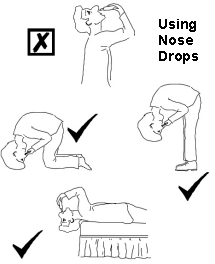
To insert the drops you should kneel, or stand and bend fully down and forwards (as if you were about to stand on your head). Stay with your head down for 3-4 minutes after putting in the drops. This will allow the drops to drain fully to the back of your nostrils. If this is difficult, you can put in the drops by lying on a bed with your head falling back off the edge of the bed.
أقراص الستيرويد
Sometimes a course of steroid tablets (بريدنيزولون) is prescribed for a week or so to reduce inflammation in your nose. This often works very well to shrink the polyps. A course of steroid tablets is a short-term solution, as taking steroid tablets long-term can have important side-effects. It is sometimes used to relieve symptoms when this is needed urgently - for example, if there is an important life event coming up, like an exam or a wedding. It should be used in combination with topical nose steroid drops or sprays.
الجراحة
An operation may be advised if polyps are large, or if steroid nose drops or tablets have not worked.
Polypectomy involves removing the polyps with a surgical instrument. It can be done through your nostrils, either with local anaesthetic (awake), or under general anaesthetic. The type of anaesthetic might depend on the number and size of the polyps, where they are and how fit you are for an operation.
Endoscopic sinus surgery is done with a general anaesthetic. It might be done where the polyps are very large and numerous, or where they are seriously blocking your sinuses. The endoscope allows the surgeon to see into the sinuses with a camera and to do the operation in a place that is difficult to reach with normal surgical instruments.
Do nasal polyps come back after surgery?
Some people are prone to repeated nasal polyps. بخاخات الأنف الستيرويدية can be used regularly, long-term, to try to prevent nasal polyps from developing further. Steroid nasal sprays include بيكلوميتازون, budesonide, fluticasone, موميتازون و triamcinolone. You can buy some of these sprays over the counter (OTC) from pharmacies, without a prescription.
It is best to see a doctor first, to have the correct diagnosis of nasal polyps, before buying medicines and treating yourself.
Regular use of a steroid nasal spray is safe. The amount of steroid in a spray is less than in the drops. Drops are better at clearing polyps if they do come back.
Side-effects of topical steroid medications
These include nasal irritation, sore throat and nosebleeds. About 1 in 10 people using these medications will experience one of these symptoms. Some people are sensitive to a preservative called benzalkonium chloride, found in all all nasal steroid treatments (drops and sprays), except for Flixonase Nasule و Rhinocort Aqua. This preservative can cause irritation of the lining of the nose.
Some side-effects are caused by not using the treatments correctly. It is important to follow the instructions carefully.
Patients who have raised pressure in the eye (glaucoma) should be monitored more closely when using steroid nose sprays or drops. This is because of a small chance of increasing the pressure within the eyes - raised intraocular pressure (IOP).
Other treatments for nasal polyps
Nasal decongestants are often bought from pharmacies to clear a blocked nose. They contain ephedrine أو xylometazoline. They are not advised for the treatment of nasal polyps. If they are used for nasal blockage due to other causes (a cold or sinusitis, for instance), they should be stopped within 10 days. Prolonged use of these medicines can actually worsen your symptoms on stopping (so-called rebound). In some cases, inflammation of the nose (rhinitis), which also causes stuffiness and running of the nose, can be caused by such treatments (rhinitis medicamentosa).
Salt water (saline) nasal douches are a cheap and safe treatment which are sometimes used in combination with other treatments.
Are nasal polyps common?
Around 4 in 100 people will develop nasal polyps at some stage in their lives. Nasal polyps can affect anyone but most cases occur in people over the age of 40 years. They are twice as common in men as in women. Nasal polyps are uncommon in children. A child with nasal polyps should also be checked for cystic fibrosis, as cystic fibrosis is a risk factor for developing nasal polyps. (About half of people with cystic fibrosis have nasal polyps.)
اختيارات المرضى لـ Nose and sinuses
الأذن والأنف والحنجرة
إيقاف نزيف الأنف
تم إنشاء هذه النشرة من نصائح الإسعافات الأولية المقدمة من قبل منظمة سانت جون للإسعاف، وهي المؤسسة الخيرية الرائدة في مجال الإسعافات الأولية في البلاد. هذه النصائح ليست بديلاً عن التدريب على الإسعافات الأولية - ابحث عن دورة تدريبية بالقرب منك.
بقلم الدكتورة هايلي ويلاسي، FRCGP
الأذن والأنف والحنجرة
احتقان الأنف
احتقان الأنف هو شعور بانسداد أو احتقان أو انسداد في الأنف. تتناول هذه النشرة أسباب وعلاج احتقان الأنف.
بقلم الدكتورة فيليبا فينسنت، MRCGP
الأسئلة الشائعة
هل يمكن للطبيب العام تشخيص الزوائد الأنفية؟
قد يشتبه طبيبك العام في أنك تعاني من زوائد أنفية بناءً على الأعراض التي تعاني منها وقد يتمكن من رؤية زائدة كبيرة في الجزء السفلي من فتحات أنفك أثناء الفحص. ومع ذلك، للحصول على تشخيص نهائي، خاصة للزوائد الصغيرة أو تلك الموجودة في عمق الجيوب الأنفية، من المحتمل أن يحيلك إلى جراح الأذن والأنف والحنجرة (ENT).
ما هو لون السلائل الأنفية؟
يمكن أن تكون السلائل الأنفية صفراء أو رمادية أو وردية اللون. إنها تورمات لحمية ناعمة تنمو داخل الأنف.
هل يمكن أن تسبب السلائل الأنفية نزيف الأنف؟
يمكن أن يكون نزيف الأنف أحد الآثار الجانبية لاستخدام قطرات أو بخاخات الأنف الستيرويدية، وهي علاجات شائعة للزوائد الأنفية. إذا كنت تعاني من إفراز دموي من فتحة أنف واحدة، فمن المهم استشارة طبيبك، حيث يمكن أن يكون ذلك نادرًا علامة على مشكلة أكثر خطورة، على الرغم من أنه غالبًا ما يكون بسبب أسباب غير ضارة مثل العدوى أو العبث بالأنف.
هل تبدو السلائل الأنفية دائمًا بنفس الشكل؟
يمكن أن تختلف السلائل الأنفية بشكل كبير في الحجم والمظهر. قد يكون هناك واحدة فقط، أو يمكن أن تنمو عدة منها معًا، أحيانًا تشبه عنقودًا صغيرًا من العنب على ساق. يؤثر حجمها وموقعها على ما إذا كانت مرئية من الخارج أو تتطلب فحصًا داخليًا.
هل يمكن لمزيلات احتقان الأنف أن تساعد في علاج الزوائد الأنفية؟
لا، لا يُنصح باستخدام مزيلات احتقان الأنف التي تحتوي على الإفيدرين أو الزيلوميتازولين لعلاج الزوائد الأنفية. في حين أنها قد تفتح الأنف المسدود لأسباب أخرى مثل الزكام، فإن استخدامها لفترة طويلة يمكن أن يؤدي إلى تفاقم الأعراض عند التوقف، وهي ظاهرة تُعرف باسم "احتقان الارتداد".'
قراءة إضافية ومراجع
- Manufacturer's PIL, Nasacort® Nasal Spray; Sanofi, The electronic Medicines Compendium. Dated September 2021.
- Manufacturer's PIL, Beconase Aqueous Nasal Spray; GlaxoSmithKline UK, The electronic Medicines Compendium. Dated October 2020.
- السلائل الأنفية; NHS ٢٠٢٣
عن المؤلفعرض السيرة الذاتية الكاملة

Dr Toni Hazell, FRCGP
بكالوريوس الطب والجراحة، بكالوريوس العلوم، زميل الكلية الملكية للأطباء العامين، دبلوم في الصحة الجنسية والإنجابية، دبلوم في طب الجهاز البولي التناسلي، دبلوم الكلية الملكية لأطباء النساء والتوليد، دبلوم في صحة الطفل (لندن، المملكة المتحدة، 2000)
تخرجت الدكتورة توني هازيل من كلية الطب بمستشفى سانت ماري وأكملت تدريبها في مستشفى نورثويك بارك.
حول المراجععرض السيرة الذاتية الكاملة

الدكتور كولين تايدي، MRCGP
طبيب عام، مؤلف طبي
MBBS, MRCGP, MRCP (Paediatrics), DCH
الدكتور كولين تايدي هو طبيب في هيئة الخدمات الصحية الوطنية، ويعمل في أوكسفوردشاير.
تاريخ المقال
تمت كتابة المعلومات على هذه الصفحة ومراجعتها من قبل أطباء مؤهلين.
المقال متاح أيضًا باللغة الإنجليزية, الألمانية, إسبانية, الفرنسية, إيطالي, البرتغالية, الهندية, العبرية, العربية ,، و السويدية.
المراجعة التالية مستحقة: 22 سبتمبر 2027
23 Sept 2022 | أحدث إصدار

اسأل، شارك، تواصل.
تصفح المناقشات، اطرح الأسئلة، وشارك التجارب عبر مئات المواضيع الصحية.

هل تشعر بتوعك؟
قم بتقييم أعراضك عبر الإنترنت مجانًا
اشترك في النشرة الإخبارية للمرضى
جرعتك الأسبوعية من النصائح الصحية الواضحة والموثوقة - مكتوبة لمساعدتك على الشعور بالاطلاع والثقة والتحكم.
من خلال الاشتراك، فإنك تقبل سياسة الخصوصية. يمكنك إلغاء الاشتراك في أي وقت. نحن لا نبيع بياناتك أبدًا.
المزيد في الأذن والأنف والحنجرة
- ورم العصب السمعي
- التهاب الجيوب الأنفية الحاد
- علم السمع
- إصابة الأذن بالضغط
- انسداد الأنف عند الأطفال
- التهاب الجيوب الأنفية المزمن
- الأذنين والطيران
- شمع الأذن
- عدوى فطرية في الأذن
- الحمى الغدية
- إحساس الغصة
- التهاب الحنجرة
- فقدان حاسة التذوق والشم
- مرض منيير
- احتقان الأنف
- نزيف الأنف
- التهاب الحلق
- إيقاف نزيف الأنف
- التهاب اللوزتين
- التهاب العصب الدهليزي والتهاب التيه