Abdominal masses
Peer reviewed by Dr Toni Hazell, FRCGPLast updated by Dr Philippa Vincent, MRCGPLast updated 30 Jul 2024
Meets Patient’s editorial guidelines
- DownloadDownload
- Share
- Language
- Discussion
- Audio Version
- Add to preferred sources on Google
An abdominal mass is a lump felt in the tummy (abdomen). There are many different causes of an abdominal mass. Urgent medical attention should be sought if a new mass is found in the abdomen.
At a glance
An abdominal mass is a lump in the tummy.
It can be felt or discovered during an examination for other symptoms like abdominal pain.
Symptoms can include pain, changes in bowel habits, weight loss, or blood in urine.
Causes vary depending on the lump's location and can range from normal body parts to more serious conditions like cancer.
Diagnosis often involves physical examination, blood, urine, or stool tests, and scans.
Treatment depends on the cause; some masses may not need treatment.
What is an abdominal mass?
An abdominal mass is a lump in the tummy (abdomen). The abdomen contains many different structures including the:
Stomach and gut (bowel).
Liver.
Kidneys and bladder.
Womb (uterus) and ovaries in women.
Major blood vessels - for example, the aorta.
The position of the mass will help to determine which structure the mass is arising from.
The abdomen is traditionally divided into nine areas:
Just below the ribs on the right side (right upper quadrant/hypogastrium).
Just below the ribs in the middle (epigastrium).
Just below the ribs on the left side (left upper quadrant/hypogastrium).
Right side of the middle abdomen (right loin/lumbar region).
Around the tummy button (periumbilical).
Left side of the middle abdomen (left loin/lumbar region).
Right side of the lower abdomen (right lower quadrant/inguinal or iliac region).
Middle of the lower abdomen (suprapubic and pelvis).
Left side of the lower abdomen (left lower quadrant/inguinal or iliac region).
Abdominopelvic regions
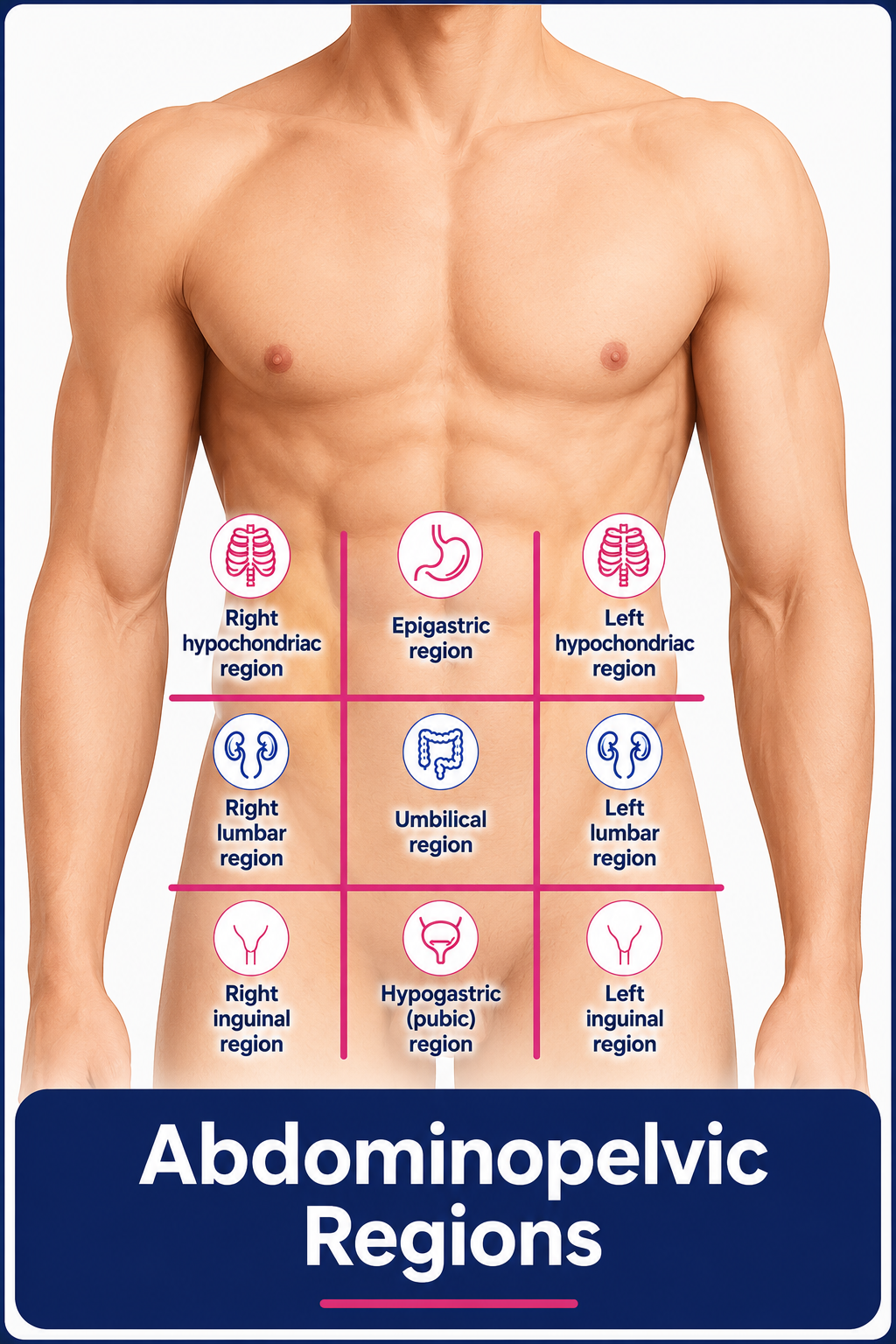
© Blausen.com staff (2014). "Medical gallery of Blausen Medical 2014". WikiJournal of Medicine 1 (2). DOI:10.15347/wjm/2014.010. ISSN 2002-4436., CC BY 3.0 , via Wikimedia Commons
Often nowadays, the abdomen is described in quadrants rather than using the nine areas. These are described as the right upper, right lower, left upper and left lower quadrants.
Abdominal mass symptoms
It is possible to feel a lump in the stomach (the mass in your own abdomen) before any other symptom but, much more frequently, it is first felt by a doctor examining the abdomen because of a different symptom, such as abdominal pain.
Therefore, it is more usual to become aware of a mass in the abdomen because of other symptoms such as:
A mass in the kidney may also cause blood in the urine. Other symptoms will depend on the cause of the mass.
Abdominal mass causes
The possible cause of the abdominal mass will depend on where it is in the abdomen. The following lists are examples of the more common causes of an abdominal mass in each area. A lump (swelling) that can be seen and felt over the front of the abdomen (abdominal wall) may also be a skin lump, a lipoma (fatty lump) or a hernia.
Right upper quadrant
Liver: enlarged liver (hepatomegaly), liver cancer. There are many causes of an enlarged liver, including infection, heart failure, liver cancer, alcoholic liver disease and fatty liver disease.
Gallbladder: cholecystitis, cancer of the bile duct in the liver (cholangiocarcinoma).
Epigastrium
Stomach: for example, stomach cancer.
Pancreas: for example, a pancreatic abscess or cancer of the pancreas.
Ribcage: at the very bottom of the rib cage in the centre of the body, there is a small bone called the xiphisternum. In some people this bone sticks out and can feel like a lump. This is entirely normal and can be easily diagnosed by a doctor on clinical examination.
Left upper quadrant
Spleen: enlarged spleen (splenomegaly). There are many causes of an enlarged spleen, including leukaemia, lymphoma, thalassaemia, sickle cell disease, malaria and glandular fever.
Stomach: for example, stomach cancer.
Pancreas: for example, an abscess or cancer of the pancreas.
Gut (bowel): for example, colon cancer.
Kidney: for example, kidney cancer.
Right loin
Kidney: for example, kidney cancer.
Periumbilical
Enlarged part of the major blood vessel (aorta): aortic aneurysm.
Left loin
Kidney: for example, kidney cancer.
Right lower quadrant
Bowel: for example, colon cancer.
Kidney: for example, kidney cancer.
Ovary: for example, cancer of the ovary.
Suprapubic and pelvis
Bladder: for example, a distended bladder caused by a blockage preventing you from emptying the bladder - such as in prostate gland enlargement in men.
Ovary: for example, ovarian cyst, ovarian cancer.
Abdominal aorta: for example, a pulsatile mass due to an abdominal aortic aneurysm.
Left lower quadrant
Bowel: for example, constipation, colon cancer, diverticular disease.
Kidney: for example, kidney cancer.
Ovary: for example, cancer of the ovary.
Diagnosing an abdominal mass
What tests are needed?
There are lots of different causes of an abdominal mass. Doctors will ask about various other symptoms and do a physical examination of the abdomen. Further tests depend on what they find, and what they think the cause might be.
Examples of tests that might be needed include:
Blood tests - for example, a CA-125 test to look for ovarian cancer.
Urine tests - to look for hidden blood in the urine which can be a sign of kidney cancer or bladder cancer.
Stool tests - a qFIT test is a test to look for hidden blood in the stool which can be a sign of bowel cancer.
Scans or other imaging, such as:
Ultrasound scans; abdominal ultrasound and sometimes transvaginal ultrasound scans.
Depending on the scan results, sometimes a biopsy (sample) of the mass is needed. This would be done in hospital. It might require an operation, depending on where the mass is.
Blood, stool and urine tests can be done by a GP; others need to be done by a hospital team.
If the GP suspects that the mass might be due to cancer, they are likely to make an urgent referral to the hospital - suspected cancer pathways mean that patients should have been seen and investigated within 28 days of referral. Often particular tests are needed before the hospital referral can be sent (for example, a qFIT result may be needed in advance).
Cancer is one cause of an abdominal mass, but there are many others. Most people referred to hospital for suspected cancer end up with normal or reassuring test results. For instance, fibroids are a common cause of a pelvic mass in women, but are not cancerous.
Abdominal mass treatment
Treatment options will depend on the cause of the abdominal mass. If the mass isn't cancer, and isn't causing any problems, no treatment may be needed. Treatment for cancer depends on the type of cancer and how advanced it is. Depending on what the mass is, an operation to remove it may be possible.
Complications of an abdominal mass
There are lots of different causes of an abdominal mass. Complications differ depending on the cause.
In general, masses can cause:
Pressure symptoms. A large mass in the abdomen can press on other organs. This might cause bloating, abdominal swelling, a reduced appetite, leg swelling and pain.
Other complications depend on the cause of the mass. For example:
Uterine (womb) fibroids can cause heavy menstrual bleeding and anaemia.
People with polycystic kidney disease, which causes enlarged kidneys with multiple fluid-filled cysts in them, can develop high blood pressure and kidney problems.
Cancer can spread to other organs.
Patient picks for Other digestive conditions

Digestive health
Hernia
A hernia occurs when an internal part of the body pushes through a weak spot in the surrounding muscle or tissue wall. This leaflet deals with abdominal hernias which occur when a weakness in the wall of the tummy (abdominal wall) results in some of the contents in the abdominal cavity bulging through. Some hernias need treating by performing an operation. There are now various different types of operation, which are usually very successful.
by Dr Toni Hazell, FRCGP

Digestive health
Acute pancreatitis
Acute pancreatitis is an inflammation of the pancreas that develops quickly. The main symptom is abdominal pain. It usually settles in a few days but sometimes it becomes severe and very serious. The most common causes of acute pancreatitis are gallstones and drinking alcohol above recommended limits.
by Dr Philippa Vincent, MRCGP
Frequently asked questions
If I feel a lump in my abdomen, does it mean it's serious?
Not necessarily. While an abdominal mass can be a symptom of a serious condition, there are many other causes that are not serious or cancerous. For instance, fibroids in women are a common cause of a pelvic mass and are not cancerous. Even if tests are done for suspected cancer, most people end up with normal or reassuring results.
What is the xiphisternum and why might it feel like a lump?
The xiphisternum is a small bone located at the very bottom of the rib cage in the centre of the body. In some individuals, this bone can stick out and be mistaken for a lump. This is considered entirely normal and can be easily identified by a doctor during a physical examination.
Can an abdominal mass affect my appetite or cause swelling in my legs?
Yes, a large abdominal mass can press on other organs, leading to various symptoms. These pressure symptoms can include bloating, general abdominal swelling, a reduced appetite, and swelling in the legs.
How soon will I get a diagnosis if my GP suspects cancer due to an abdominal mass?
If your GP suspects that an abdominal mass might be due to cancer, they are likely to make an urgent referral to the hospital. Suspected cancer pathways aim for patients to be seen and have investigations completed within 28 days of the referral. Sometimes, specific tests like a qFIT result may be needed before the hospital referral can be sent.
Can an abdominal mass be treated without surgery?
Treatment for an abdominal mass depends entirely on its underlying cause. If the mass is not cancerous and not causing any problems, no treatment may be needed. For other causes, treatment might involve medication, lifestyle changes, or other medical procedures, with surgery being one of the options depending on what the mass is and its location.
Further reading and references
- Suspected cancer: recognition and referral; NICE guideline (2015 - last updated April 2026)
About the authorView full bio

Dr Philippa Vincent, MRCGP
General Practitioner, Medical Author
MB BS, Bsc, MRCGP (2000), DCH, DFSRH, DRCOG
Dr Philippa Vincent is an NHS GP working in North London.
About the reviewerView full bio

Dr Toni Hazell, FRCGP
MBBS, BSc, FRCGP, DFSRH, Dip GU med, DRCOG, DCH (London, UK, 2000)
Dr. Toni Hazell qualified from St. Mary’s Hospital Medical School and did her VTS at Northwick Park Hospital.
Article history
The information on this page is written and peer reviewed by qualified clinicians.
Article also available in English, German, Spanish, French, Italian, Portuguese, Hindi, Hebrew, Arabic, and Swedish.
Next review due: 29 Jul 2027
30 Jul 2024 | Latest version
Join the conversation
Share your thoughts or experiences with others in our patient communities.

Ask, share, connect.
Browse discussions, ask questions, and share experiences across hundreds of health topics.

Feeling unwell?
Assess your symptoms online for free
Sign up to the Patient newsletter
Your weekly dose of clear, trustworthy health advice - written to help you feel informed, confident and in control.
By subscribing you accept our Privacy Policy. You can unsubscribe at any time. We never sell your data.
More in digestive health
- Anal fissure
- Bile acid diarrhoea
- Cholecystitis
- Chronic pancreatitis
- Constipation
- Gastroenteritis
- Jaundice
- Left lower quadrant pain
- Left upper quadrant pain
- Non-alcoholic fatty liver disease
- Piles
- Primary sclerosing cholangitis
- Proton pump inhibitors
- Rectal prolapse
- Recurrent abdominal pain in children
- Right lower quadrant pain
- Right lower quadrant pain in pregnancy
- Shigella
- Symptoms of appendicitis
- Toddler's diarrhoea